
Cramer's PG Call: A Tactical Bounce or a Mispricing Setup?
The specific catalyst was Jim Cramer's on-air recommendation for Procter & Gamble on the January 7 episode. His commentary, which framed the stock as a "tremendous company" that had become "hated" and "unloved," directly triggered a sharp technical bounce. The immediate market impact was a $3.50 rally the next day, a clear reaction to the high-profile call.
This short-term pop, however, must be viewed against the stock's deeper bear market context. The 5-day gain of +3.93% stands in stark contrast to the stock's 1-year decline of -9.61%. As of the latest close, PGPG-- trades at $143.46, which is still 25.5% below its 52-week high. This gap underscores that the rally is a tactical move within a prolonged downtrend, not a reversal.
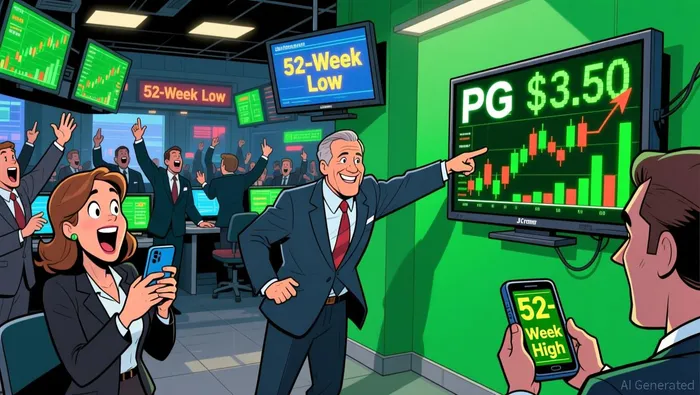
The tactical question is whether this bounce reflects a fundamental reassessment of the company's value or is merely a technical reaction to a celebrity analyst's call. The evidence suggests the latter for now. Cramer's recommendation came after a period of sustained weakness, and the stock's price action shows it is still far from its highs. The setup is one of a potential mispricing-a sharp pop on news that may not yet have changed the underlying fundamentals.
The Tactical Setup: Entry, Exit, and Risk/Reward
For a trader, the immediate setup is clear. The stock is trading at $143.46, just 4.1% above its 52-week low of $137.62. That proximity defines the downside risk: a break below that low would signal renewed weakness, but the buffer is thin.
The primary technical hurdle is the 50-day moving average, currently at $144.93. A decisive break above this level would confirm the momentum shift initiated by Cramer's call and could open the path toward the average price target of $169.23 cited by analysts. That target, however, is a longer-term view; the near-term resistance is the moving average itself.
The key risk is a broader sector sell-off. As Cramer noted, peers like Clorox and Target have been hit hard, with Clorox tumbling 38% and Target down 28% in recent days. If consumer staples weakness spreads, PG's bounce could be quickly erased. The stock's 25.5% discount to its 52-week high shows it is still deeply in a bear market, making it vulnerable to sector-wide pressure.
The tactical play hinges on that thin buffer. A trade could be structured with a stop just below the 52-week low to manage risk, with a target near the 50-day MA for a quick bounce. The reward is limited by the stock's deep decline, but the catalyst has already moved the needle. The real question is whether the move holds or is a fleeting reaction to a celebrity analyst's call.
The Financial Reality: Earnings and Guidance
The rally is not entirely sentiment-driven. The company delivered solid operational results last quarter, beating expectations. Procter & Gamble posted Q4 EPS of $1.99 against a $1.90 estimate, a clear sign of underlying profitability. Management also provided a forward-looking anchor for the year, setting a FY2026 EPS guidance range of $6.83 to $7.10. This guidance, combined with a long history of uninterrupted dividends, signals that the core cash-generating engine remains intact.
Yet, the market's reaction to this news has been muted, and recent analyst sentiment shows near-term caution. Just last week, Wells Fargo lowered its price target on PG to $158 from $170, citing updated models for HPC (Household & Personal Care) names heading into 2026. This move, while maintaining an Overweight rating, indicates that some analysts see the near-term path as challenging despite the long-term fundamentals.
The valuation context is critical. The stock's current price of $143.46 is still a steep 25.5% below its 52-week high. This compression suggests the market is pricing in significant headwinds, possibly related to consumer spending pressures or competitive dynamics in the HPC sector. The recent price target cut from Wells Fargo aligns with this view, implying that the recent bounce may be more a technical reaction than a fundamental reassessment of the company's intrinsic value.
The bottom line is a tension between solid earnings and cautious forward guidance. The beat provides a floor for the stock, but the guidance range and analyst downgrades point to a period of operational pressure. For now, the rally appears to be a tactical bounce on news that hasn't yet changed the near-term outlook.
Catalysts and Risks: What to Watch Next
The tactical bounce is now live, but its sustainability depends on a few clear signals. The immediate catalyst to watch is the stock's ability to break above key technical levels. A decisive move above the 50-day moving average at $144.93 would confirm the momentum shift initiated by Cramer's call. For a broader breakout, a move above the 200-day moving average at $151.45 would be required, signaling a potential reversion to the longer-term uptrend.
More importantly, the setup hinges on fundamental validation. Investors should watch for any revision to the company's FY2026 EPS guidance range of $6.83 to $7.10 in upcoming earnings or commentary. Management's discussion of consumer demand trends, particularly in the Household & Personal Care segment, will be critical. This is the core of the near-term pressure, as evidenced by Wells Fargo's recent price target cut citing updated models for HPC names heading into 2026.
The primary risk remains a broader sector sell-off. The recent weakness in peers is a clear warning. As Cramer noted, Clorox tumbled 38% and Target was down 28% in recent days. If consumer staples sentiment deteriorates further, PG's tactical bounce could be quickly erased, regardless of its own operational results.
The bottom line is a binary setup. The stock needs to hold its ground above the 52-week low and show technical strength to justify the rally. At the same time, it needs to avoid any negative guidance revisions and see consumer demand stabilize. Until those catalysts align, the move remains a tactical bounce on news, not a fundamental reassessment.





Comentarios
Aún no hay comentarios