
Is Cracker Barrel (CBRL) a Distressed Buy or a Cautionary Tale?
The restaurant sector in 2025 has been a study in contrasts. While casual dining chains like Chili's and Olive Garden have leveraged value-driven promotions to outperform industry averages, Cracker BarrelCBRL-- (CBRL) has stumbled, grappling with declining sales, operational missteps, and a fractured brand identity. For contrarian investors, the question looms: Is CBRL's current distress a buying opportunity, or does it signal a deeper, intractable decline?
A Mixed Bag of Q3 Results
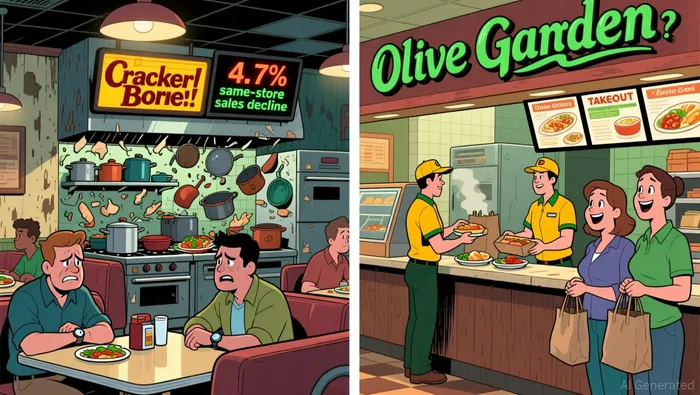
Cracker Barrel's Q3 2025 earnings report underscored its struggles. Revenue fell 5.7% year-on-year to $797.2 million, aligning with analyst expectations but missing adjusted EBITDA estimates by a wide margin-$7.19 million versus $19.81 million expected. The company's non-GAAP loss per share of $0.74, a 1.8% miss relative to forecasts, further dented confidence. Full-year revenue guidance was slashed to $3.25 billion at the midpoint, a 4.4% reduction from prior projections. Same-store sales, a critical metric, plummeted 4.7% year-on-year, reversing a decade-long trend of modest growth.
Management attributed these challenges to operational hiccups in implementing new back-of-house initiatives, which disrupted food consistency and guest experience. Retail sales, a key differentiator for CBRL's omnichannel model, also faltered, declining 3.8% year-on-year. These issues highlight a broader vulnerability: CBRL's reliance on a brand identity tied to nostalgia, which may struggle to resonate with younger, value-conscious diners.
Sector-Wide Struggles vs. Company-Specific Weaknesses
The casual dining sector in 2025 has faced its own headwinds. Staffing shortages, particularly in back-of-house roles, have plagued 54% of full-service restaurants. Consumer sentiment, though slightly improved in June, remains cautious, with diners prioritizing affordability over ambiance. Yet, competitors like Chili's and Olive Garden have navigated these challenges by emphasizing value-driven promotions. For instance, Chili's "3 for Me" and "Triple Dipper" campaigns drove 31.6% same-store sales growth in Q1 2025, while Olive Garden's focus on takeout and bundled meals boosted sales by 2.0%.
CBRL's performance, however, diverges sharply. While the sector's median same-store sales growth in September 2025 was +3% for positive performers and -5% for negative ones, CBRL's 4.7% decline outpaced even the worst performers. This suggests that CBRL's struggles are not merely sector-wide but stem from internal mismanagement. For example, its debt-to-equity ratio of 0.93-moderate by restaurant standards-does not explain its underperformance, nor does its dividend yield of 3.7%, which lags behind Bloomin' Brands' 8.4% according to market data.
Financial Metrics: Profitability vs. Valuation
CBRL's financials reveal a mixed picture. Its net margin of 0.49% outperforms Bloomin' Brands' -1.46%, and its adjusted EBITDA of $48.1 million in Q3 2025 showed a 0.4% year-on-year increase. However, these gains are overshadowed by its elevated price-to-earnings ratio of 36.47, which suggests the market is pricing in future earnings that may not materialize. By contrast, Bloomin' Brands' negative P/E ratio of -10.72 reflects its unprofitability but also signals a potentially undervalued stock for risk-tolerant investors.
The company's dividend, while a positive for income-focused investors, may also be a double-edged sword. Paying $0.25 per share despite a $0.74 non-GAAP loss raises questions about its sustainability. If CBRL's operational turnaround falters, the dividend could become a drag on liquidity.
Contrarian Considerations
For contrarians, CBRL's current valuation-trading at a 36.47 P/E ratio-may appear attractive, especially if the company can reverse its same-store sales decline. However, the risks are significant. The brand's reliance on a "Southern hospitality" aesthetic, while nostalgic for some, may alienate younger demographics who prioritize innovation and affordability. Moreover, the company's recent operational missteps-such as the failed back-of-house initiatives-suggest a lack of agility in adapting to market shifts.
A critical factor for investors will be CBRL's ability to execute its rebranding efforts. Recent layoffs and store closures indicate a pivot toward cost discipline, but without a compelling new value proposition, these measures may prove insufficient. The broader sector's shift toward value-driven promotions also raises the bar for CBRLCBRL-- to compete effectively.
Conclusion: A Cautionary Tale with Limited Upside
While CBRL's financials show pockets of strength-such as its profitability relative to peers and a modest dividend-its operational challenges and brand stagnation make it a cautionary tale rather than a distressed buy. The company's struggles are not merely cyclical but structural, rooted in a brand identity that struggles to align with modern consumer preferences. For contrarian investors, the lesson is clear: Distress can be tempting, but it is not always a gateway to value. In CBRL's case, the risks of a prolonged decline outweigh the potential rewards of a turnaround.







Comentarios
Aún no hay comentarios