
Country Garden's Debt U-Turn: A Harbinger of Systemic Risk in China's Real Estate Sector
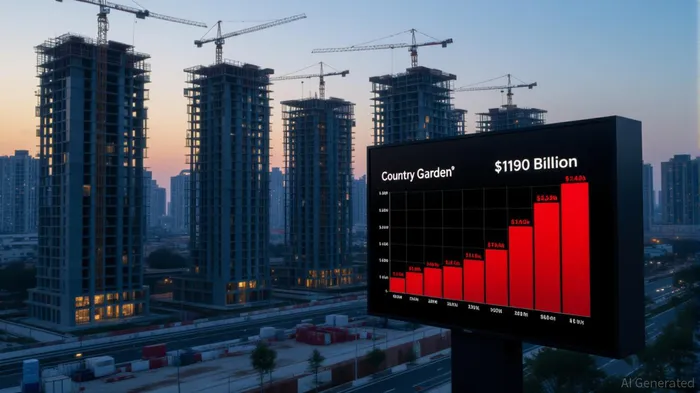
In 2025, Country Garden, once a titan of China's real estate boom, finds itself at the epicenter of a sectoral crisis that has rattled global markets. The developer's precarious liquidity situation—marked by a $190 billion debt mountain, a 78% debt write-down in its offshore restructuring plan, and a pending Hong Kong court hearing—has become a microcosm of China's broader property sector instability. For global investors, the company's struggles are not an isolated event but a warning flare: the real estate sector, which accounts for 14% of China's GDP and employs 130 million people, is teetering on the edge of a systemic collapse.
The Debt U-Turn: Country Garden's High-Stakes Restructuring
Country Garden's offshore debt restructuring, supported by 75% of bondholders, is a lifeline—but one that hinges on securing approval from the coordination committee of bank creditors. This group, holding significant leverage, has demanded a $178 million compensation package, a move that underscores the fragmented and opaque nature of China's distressed debt resolution framework. The company's request for a court extension until late 2024 to finalize terms highlights the urgency of its situation. If successful, the restructuring could unlock capital recycling in the sector; if it fails, liquidation risks could trigger a domino effect, deepening the crisis for creditors and eroding global confidence in Chinese property debt.
Systemic Risks: A Sector in Structural Freefall
Country Garden's plight is emblematic of a sector grappling with systemic risks. China's real estate debt overhang now exceeds $300 billion, with mid-sized developers particularly vulnerable to liquidity shocks. The government's hands-off approach—prioritizing long-term stability over bailouts—has forced painful restructuring but failed to address deeper structural imbalances. Overbuilt inventory, weak demand, and opaque governance persist, while regulatory inaction has left financial institutionsFISI-- exposed to deteriorating assets. The absence of a clear legal framework for secured vs. unsecured creditors further complicates resolution efforts, creating a vacuum where political and legal challenges could escalate.
Goldman Sachs warns that home prices could fall another 10% by 2027, compounding the sector's woes. Meanwhile, the Chinese government's stabilization measures—such as relaxed mortgage rates and a RMB 300 billion fund to complete stalled projects—have yielded only modest results. The sector's debt-to-equity ratio for top developers, though down to 150% in 2025 from 200% in 2022, remains dangerously high.
Contagion Potential: Global Investors on the Frontline
For global investors, the risks are magnified by the scale of exposure. Country Garden's offshore creditors alone face a $10.3 billion loss, while the broader sector's debt overhang threatens to spill into global markets. The lack of a robust resolution mechanism in China means that enforcement actions—such as asset seizures or legal battles—could destabilize cross-border investments.
The contagion potential extends beyond direct creditors. A property-led economic slowdown in China could ripple through global supply chains, trade flows, and commodity markets. For instance, a 10% decline in Chinese real estate investment could shave 0.5–1% off global GDP growth, according to the IMF. Investors with exposure to Chinese construction debt, infrastructure bonds, or real estate-linked ETFs must now grapple with the sector's fragility.
Investment Advice: Reevaluating Exposure in a Shifting Landscape
The path forward for investors is clear: reassess portfolio allocations to China's real estate-linked assets. Diversification is key. While speculative bets on residential developers carry high risk, opportunities exist in sectors aligned with the government's stabilization agenda.
- Prioritize Resilient Sectors: REITs and affordable housing projects, which have outperformed developer stocks by 84% in H1 2025, offer a safer bet. These instruments align with the sector's shift toward asset preservation and public-private partnerships.
- Monitor Legal and Policy Developments: The August 11 court hearing for Country Garden and potential policy shifts in 2025 (e.g., property tax reforms) will shape the sector's trajectory. Investors should track these events closely.
- Diversify Geographically and Sectorially: Reduce overexposure to Chinese residential real estate by allocating to non-residential assets (e.g., logistics hubs, data centers) or emerging markets with more transparent regulatory frameworks.
Conclusion: A Sector at a Crossroads
Country Garden's debt restructuring is more than a corporate drama—it is a barometer of China's real estate sector's health. The outcome will signal whether the government can stabilize the market without triggering a broader economic collapse. For global investors, the lesson is stark: the era of speculative growth in Chinese real estate is over. The new playbook demands caution, diversification, and a focus on structural resilience. As the sector navigates its U-turn, those who adapt will find opportunities in the rubble.







Comentarios
Aún no hay comentarios