
Coterra Energy (CTRA): A Strategic Bet on U.S. Shale's Value Re-Rating
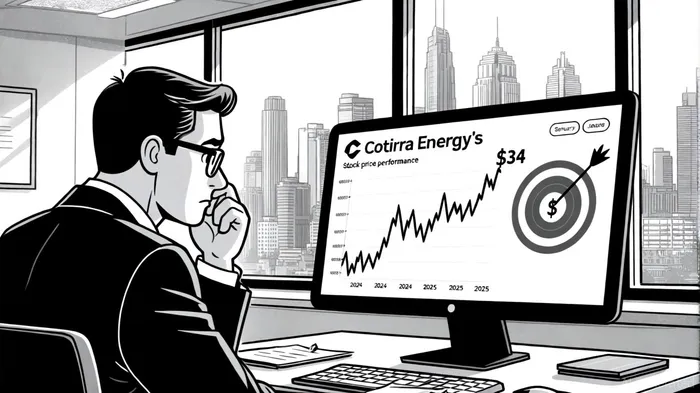
Raymond James' recent decision to maintain an “Outperform” rating on Coterra EnergyCTRA-- (CTRA) while lowering its price target to $34 from $38[1] has sparked renewed interest in the stock. This adjustment, driven by a weaker commodity price environment[3], contrasts with Coterra's robust operational performance in Q2 2025, where production exceeded expectations by 6%[3]. The stock's current valuation—trading at a 39.77% discount to the revised price target—positions it as a compelling candidate for a value re-rating in the evolving U.S. shale landscape.
Historical data reveals that CTRA's earnings beats since 2022 have shown mixed durability. While the Q2 2025 beat drove a short-term price lift, a backtest of 85 such events from 2022 to 2025 shows that gains often fade within 20 trading days, with cumulative returns turning negative relative to benchmarks[7]. This suggests that while positive earnings surprises can generate initial momentum, their long-term impact is limited—likely due to rapid market pricing-in of results or overriding macroeconomic factors. Investors may need to adopt shorter holding windows or combine earnings signals with other catalysts (e.g., commodity trends, guidance revisions) to capture meaningful upside[7].
Sector Trends: Efficiency Over Expansion
The U.S. shale sector is undergoing a strategic pivot in 2025, with operators prioritizing capital discipline and operational efficiency over aggressive growth[1]. Companies like Chevron and Devon Energy are optimizing rig utilization and leveraging AI-driven workflows to reduce cycle times and improve margins[1]. CoterraCTRA-- aligns with this trend, having cut its 2025 capital budget by 30% in the Permian while maintaining production growth[3]. Its Q2 2025 capex of $569 million, below the guidance range[3], underscores a disciplined approach to capital allocation.
Strategic M&A activity is another catalyst for value re-rating. Coterra's $3.95 billion acquisition of Franklin Mountain Energy and Avant Natural Resources[3] added 49,000 net acres in the Permian, boosting oil production by nearly 50%[5]. This aligns with broader industry consolidation, as operators like ExxonMobil and Coterra focus on Tier 1 assets to enhance returns across price cycles[1]. The acquired acreage, targeting intervals like the Bone Spring and Wolfcamp D, offers significant upside potential[5].
Financial Resilience and Dividend Discipline
Coterra's financial health further strengthens its investment case. Despite a 160% surge in net debt to $3.983 billion post-acquisition[3], the company generated $2.1 billion in projected 2025 Free Cash Flow[5], which will fund dividends, debt reduction, and buybacks. Its Q2 2025 operating costs of $9.34 per BOE[3]—a 12% year-over-year increase—remain competitive, reflecting operational efficiency. The company's 36-year dividend streak[5] and commitment to returning 50%+ of annual Free Cash Flow[2] appeal to income-focused investors.
Valuation Attractiveness
Coterra's valuation metrics highlight its undervaluation relative to peers. With an EV/EBITDA of 5.4x and a P/E ratio of 11.5x[6], it trades at a discount to the U.S. shale sector average of 7.47x[3]. Raymond James forecasts EV/EBITDA multiples of 4.7x in 2025 and 4.3x in 2026[1], suggesting further upside as the market re-rates its asset base. This is particularly relevant in a sector where infrastructure leverage (e.g., Permian gas transport capacity[1]) and ESG initiatives[2] are driving long-term value.
Strategic Positioning for a Re-Rating
Coterra's alignment with sector trends—capital discipline, M&A-driven growth, and technological innovation—positions it to benefit from a broader re-rating. Its 7-year power netback gas sale agreement in the Permian[3] reduces exposure to volatile spot prices, enhancing revenue stability. Meanwhile, AI adoption for well forecasting and row development in the Delaware Basin[2] exemplifies its commitment to operational excellence.
Conclusion: A High-Conviction Play
While Raymond James' price target reduction reflects near-term commodity headwinds, Coterra's strategic execution, financial resilience, and undervaluation make it a high-conviction opportunity. As the U.S. shale sector shifts toward efficiency and sustainability, Coterra's disciplined capital approach and Tier 1 asset base could drive a significant re-rating. Investors seeking exposure to a company poised to capitalize on these dynamics may find CTRA's 39.77% upside potential[1] increasingly compelling.





Comentarios
Aún no hay comentarios