
Costco vs. Walmart: A Risk-Averse Investor's Comparative Analysis
The recent surge in U.S. oil production and record freight activity highlights both opportunity and pressure for major retailers like CostcoCOST-- and WalmartWMT--. Their financial health now comes under sharper scrutiny, particularly regarding leverage and liquidity.
Costco demonstrates significantly lower financial risk. , reflecting a deliberate reduction in borrowed funds relative to shareholder capital. , indicating a conservative capital structure that provides a strong buffer against economic shocks. According to financial data, .
Walmart operates with considerably more financial leverage. , nearly double Costco's level. , . . As reported in the 2024 annual report, .
Compounding this vulnerability, , signaling potential exposure to future claims. While not currently material, these provisions represent a financial headwind absent from Costco's profile. The combination of higher debt levels, negative free cash flow, and substantial legal reserves positions Walmart in a more precarious financial position compared to its lower-leverage competitor. Investors must weigh Walmart's operational scale against these accumulating financial pressures and liquidity constraints.
Walmart vs. Costco: Contrasting Paths to Profitability
The contrasting strategies of Walmart and Costco reveal fundamentally different approaches to maintaining profitability and operational efficiency. Walmart leverages massive scale and explosive e-commerce growth, while Costco prioritizes disciplined cost control and a membership ecosystem.
Walmart's global e-commerce surge accelerated sharply in Q3 2024, achieving 27% growth. This volume-driven model fuels overall revenue expansion, , but comes with significant liquidity pressure. , as detailed in the 2024 financial report, . 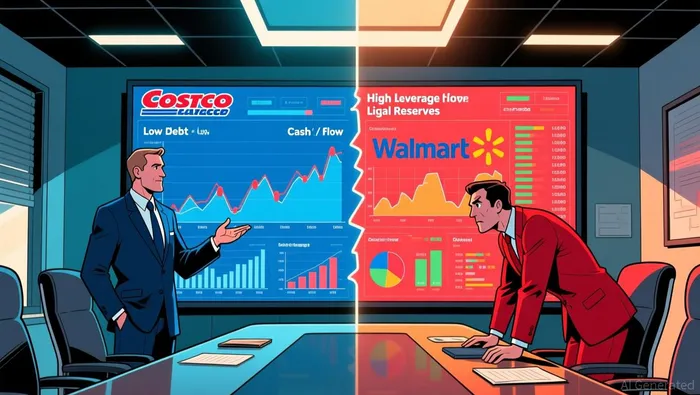 , creating ongoing leverage concerns that could constrain financial flexibility during economic stress.
Costco, meanwhile, demonstrates superior operating efficiency despite slower e-commerce expansion. , notably below Walmart's pace, yet the company maintained robust profitability through exceptional cost management. Costco's selling, , supporting healthy margin protection. , demonstrating how disciplined operational control can sustain margins even without Walmart's rapid digital channel growth.
The divergent financial trajectories reflect their underlying risk profiles. Walmart's growth engine strains liquidity with massive capex and high debt levels, while Costco's conservative model preserves cash flow and mitigates leverage risk. Investors must weigh Walmart's expansion potential against its liquidity pressures versus Costco's steadier, margin-protected performance. This fundamental divergence in business model execution ultimately defines each retailer's profitability trajectory and operational resilience.
Valuation & Catalysts
Walmart's valuation faces headwinds from structural cash flow pressures despite its modest dividend appeal. , . As reported in the 2024 financial report, , .
Costco's balance sheet provides a stark contrast, . , . However, . According to the Conference Board, .
escalations pose a shared downside catalyst. Rising trade barriers could lift input costs for both retailers, squeezing margins already pressured by weaker big-ticket spending. Costco's international expansion may face added friction from geopolitical tensions, while Walmart's cost leadership model risks erosion if tariff shocks disrupt its global supply chains.
Investors should monitor two key triggers: first, ; second, . Until then, , .
and Consumer Sentiment Vulnerabilities
, creating potential underfunding risks if litigation escalates beyond current estimates. , . Simultaneously, . , . According to the Conference Board, .
Costco presents a contrasting but equally significant compliance blind spot. The absence of disclosed regulatory investigations in its August 2025 financials stands in stark contrast to Walmart's explicit legal disclosures, suggesting either superior governance or insufficient transparency. , the lack of visibility into potential regulatory exposures creates latent risk, particularly if enforcement actions emerge from unmonitored areas. This opacity becomes especially concerning given the broader political climate, where government shutdowns and policy uncertainty frequently amplify compliance scrutiny across retail sectors.
. , . . , .







Comentarios
Aún no hay comentarios