
Costco's Valuation Resilience Amid Analyst Downgrades: Risk or Opportunity?
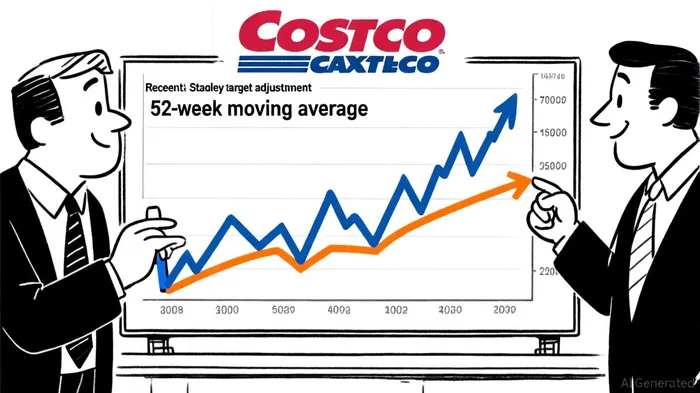
The recent downgrade of Costco WholesaleCOST-- (NASDAQ: COST) by Morgan Stanley, which cut its price target from $1,225 to $1,130 while maintaining an “overweight” rating, has sparked debate among investors. This adjustment, though signaling caution, must be contextualized within Costco's robust operational performance and the broader dynamics of the warehouse club sector. For long-term investors, the question is not merely whether the stock is undervalued but whether the risks flagged by analysts align with Costco's strategic resilience.
Operational Excellence: The Bedrock of Resilience
Costco's Q4 2025 results underscore its ability to navigate macroeconomic headwinds. Net sales surged 8.1% year-over-year to $86.16 billion, driven by a 14% increase in membership fees and a 5.7% rise in global comparable store sales[1]. Gross margins expanded to 11.13%, reflecting supply chain optimizations and higher Kirkland Signature product penetration[4]. These metrics highlight Costco's disciplined cost management and pricing power, even as inflationary pressures persist.
Membership growth remains a cornerstone of its success. With 81 million paid members globally—38.7 million of whom are executive tier—Costco's recurring revenue model provides stability. The U.S. and Canada membership renewal rate of 92.3%[4] underscores customer loyalty, a critical advantage in a competitive retail landscape. Meanwhile, digital transformation has accelerated: e-commerce sales grew 13.6% in Q4, outpacing industry averages[4], as CostcoCOST-- enhances its online platform with features like virtualCYBER-- waiting rooms and AI-driven search tools.
Valuation Metrics: Premium Pricing Justified?
Costco's valuation multiples appear elevated relative to industry benchmarks. As of Q4 2025, the company trades at an EV/EBITDA of 36.8x and a P/E ratio of 51.3x[2], significantly higher than the warehouse club industry average of 17.33x for EV/EBITDA[4]. However, these premiums are not unwarranted. Costco's dominance—over 60% U.S. market share—coupled with its operational efficiency (SG&A expenses at 9.21% of revenue[4]) and consistent profitability, justify a premium to peers.
The key question is whether these multiples are sustainable. Morgan Stanley's revised target price of $1,130 implies a 19.79% upside from its previous close, reflecting confidence in Costco's ability to maintain margins despite trade-related challenges[1]. Analysts at Evercore ISI Group similarly trimmed their target to $1,060 but retained an “Outperform” rating, citing Costco's “structural advantages in scale and value proposition”[2].
Strategic Risks and Industry Tailwinds
While Costco's fundamentals are strong, risks persist. Membership renewal rates dipped marginally in Q4 due to a promotional campaign, and global inflation could erode profit margins if cost-pass-through proves imperfect[3]. Additionally, the warehouse club sector faces intensifying competition from e-commerce giants and traditional retailers expanding into bulk sales.
However, industry tailwinds offset these risks. The global warehouse club market is projected to grow at a 4.6% CAGR through 2033[1], driven by consumer demand for value and convenience. Costco's expansion plans—35 new warehouses in 2026—position it to capitalize on this growth. Its digital initiatives, including same-day delivery and AI-enhanced customer experiences, further insulate it from disruption.
Investor Implications: A Case for Patience
For long-term investors, Morgan Stanley's target price cut should not trigger panic. The adjustment reflects a recalibration of expectations rather than a fundamental shift in Costco's business model. The company's ability to balance membership growth, operational efficiency, and digital innovation suggests its valuation resilience is well-founded.
That said, investors should monitor two key metrics: (1) the sustainability of membership fee increases without attrition and (2) the effectiveness of supply chain strategies in mitigating trade costs. If Costco maintains its 10–12% annual revenue growth and expands margins further, the current price correction could present a buying opportunity for those aligned with its long-term value proposition.
Conclusion
Costco's valuation, though premium, is underpinned by a durable business model and strategic agility. Analyst downgrades like Morgan Stanley's target cut highlight the importance of risk management but overlook the company's structural advantages. For investors with a multi-year horizon, the recent pullback may offer a chance to acquire shares in a business that continues to redefine retail through innovation and customer-centricity.







Comentarios
Aún no hay comentarios