
Costco's Stock Dip: Strategic Buy or Warning Signal in 2025?
In the volatile retail landscape of 2025, Costco WholesaleCOST-- (COST) has seen its stock price dip by 2.34% in recent trading sessions, lagging behind the S&P 500 despite posting robust financial results[4]. This decline has sparked debate among investors: Is the pullback a strategic buying opportunity, or a warning signal amid macroeconomic headwinds? To answer this, we must dissect Costco's financial resilience, long-term growth drivers, and valuation metrics against broader industry trends.
Market Sentiment and External Pressures
Costco's stock has traded at a lofty price-to-earnings (P/E) ratio of 56.71 as of August 2025[5], reflecting investor optimism about its long-term earnings potential. However, this optimism has been tempered by macroeconomic concerns. Heightened tariffs, potential recessionary pressures, and inflationary trends have dampened retail sector sentiment[6]. For CostcoCOST--, these factors have created a tug-of-war: While its membership fees grew at a double-digit rate in 2025[1], and e-commerce sales surged 13.6% year-over-year[2], external pressures have offset some of its operational strengths.
Analysts remain cautiously optimistic. A consensus "Buy" rating persists, with an average price target of $1,061—implying a 14.62% upside from current levels[5]. This suggests that while short-term volatility is acknowledged, the core fundamentals of Costco's business model remain intact.
Financial Resilience: Strong Cash Flow, Manageable Debt
Costco's fiscal 2025 results underscore its financial durability. The company reported net sales of $269.9 billion, operating income of $10.383 billion, and net income of $8.099 billion[1]. Its operating cash flow of $13.335 billion[1] provides a buffer against economic downturns, while a debt-to-equity ratio of 1.64[1]—though elevated—remains manageable given its cash-generative business model.
Profit margins, however, remain modest. Costco's operating margin of 3.85%[1] lags behind its historical averages, a reflection of its low-margin, high-volume strategy. Yet, this model has proven resilient, with membership fees contributing over 65% of operating income[2]. Recent fee hikes (Gold Star: $65, Executive: $130)[4] further insulate the company from margin compression, as membership renewal rates remain sky-high at 90% globally[2].
Long-Term Growth Drivers: Expansion and Digital Transformation
Costco's strategic playbook for 2025 hinges on three pillars: international expansion, e-commerce acceleration, and membership innovation.
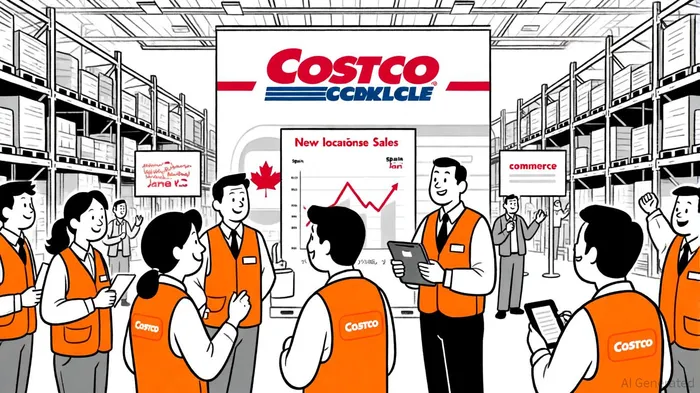
Global Footprint Expansion: The company plans to open 28–29 new warehouses in 2025, targeting markets like Japan, Spain, Mexico, and Canada[3]. These locations are tailored to local demand, leveraging Costco's cost-efficiency and product differentiation. For example, the Zaragoza, Spain, and Ogori, Japan, stores will cater to regional consumer preferences while maintaining the company's signature value proposition[3].
E-Commerce Surge: Online sales grew 13.6% in Q4 2025[2], driven by investments in digital infrastructure. Features like passwordless access, data augmentation, and improved delivery logistics[2] position Costco to compete with Amazon and Walmart in the omni-channel retail space.
Membership Model Reinvention: With Executive members now accounting for 74.2% of sales[2], Costco's tiered membership strategy has proven effective. The inelasticity of membership demand—evidenced by 92.3% renewal rates in the U.S. and Canada[2]—ensures a stable, recurring revenue stream.
Valuation Metrics: Overpriced or Justified?
Costco's valuation appears stretched relative to industry peers. Its P/E ratio of 60.71[5] dwarfs the retail sector's average of 33.59[6], while its P/B ratio of 15.5[4] and P/S ratio of 1.7[2] suggest a premium for growth. However, these multiples may be justified by long-term earnings projections. Analysts anticipate Costco's earnings could more than double over the next decade[5], and its EV/EBITDA ratio of 32.95[4]—though high—reflects confidence in its ability to sustain cash flow growth.
The PEG ratio, a critical metric for growth stocks, tells a more nuanced story. Costco's PEG of 5.87[3] (up from 5.18 in 2024) indicates overvaluation relative to its earnings growth. Yet, this metric fails to capture the company's unique advantages: a sticky membership base, global expansion tailwinds, and a digital transformation that aligns with retail trends.
Is the Dip a Buy?
Costco's stock decline in 2025 is a function of macroeconomic pessimism rather than operational weakness. While its valuation multiples are elevated, the company's financial resilience, membership-driven moat, and strategic investments in e-commerce and international markets provide a compelling case for long-term investors.
For the risk-averse, the current pullback offers an opportunity to buy into a business with a proven ability to navigate economic cycles. For the cautious, the high P/E and PEG ratios warrant patience until macroeconomic clarity emerges. Either way, Costco's fundamentals suggest that the dip is more a correction than a collapse—a buying opportunity for those aligned with its long-term vision.





Comentarios
Aún no hay comentarios