
Is Costco Stock (COST) a Buy for 2026 Amid Elevated Valuation and Market Volatility?
The investment community is divided on Costco Wholesale CorporationCOST-- (COST) as it enters 2026. On one hand, the stock trades at a valuation premium far exceeding historical and industry benchmarks. On the other, its durable business model, robust membership growth, and strategic expansion plans suggest long-term resilience. This analysis weighs valuation realism against Costco's competitive advantages to determine whether the stock merits a "buy" label in a volatile market.
Valuation Realism: A Premium with Caveats
Costco's current valuation metrics are striking. As of November 2025, its trailing price-to-earnings (P/E) ratio stands at 45.83, surpassing its 5-year average of 44.78 and 10-year average of 38.09. More notably, its P/E of 56.8 in Q3 2025-well above the retail sector average of 28.3-has raised concerns about overvaluation according to earnings analysis. Similarly, the enterprise value to EBITDA (EV/EBITDA) ratio of 28.25 dwarfs the grocery sector's 7.46–7.74 and general retail's 12.87–18.21 averages.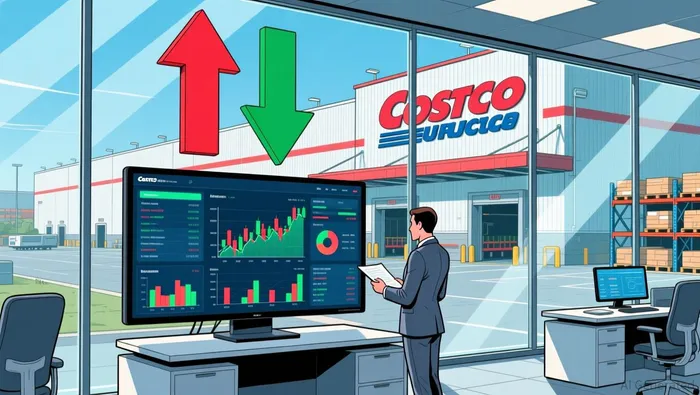
While Costco's price-to-sales (P/S) ratio of 1.36 and price-to-book (P/B) ratio of 12.53 are closer to historical averages, they still exceed the general retail sector's P/S of 1.14 and P/B of 7.89 according to industry benchmarks. These metrics suggest investors are paying a premium for Costco's perceived stability, but the gap raises questions about sustainability. notes that Costco's stock dipped post-Q3 earnings despite beating revenue expectations, as investors grappled with valuation concerns.
Long-Term Durability: A Fortress of Competitive Advantages
Costco's business model remains a fortress of durability. Its membership-driven revenue structure-generating 10.4% year-over-year growth in membership fees to $1.24 billion in Q3 2025-provides a predictable cash flow stream. With a global membership renewal rate of 93%, the company has demonstrated resilience even amid inflationary pressures according to Nasdaq analysis.
The company's competitive advantages extend beyond membership fees. CostcoCOST-- leverages its scale to negotiate supplier discounts, offering bulk pricing that attracts cost-conscious consumers. Ancillary services like gas stations, food courts, and optical centers further enhance customer retention according to earnings call details. Analysts project 8% revenue and 11% adjusted EPS growth for 2026, driven by 28 new warehouse openings and digital transformation initiatives.
Financially, Costco is in a strong position. Its debt-to-equity ratio of 0.20 as of August 2025 reflects a declining trend from 2.93 in 2020, while financial leverage has dropped from 3.1x in 2022 to 2.6x in 2025 according to financial data. The key question is whether Costco's valuation premium is warranted by its long-term prospects. While the stock trades at a significant multiple to earnings and EBITDA, its durable business model and growth trajectory offer a counterargument. The company's ability to expand profitably-through both physical and digital channels-suggests that its high valuation may be justified if growth projections materialize.
However, risks remain. Inflation, healthcare costs, and supply chain disruptions could pressure gross margins and membership renewal rates. Additionally, market volatility in 2026 may amplify short-term swings, testing investor patience.
Conclusion: A Buy for the Patient Investor
Costco's elevated valuation is undeniably high by historical and industry standards. Yet, its membership model, strategic expansion, and financial resilience create a compelling case for long-term investors. For those with a 5–10 year horizon, the stock's premium may be justified if the company continues to execute its growth plans. However, investors seeking immediate returns may find the valuation too stretched. In a volatile market, patience and confidence in Costco's durability will be key.





Comentarios
Aún no hay comentarios