
Costco's Resilience in a Volatile Jobs Market: Pricing Power and Membership Model in a Shifting Consumer Landscape
The U.S. job market in 2025 has been marked by contradictions: a 4.1% employment rate in Q2 2025, with 449,000 jobs added, yet looming threats from tariff wars projected to erase nearly 100,000 jobs in the same period. Amid this volatility, consumer spending trends have further fragmented, with higher-income households driving 49.2% of total spending while lower-income groups merely kept pace with inflation. In this environment, CostcoCOST-- has emerged as a standout performer, leveraging its pricing power and membership model to navigate economic headwinds. This analysis explores how Costco's strategic adaptations position it as a resilient player in a shifting retail landscape.
Economic Context: A Fractured Labor Market and Value-Driven Consumers
The U.S. labor market's resilience has been tempered by sector-specific challenges. Manufacturing and trade sectors faced tariff-driven pressures, while hospitality and food service industries lost 310,000 jobs due to pandemic-related restrictions and evolving consumer habits. Meanwhile, digital transformation fueled growth in electronic shopping and local delivery, reflecting a broader shift in consumer behavior.
Consumer spending itself has become increasingly polarized. While indulgent items like ice cream and cookies saw declining sales, budget-friendly staples such as Hamburger Helper and rice gained traction. This "value shift" underscores a critical trend: consumers are prioritizing affordability over discretionary spending. For retailers, this means adapting to a market where price sensitivity is paramount.
Costco's Pricing Power: Efficiency and Value-Driven Innovation
Costco's operational model is built on high-volume, low-cost principles. With roughly $260 million in annual sales per warehouse and a revenue-per-square-foot of $1,700–$1,800, the company's efficiency is unmatched. This is amplified by its private-label Kirkland Signature brand, which accounts for 25% of sales and offers 15–20% cost savings over national brands. Such offerings align directly with the value-driven consumer shift, ensuring Costco remains a go-to destination for price-conscious shoppers.
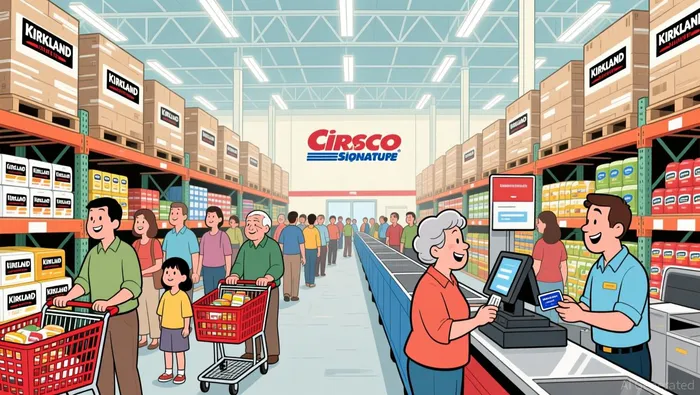
Despite inflationary pressures, Costco has maintained its low-price promise. In 2025, the company reported $269.9 billion in net sales, an 8.1% year-over-year increase, with e-commerce sales surging 18.9% in December 2025. This growth is underpinned by a streamlined inventory strategy- each warehouse carries only 3,700 distinct products-enabling rapid turnover and supply chain efficiency. Even as tariffs threaten to disrupt global trade in 2026, Costco has vowed to shield members from price hikes, reinforcing its value proposition.
Membership Model: Stability Amid Uncertainty
Costco's membership model is a cornerstone of its resilience. Membership fees contributed $5.3 billion to total revenue in FY2025, accounting for 65–73% of operating profits. The company's global membership base of 128 million households, with renewal rates consistently above 90%, reflects a loyal customer base. Strategic adjustments, such as a $5 increase in U.S. individual membership fees in 2024, have further bolstered revenue without deterring growth. By the end of FY2025, individual memberships reached 68.3 million, up from 63.7 million in 2024.
Digital innovation has also strengthened the membership model. Costco's "Costco Next" platform and expanded e-commerce capabilities drove a 20.5% surge in digitally-enabled comparable sales in Q1 2026. Additionally, measures like card scanners to curb membership sharing have enhanced security and revenue integrity. These adaptations ensure the membership model remains a stable, high-margin revenue stream even as traditional retail faces a "hangover" from inflation and shifting consumer habits. As the U.S. labor market faces further volatility-projected to see an employment rate rise to 4.5% in 2026 due to a loosening labor market and weak population growth-Costco's focus on affordability and digital innovation positions it to outperform peers. For investors, the company's ability to balance cost control, membership growth, and adaptability to macroeconomic shifts makes it a compelling long-term bet.





Comentarios
Aún no hay comentarios