
Costco's Operational Excellence and Scalable Membership Model: A Blue-Print for Sustained Retail Dominance
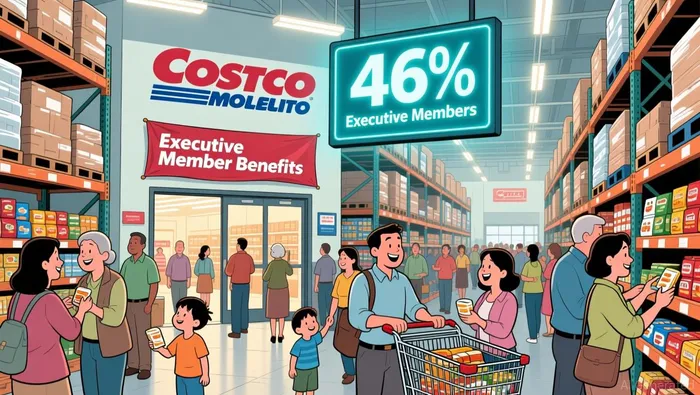
In the ever-evolving retail landscape, Costco's ability to balance razor-thin margins with explosive growth has cemented its status as a colossus. The company's membership model, which prioritizes customer value over short-term profit, has proven to be a masterclass in scalable execution. As of 2025, Costco's global membership has surged to 145.2 million, up from 127.9 million in 2023, with Executive members-paying $130 annually-accounting for 46% of total paid members and 74.2% of global sales according to reports. This shift toward premium tiers underscores a strategic pivot to monetize loyalty while maintaining the core ethos of affordability.
Membership Economics: A Self-Funding Engine
Costco's membership model is a self-funding engine, where dues cover fixed costs, allowing the company to pass savings to members through low product markups. The recent 14% year-over-year increase in membership fee revenue to $1.724 billion in Q4 2025 demonstrates the resilience of this model, even after fee hikes in the U.S. and Canada. Despite raising individual membership fees to $65 and Executive fees to $130 in September 2024, the company maintained a U.S. renewal rate of 92% and a global rate of 90%. This loyalty is fueled by value-adds like early warehouse access and a $10 monthly Instacart credit for Executive members according to reports, which incentivize upgrades and deepen engagement.
 By contrast, Sam's Club, while growing its e-commerce sales by 22% to $12.1 billion in 2025, lags in per-customer spending ($261 vs. Costco's $371) and membership fee revenue. Costco's two-tier system, with higher cash-back caps and premium product quality, creates a more compelling value proposition for high-spending households according to analysis. This structural advantage-coupled with Costco's focus on demand captivity-ensures that membership fees remain a stable, recurring revenue stream.
Unit Economics and Margin Resilience
Costco's unit economics are a testament to its operational discipline. The company targets merchandise margins of 11% for Kirkland Signature products and 14% for total cost of goods sold, ensuring prices remain competitive while preserving margins. This strategy is amplified by Kirkland Signature's $86 billion in annual sales, which leverages economies of scale and localized sourcing to mitigate tariff impacts. For instance, sourcing Ultra Clean laundry products in Asia for APAC warehouses reduced member prices by 40% while cutting transportation costs.
Meanwhile, Costco's inventory turnover-critical to its low-cost model-has been optimized through AI-driven demand forecasting. Machine learning models now analyze multi-year sales data, weather patterns, and local events to predict SKU-level demand in perishable categories like bakery and produce, reducing waste and boosting in-stock rates above 98%. This technological edge, combined with a curated 3,700-SKU product mix, streamlines supply chains and enhances operational efficiency.
CEO Ron Vachris's Strategic Vision
Under CEO Ron Vachris, CostcoCOST-- has doubled down on modernizing its infrastructure while preserving its core principles. The company's 2025 expansion plan-28 new warehouses and a target of over 30 annual openings-reflects confidence in its scalable model. Simultaneously, Vachris has prioritized digital transformation, with e-commerce sales growing 14.8% year-over-year in Q3 2025, driven by personalized recommendations and buy-now-pay-later services.
Vachris's approach to margin resilience also includes strategic sourcing and AI adoption. By shifting production of Kirkland Signature goods to lower-cost regions and leveraging AI in pharmacy inventory management-where filled prescriptions grew by mid-teen percentages-Costco mitigates input cost pressures without sacrificing quality. This balance between innovation and cost control is a hallmark of his leadership.
Competitive Edge Over Sam's Club
While Sam's Club benefits from Walmart's retail network and convenience perks like Scan & Go, Costco's operational moat remains broader. Its 2.7–2.8% operating margin outpaces Sam's Club's 2.5% according to analysis, driven by higher membership fees and superior per-customer spending. Moreover, Costco's focus on premium rewards and product curation fosters deeper loyalty, as evidenced by its 92.3% U.S. renewal rate. Sam's Club's digital growth, though impressive, is constrained by its reliance on Walmart's broader retail ecosystem, which dilutes its membership-centric identity.
The Investment Case
Costco's formula-combining membership-driven demand captivity, AI-optimized operations, and disciplined expansion-creates a compounding flywheel. With 249.6 billion in net sales for 2025, the company's ability to scale without sacrificing margins is unparalleled. For investors, the key risks lie in macroeconomic headwinds and e-commerce saturation, but Costco's strategic agility-evidenced by its rapid AI adoption and localized sourcing-positions it to navigate these challenges.
In an era where retail is increasingly defined by value and convenience, Costco's blueprint offers a rare combination of scalability, margin resilience, and customer trust. As Ron Vachris continues to modernize the business while staying true to its roots, the company's membership model remains a gold standard for sustainable growth.





Comentarios
Aún no hay comentarios