
Costco's Membership Moat: A Value Investor's Look at the $3,000 Break-Even Point
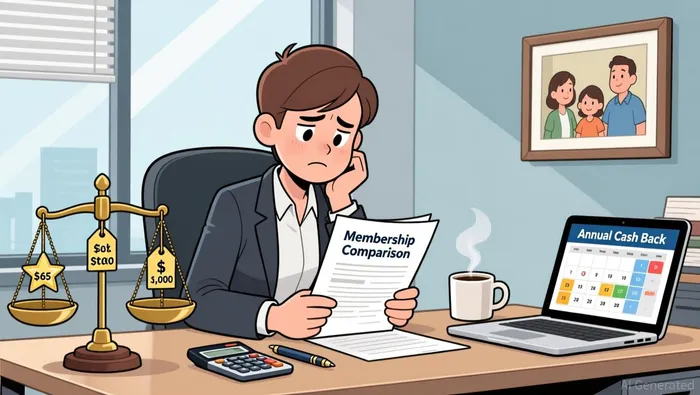
Costco's membership model is a fortress of recurring revenue, but the real test of its durability is how well its customers understand and exploit its own financial mechanics. The company's most straightforward value proposition is the Executive membership upgrade. For an extra $65 annually over the standard Gold Star, members gain a 2% cash back reward on qualified purchases. The math is simple: a customer needs to spend about $3,000 a year to break even, where the reward equals the added fee. This is a personal financial decision, but one made within a business model engineered to make the upgrade look compelling.
The evidence shows a significant portion of Costco's customer base is choosing not to take the deal. While total paid households grew 5.2% year-over-year, the number of Executive members surged 9.1% to 39.7 million. That growth rate, while strong, is still outpaced by the base membership expansion. In other words, a majority of new and existing members are not paying the extra $65 for the cash back. This widespread neglect is the flip side of the model's strength. It means CostcoCOST-- is collecting predictable, high-margin revenue from a large base of customers who are not optimizing their own spending, a situation that benefits the company's bottom line.
The setup is classic value investing. The company has built a wide moat with its membership model, and it is offering a clear, quantifiable financial incentive for members to deepen their loyalty. Yet, the market-here, the customer base-is not fully capitalizing on it. For investors, this isn't a flaw; it's a feature. It underscores the pricing power and customer inertia embedded in the system. Costco doesn't need everyone to be a savvy optimizer; it needs a large, predictable stream of fees. The fact that so many members pass on the upgrade suggests the model is working exactly as intended, turning a broad customer base into a reliable source of income.
The Math: A Personal Break-Even Analysis
The personal economics of the Executive upgrade hinge on a simple equation, but the details reveal important constraints. The break-even point is indeed around $3,000 in annual spending, where the 2% cash back equals the $60 upgrade fee. For a shopper spending roughly $250 a month on qualifying items, the math works out. However, the model is not a pure, unlimited cash-back deal. The reward is capped at $1,000 per year, which means high-spending members who spend $50,000 or more will see their effective return rate drop to 2% on the first $50,000, then zero on anything above that. This ceiling limits the upside for the most loyal customers. Another factor is the method of redemption. The cash back comes as a paper certificate mailed with the renewal notice, which must be used at the front-end register. It cannot be applied at self-checkout. For some, this adds a layer of friction, potentially reducing the perceived convenience and immediacy of the reward. It turns a simple transaction into a two-step process, which may subtly discourage use.
Costco has designed the offer to lower the barrier to entry. The company provides a no-risk trial for upgrades, meaning members can try the Executive tier without penalty if they later decide it's not for them. This feature is a critical part of the customer experience, turning a financial commitment into a low-stakes experiment. It's a smart move for Costco, as it encourages members who are near the $3,000 threshold to take the leap, knowing they can easily revert if the math doesn't work out for their specific spending habits.
The bottom line for the individual is a trade-off between simplicity and potential savings. The model is straightforward for the average shopper, but it comes with built-in limits on the reward and a slightly less convenient redemption process. For the value investor, the key insight is that the company's financial model is not dependent on maximizing the personal benefit for every customer. It is built on the predictable, high-margin revenue from the upgrade fee itself, with the cash-back reward acting as a loyalty tool for those who spend enough to make it worthwhile.
Why Costco Wants You to Make It: The Strategic Incentive
For Costco, the push to upgrade is a direct play on its financial model. With gross margins on product sales a slim 11%, the company's profitability is heavily reliant on its high-margin membership fees. Each upgrade from a standard Gold Star to an Executive membership is a double win: it brings in an immediate $65 annual fee and, more importantly, locks the customer into a higher-value relationship. This is the core of the strategy-converting a broad base of customers into a more engaged, higher-spending cohort.
The company has engineered specific perks to make that conversion more attractive. The most notable is the hour earlier store opening for Executive members, a change implemented last summer. On the surface, this seems like a simple convenience. But viewed through a value lens, it's a masterstroke of operational design. By giving Executive members an exclusive early slot, Costco creates a tangible, daily incentive to upgrade. As one analyst noted, this perk "may also encourage some people to trade up to a higher tier."
The operational benefits are a bonus. Data shows the early access has smoothed out customer traffic, reducing concentration during late-morning and afternoon peaks. This means a better shopping experience for everyone, without requiring additional staff, while also potentially encouraging more efficient, shorter visits. It's a win for customer satisfaction and store efficiency, all while deepening the loyalty of the higher-tier members.
The numbers confirm the strategic payoff. Membership income grew 7.3% year over year, driven significantly by the 9.1% surge in Executive memberships to 39.7 million. This growth is critical because it improves the quality and predictability of the fee stream. As the CFO pointed out, the higher-tier members represent a more engaged base, and their spending habits are likely to be more resilient. In a low-margin, high-volume business, every dollar of incremental, fee-based profit is pure margin expansion.
The bottom line is that Costco's upgrade push is not about maximizing the personal savings for each customer. It's about reinforcing the company's economic moat. By offering targeted perks that increase the perceived value of the higher tier, Costco is systematically converting more of its vast customer base into higher-value, more predictable revenue streams. This is the disciplined, long-term compounding that value investors look for.
The Value Investor's Take: Moat, Margin of Safety, and Catalysts
The analysis of Costco's membership model converges on a classic value investing thesis: a wide moat generating predictable, high-margin cash flows. The numbers are compelling. A 92.2% U.S./Canada renewal rate and 14% year-over-year membership income growth demonstrate the model's durability. This isn't just growth; it's the compounding of a reliable fee stream that operates with minimal capital intensity and high margins. For a value investor, this is the essence of intrinsic value-recurring revenue from a loyal customer base that is difficult to replicate.
The primary risk to this thesis is economic sensitivity. The model thrives when consumers face financial strain, as noted by economists, because it offers a path to significant savings. In a downturn, membership growth and renewal rates may hold up or even accelerate. In a strong economy, the value proposition could weaken, potentially pressuring margins and slowing the growth of higher-tier memberships. This cyclical vulnerability is the margin of safety's counterpoint. The high renewal rate provides a buffer, but the company's reliance on membership fees for most of its revenue means it is not immune to shifts in consumer sentiment or disposable income.
Key watchpoints for the disciplined investor are straightforward. First, monitor the trajectory of membership fee growth. The recent 14% jump was driven by both new households and the 9.1% surge in Executive memberships. Sustained growth here signals continued moat expansion. Second, watch for any changes to the 2% reward program. Altering the terms or capping the reward could change the upgrade calculus for near-break-even customers, potentially dampening the growth of the higher-value membership tier. The current design, with its no-risk trial and targeted perks, is a masterclass in incentivizing the upgrade without overpaying for it.
The bottom line is that Costco's membership model is a cash-generating machine. Its strength is not in the individual math of a $3,000 break-even point, but in the aggregate of millions of customers who renew, often without fully optimizing their own spending. For the patient investor, the margin of safety lies in the model's proven resilience and the high cost of entry for any competitor. The catalysts are not dramatic; they are the steady, predictable compounding of a wide moat.





Comentarios
Aún no hay comentarios