
Costco's E-Commerce Acceleration: A Blueprint for Long-Term Competitive Dominance and Margin Resilience
Costco's e-commerce growth in 2025 has emerged as a defining force in its long-term competitive positioning, driven by a combination of strategic digital innovation, operational efficiency, and disciplined cost management. As the retail landscape evolves, the company's ability to balance rapid online sales expansion with margin resilience underscores its unique value proposition in an increasingly fragmented market.
Digital Transformation: Scaling E-Commerce While Enhancing the Member Experience
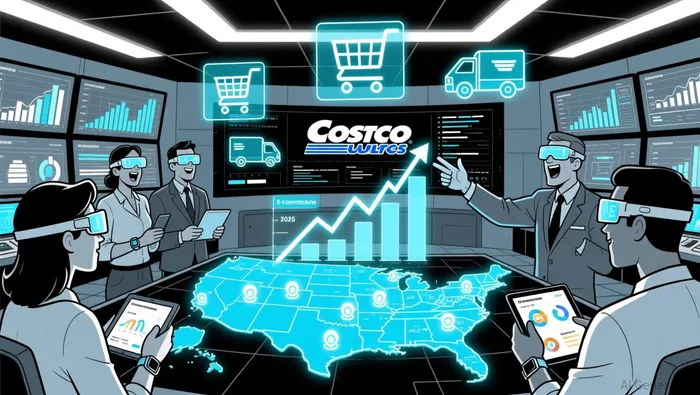
Costco's e-commerce sales surged 13.6% year-over-year in Q4 2025, contributing to a full-year 15.6% growth to over $19.6 billion in digital revenue. This acceleration reflects a deliberate focus on improving the online experience, including password-less sign-in for its mobile app, enhanced search functionality, and a "waiting room" feature for high-demand items like Pokémon cards according to reports. These initiatives not only streamline user engagement but also mitigate friction during peak demand, a critical differentiator in an era where convenience and reliability drive customer loyalty.
The company's digital-enabled comparable sales further highlight its momentum, with a 20.5% surge in Q1 2026 driven by personalized recommendations, improved website traffic, and expanded product offerings. By leveraging its existing logistics network-spanning regional distribution centers and logistics hubs-Costco has minimized infrastructure costs while ensuring rapid fulfillment for both in-store and online orders. This integration of physical and digital operations creates a flywheel effect, where e-commerce growth reinforces the value of its physical footprint and vice versa.
Margin Resilience: Thin Margins, Strategic Leverage
Despite operating on historically thin gross margins, CostcoCOST-- has demonstrated remarkable resilience in 2025. The e-commerce segment's gross margin improved to 11.13% in Q4 2025, a 13-basis-point increase year-over-year. This trend continued into earlier quarters, with margins expanding by 4 basis points to 11.3% in Q1-Q3 2025 and hitting 11.25% in Q3 2025 (up 41 basis points from fiscal 2024). These gains were achieved despite challenges such as a $130 million LIFO accounting charge in Q3, underscoring the company's ability to absorb costs while maintaining profitability.
Costco's margin discipline stems from its no-frills retail model and strategic cost management. By limiting SKU selection, the company reduces overhead and inventory complexity, enabling greater flexibility in sourcing and pricing. For instance, Kirkland Signature private-label products have become a cornerstone of its strategy, offering cost-effective alternatives to tariff-impacted goods while preserving member value. Additionally, bulk purchasing and supplier consolidation have yielded 30–40% savings in certain categories, further insulating margins from inflationary pressures.
Supply Chain and Digital Synergies: A Competitive Moat
Costco's supply chain efficiency is a critical enabler of its e-commerce success. The company's global logistics network, combined with localized sourcing strategies, has mitigated the impact of tariffs and shipping bottlenecks. For example, rerouting goods from high-tariff countries to lower-cost producers has stabilized pricing for key categories, a move that directly supports margin stability. Meanwhile, investments in technology-such as pre-scan systems in stores and AI-driven inventory management- enhance operational speed and reduce waste.
These capabilities create a durable competitive moat. Unlike pure-play e-commerce rivals, Costco's hybrid model allows it to leverage its 800+ U.S. warehouses as both fulfillment centers and marketing tools. The company's plan to open 30+ new warehouses annually further amplifies this advantage, as expanded physical presence drives online traffic while reinforcing its brand as a one-stop destination for bulk goods.
Long-Term Implications: Sustaining Growth in a Competitive Era
Costco's e-commerce strategy is not merely about capturing short-term market share but redefining its role in the retail ecosystem. By prioritizing member experience over aggressive price undercutting, the company fosters loyalty that transcends price sensitivity. This is evident in its digital sales growth outpacing broader retail trends, even as competition intensifies from Amazon, Walmart, and niche players.
Moreover, Costco's focus on ancillary revenue streams such as pharmacy services, travel bookings, and financial products adds layers of profitability that offset the thin margins of its core retail operations. These diversifications, coupled with a disciplined approach to capital allocation, position Costco to sustain its growth trajectory without compromising financial health.
Conclusion
Costco's e-commerce acceleration in 2025 exemplifies a masterclass in balancing scale with efficiency. By investing in digital infrastructure, optimizing supply chains, and leveraging its private-label ecosystem, the company has turned its traditionally low-margin model into a high-resilience engine. For investors, this represents a compelling case of strategic foresight: a business that is not only adapting to the digital age but redefining its competitive advantages to thrive in it.





Comentarios
Aún no hay comentarios