
The Cost of Cyber Vulnerability: Investment Implications of Data Breaches in 2024–2025
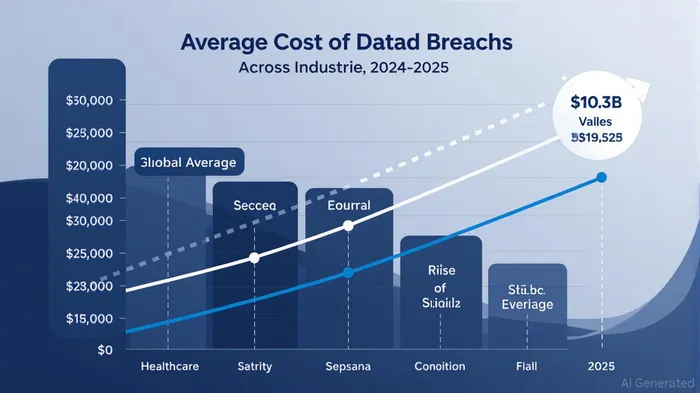
In the past year, cybersecurity has transitioned from a technical concern to a boardroom priority, with investors increasingly scrutinizing companies' digital resilience. The financial and reputational toll of high-profile data breaches in 2024–2025 has underscored the urgency of this shift. According to a report by IBMIBM--, the global average cost of a data breach in 2024 reached $4.88 million, with healthcare and financial services bearing the brunt—$10.93 million and $6.08 million per incident, respectively. These figures are not just numbers; they represent systemic risks to corporate valuations and investor confidence.
The Financial Fallout: From Ransomware to Reputational Damage
The UnitedHealth GroupUNH-- ransomware attack in early 2024 exemplifies the cascading costs of cyber incidents. The company paid a $22 million ransom and faced estimated total losses of $2.4 billion, including remediation, regulatory fines, and customer attrition. Similarly, Santander's 2024 breach, linked to the ShinyHunters group, exposed 30 million customer records through a third-party supply chain vulnerability. Such incidents highlight the growing sophistication of threats, including AI-powered phishing and ransomware, which now account for 35% of all cyberattacks.
The financial sector, in particular, has seen a surge in targeted attacks. LoanDepot's 2024 breach, which compromised 17 million customers, triggered class-action lawsuits and a sharp decline in stock price. Academic research corroborates this trend: stock returns typically drop by -0.24% on the day after a cyber event, with the most severe breaches causing prolonged market underperformance.
Insider Threats: A Hidden but Costly Risk
While external attacks dominate headlines, insider threats remain a critical blind spot. The IBM Cost of a Data Breach Report 2025 notes that malicious insiders cost organizations an average of $4.99 million per incident. Financial institutionsFISI--, where breaches average $6.08 million, are especially vulnerable due to the high value of sensitive data. For example, the Connex Credit Union breach in 2024 exposed 172,000 members' financial records, underscoring the fragility of internal controls.
Investor Behavior and Sector Resilience
Investors are recalibrating their strategies in response to these risks. The global cyber insurance market, projected to reach $16.3 billion in 2025, reflects growing demand for risk mitigation. However, not all sectors adapt equally. Healthcare, which spends only 4–7% of IT budgets on cybersecurity compared to 15% in financial services, faces disproportionate exposure. The sector's 2024 breach campaign—exposing 275 million patient records—has led to regulatory scrutiny and a 63.5% year-over-year increase in incidents.
Meanwhile, companies adopting advanced defenses, such as Zero Trust architectures and AI-driven threat detection, are seeing lower breach costs. Organizations leveraging automation reduced average breach costs by 70%, to $3.05 million. This divergence suggests that cybersecurity maturity is becoming a key differentiator in market performance.
Strategic Implications for Investors
For investors, the lessons are clear:
1. Sector Selection: Prioritize industries with robust cybersecurity frameworks, such as financial services, while exercising caution in under-resourced sectors like healthcare.
2. Due Diligence: Scrutinize companies' incident response plans, third-party risk management, and adoption of emerging technologies like AI and Zero Trust.
3. Hedging: Consider cyber insurance as a strategic asset, particularly for firms in high-risk sectors.
As cyber threats evolve, so too must investment strategies. The 2024–2025 breach landscape demonstrates that digital privacy is no longer a peripheral issue—it is a core determinant of corporate value and market stability.
Source:
[1] 110+ of the Latest Data Breach Statistics [https://secureframe.com/blog/data-breach-statistics]
[2] Top 15 Data Breaches of 2025 and Their Financial Impacts [https://keepnetlabs.com/blog/top-15-data-breaches]
[3] Data Breach Financial Institutions 2025: Trends & Defense [https://deepstrike.io/blog/data-breach-financial-institutions-2025]
[4] Cybersecurity Statistics 2025: Rising Threats and Industry Impact [https://www.fortinetFTNT--.com/resources/cyberglossary/cybersecurity-statistics]
[5] Cost of a Data Breach Report 2025 [https://www.ibm.com/reports/data-breach]
[6] HACKED: Understanding the stock market response to cyber events [https://www.sciencedirect.com/science/article/abs/pii/S1042443124001483]
[7] Cost of a Data Breach Report 2025 [https://www.ibm.com/reports/data-breach]
[8] Data Breach Financial Institutions 2025: Trends & Defense [https://deepstrike.io/blog/data-breach-financial-institutions-2025]
[9] List of Recent Data Breaches in 2025 [https://www.brightdefense.com/resources/recent-data-breaches/]
[10] Cyber Insurance: Risks and Trends 2025 [https://www.munichre.com/en/insights/cyber/cyber-insurance-risks-and-trends-2025.html]
[11] Key Cyber Security Statistics for 2025 [https://www.sentineloneS--.com/cybersecurity-101/cybersecurity/cyber-security-statistics/]
[12] Massive Data Breaches Aug 2025 [https://firecompass.com/weekly-cybersecurity-intelligence-report-cyber-threats-breaches-11-aug-18-aug/]
[13] 120 Data Breach Statistics for 2025 [https://www.brightdefense.com/resources/data-breach-statistics/]







Comentarios
Aún no hay comentarios