
Cosmos (ATOM) Network Upgrades and Their Impact on Exchange Operations
The CosmosATOM-- (ATOM) network has emerged as a pivotal player in the blockchain ecosystem, driven by its relentless focus on interoperability and modular infrastructure. Over the past year, a series of technical upgrades-most notably IBC v2 (Eureka), the Cosmos SDK v0.53, and the Tokenfactory module-have redefined the network's capabilities, directly influencing institutional adoption and exchange operations. These advancements are not merely technical refinements but foundational shifts that position Cosmos as a resilient infrastructure layer for a multichain future.
Interoperability Reinvented: IBC v2 and Cross-Chain Resilience
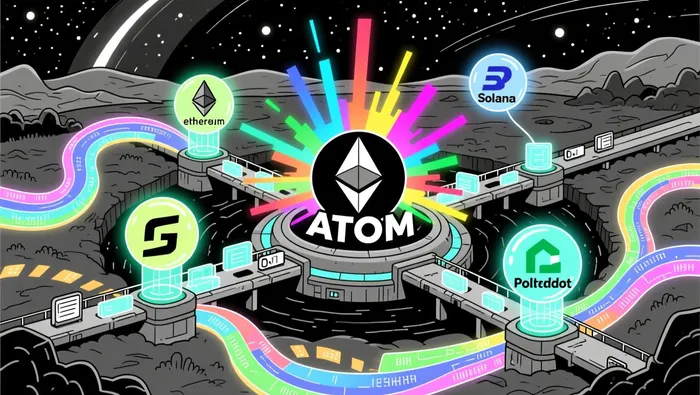
The launch of IBC v2 (Eureka) in March 2025 marked a paradigm shift in cross-chain communication. By simplifying the protocol's architecture and eliminating the complex handshake mechanisms of IBC Classic, IBC v2 enables faster, more flexible connectivity across diverse blockchain ecosystems, including EthereumETH-- and SolanaSOL-- according to protocol documentation. This redesign reduces implementation overhead, allowing developers to deploy cross-chain applications with minimal friction. For exchanges, this means reduced reliance on third-party bridges, lower gas costs, and enhanced security for asset transfers.
A notable example is Picasso's integration of IBC between Ethereum, Cosmos, and PolkadotDOT-- ecosystems, which has enabled DeFi protocols like Curve Finance to access assets such as ATOMATOM-- and DOTDOT-- with trust-minimized bridging. In a single week, the Cosmos IBC protocol facilitated 179,000 cross-chain transactions, with $175.27 million in volume- 70% of which was attributed to USDC. Such metrics underscore the protocol's operational resilience and its growing role in institutional-grade asset transfers.
Tokenomics and Developer Experience: SDK v0.53 and Tokenfactory
The Cosmos SDK v0.53, introduced in 2025, has streamlined module development and improved the developer experience, fostering a surge in application-specific blockchain creation. This is complemented by the Tokenfactory module, which allows for the permissionless creation of fungible tokens directly on the Cosmos Hub. By eliminating the need for external chains like Osmosis or Neutron, Tokenfactory reduces infrastructure complexity and retains economic value.
Institutional interest in these upgrades is evident. Projects like dYdXDYDX-- have migrated to Cosmos appchains to leverage low gas costs and high throughput for derivatives trading. Similarly, Ondo's upcoming transition to a Cosmos appchain highlights the network's appeal for institutional-grade financial applications. The Tokenfactory module is also expected to catalyze growth in tokenized real-world assets (RWAs), as seen in the USDF Consortium's use of Cosmos-based Provenance blockchain for USD-pegged stablecoin settlements.
Institutional Adoption and Exchange Operations
The technical upgrades have directly influenced institutional adoption decisions. For instance, NTT DATA and Datachain's experiments with Delivery Versus Payment (DVP) settlements using IBC between Hyperledger Fabric and Tendermint-based blockchains demonstrate the protocol's utility. Similarly, Soramitsu's implementation of atomic swaps via IBC for Payment Versus Payment (PVP) settlements underscores the network's adaptability.
Exchanges have also benefited. The Cosmos EVM stack's open-sourcing has enabled Ethereum-based projects to integrate seamlessly. This is reflected in the filing of the first spot Sei ETF built on the Cosmos SDK by Canary Capital, signaling growing institutional confidence. Furthermore, the redirection of 98% of ATOM inflation to stakers under Proposal #996 has bolstered network security, with total staked ATOM reaching 274.04 million.
Future Roadmap and Strategic Implications
Looking ahead, the activation of the Tokenfactory module and the IBC Eureka upgrade will further solidify Cosmos' position as the "Internet of Blockchains." IBC Eureka, set for 2025, will enable direct interoperability with Ethereum and Bitcoin. Meanwhile, the proposed ATOM tokenomics redesign-shifting from inflationary staking rewards to a fee-based model- aims to align the token's utility.
For exchanges and institutional investors, these upgrades present a compelling value proposition. The modular, EVM-compatible Cosmos Stack supports custom blockchain development with high performance. As the network expands its interoperability reach to chains like Solana and Base, the potential for cross-chain liquidity becomes increasingly tangible.
Conclusion
Cosmos' technical upgrades have not only enhanced infrastructure resilience but also created a fertile ground for institutional adoption. By addressing scalability, interoperability, and tokenomics, the network is positioning itself as a cornerstone of the multichain ecosystem. For exchanges and investors, the strategic alignment of these upgrades with enterprise-grade use cases-from DeFi to RWAs-signals a robust foundation for long-term growth. As the Cosmos ecosystem continues to evolve, its ability to adapt to institutional demands will likely cement its role as a critical infrastructure layer in the blockchain landscape.






Comentarios
Aún no hay comentarios