
Is COSCO SHIPPING International (Singapore) (SGX:F83) a Value Trap or a Mispriced Opportunity?
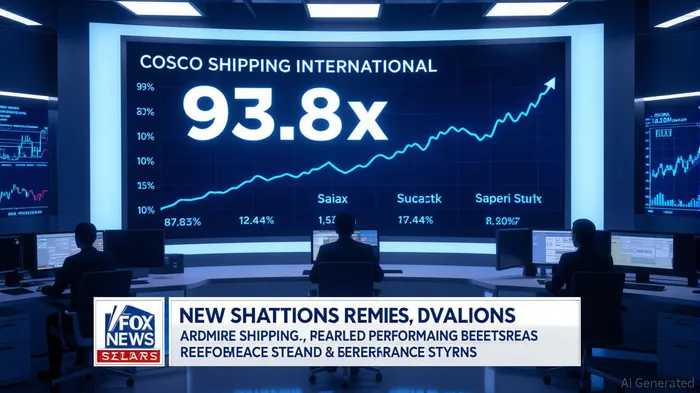
The valuation of COSCO SHIPPING International (Singapore) (SGX:F83) presents a paradox. On one hand, its share price of S$0.12 trades just 9% above a DCF-derived intrinsic value of S$0.11, suggesting a tight alignment with fundamentals. On the other, its price-to-earnings (P/E) ratio of 93.8x dwarfs the maritime transportation industry average of 21.4x[1], raising questions about whether the premium reflects justified optimism or speculative overreach. This tension between absolute and relative valuation metrics demands closer scrutiny.
DCF Valuation: A Cautious Optimism
The 2-stage free cash flow to equity (FCFE) model estimates COSCO's intrinsic value by projecting cash flows from 2026 to 2035, with growth rates shifting from negative (-4.09% in 2026) to modestly positive (2.15% by 2035)[1]. A 7.0% discount rate[1]—lower than the 8.0%–8.9% range cited in other analyses[2][3]—yields a present value of S$179 million for these cash flows. While this suggests the stock is fairly priced, the model's assumptions are critical. The projected cash flow trajectory hinges on a gradual recovery in global shipping demand and stable operating margins, both of which remain exposed to macroeconomic headwinds such as trade wars or energy price shocks.
Relative Metrics: A Stark Disconnect
COSCO's 93.8x P/E ratio[1] is an outlier even in a sector known for volatile valuations. For context, Ardmore ShippingASC-- (ASC) trades at 18.42x[2], while Performance ShippingPSHG-- (PSHG) is valued at a mere 1.20x[3], reflecting divergent earnings visibility and business models. The maritime industry's average P/E of 21.4x[1] implies that investors are paying over four times the sector's premium for COSCO's shares. Such a gap typically signals either exceptional growth expectations or a mispricing. However, the absence of recent analyst forecasts for COSCO's earnings[1] leaves this premium unanchored. Without concrete guidance on revenue or margin expansion, the high P/E appears disconnected from fundamentals.
The Case for Caution
A value trap often masquerades as a bargain, luring investors with low absolute valuations while concealing deteriorating fundamentals. COSCO's case is different: its DCF valuation suggests it is not overpriced in absolute terms, but its relative valuation implies investors are paying a premium for uncertain growth. The disconnect arises from the DCF model's reliance on extrapolated cash flows and the lack of earnings guidance to validate these assumptions. If global shipping demand falters or COSCO's margins compress faster than projected, the 93.8x P/E could collapse, dragging the share price down with it.
Conversely, a mispriced opportunity exists if the market underestimates COSCO's long-term potential. The company's exposure to Asia-Europe trade routes, a key driver of global commerce, could benefit from structural shifts such as nearshoring or green shipping investments. However, these tailwinds are not reflected in current earnings or cash flow projections.
Conclusion: A Tug-of-War Between Models
COSCO SHIPPING International (Singapore) occupies a gray zone between value and growth investing. Its DCF valuation suggests it is fairly priced, but its P/E ratio implies a speculative bet on future earnings that lack near-term validation. For risk-averse investors, the stock's marginal premium over intrinsic value offers little margin of safety. For those with a longer time horizon and conviction in the shipping sector's recovery, the DCF model's conservative assumptions may prove prescient. Until earnings guidance or macroeconomic clarity emerges, the stock remains a cautionary case of how valuation models can diverge—and why investors must reconcile both absolute and relative metrics before pulling the trigger.







Comentarios
Aún no hay comentarios