
COSCO Shipping's 1.5 Billion Yuan Share Buyback: A Strategic Move or a Signal for Investors?
In early 2025, COSCO Shipping Holdings Co., Ltd. (CICOY) announced a share buyback program of up to 1.5 billion yuan, signaling a strategic commitment to enhancing shareholder value amid a volatile global shipping market. This move, coupled with robust first-quarter financial results, has sparked debate among investors and analysts about whether the buyback reflects a calculated effort to realign market valuation with intrinsic worth or serves as a broader signal of confidence in the company's long-term prospects.
A Share Buyback as a Valuation Rebalancing Tool
COSCO's buyback plan, approved in April 2025, aims to repurchase between 50 million and 100 million A-shares at a maximum price of RMB14.83 per share, according to a buyback tranche update. By May 28, the company had already repurchased 60,109,807 shares for HKD851.31 million, completing nearly 60% of the planned allocation, according to stock statistics. This aggressive repurchase pace underscores the company's belief that its shares are undervalued.
Valuation metrics support this rationale. COSCO's trailing price-to-earnings (P/E) ratio stands at 4.32, while its forward P/E is 9.06, according to the Q1 2025 report. The enterprise value (EV) of 24.20 billion yuan, combined with an EV/EBITDA ratio of 2.23, further suggests that the market is discounting the company's earnings potential. These metrics indicate a compelling opportunity for management to deploy capital into share repurchases, effectively reducing the equity base and boosting earnings per share (EPS) without relying on operational growth.
Financial Resilience and Strategic Positioning
According to an Atlantis Press analysis, COSCO's Q1 2025 financial performance provides a strong foundation for such initiatives. The company reported a net profit of RMB13.23 billion, a 72.21% year-on-year increase, driven by rising global container throughput and optimized shipping capacity deployment. Operating revenue surged 20.05% to RMB57.96 billion, while EBIT grew by 66.17% to RMB16.58 billion. These results highlight the company's ability to capitalize on favorable market conditions, even as it navigates geopolitical and macroeconomic headwinds.
The buyback also aligns with COSCO's broader strategic priorities. As noted in the company's buyback announcement, the company has emphasized digitalization, green shipping initiatives, and expansion into emerging markets, all of which are designed to future-proof its operations. A strong balance sheet-evidenced by a current ratio of 1.56 and a debt-to-equity ratio of 0.28-further reinforces its capacity to execute on these goals without overleveraging.
Shareholder Confidence and Dividend Yield
Beyond the buyback, COSCO has demonstrated a clear focus on rewarding shareholders. Its dividend yield of 11.40%, one of the highest in the sector, reflects a payout ratio of 52.11%, suggesting sustainable distributions. This combination of buybacks and dividends creates a dual incentive for long-term investors, particularly in a market where alternative yields remain low.
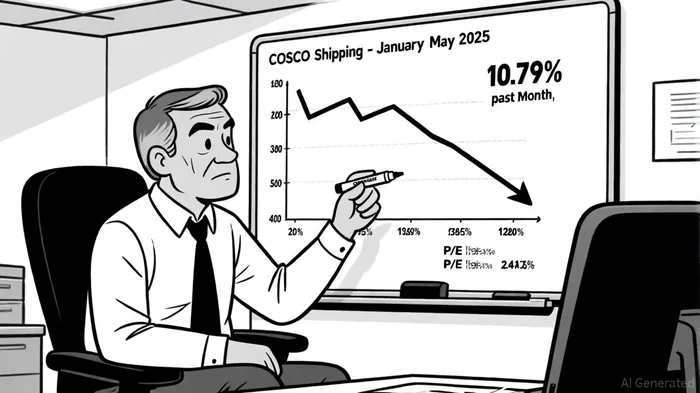
However, the recent 10.79% decline in CICOY's stock price over the past month raises questions about short-term volatility. While the company's financials remain strong, external factors such as port fee adjustments and global trade uncertainties could temporarily dampen investor sentiment. The buyback, in this context, serves as both a stabilizing mechanism and a signal of management's conviction in the company's intrinsic value.
Strategic Implications for Investors
The buyback program must be viewed through the lens of COSCO's long-term strategy. By reducing share count and signaling confidence in its financial health, the company aims to bridge the gap between its current market valuation and its projected earnings power. For investors, this represents a potential inflection point: a low P/E ratio and high dividend yield make the stock attractive for income-focused portfolios, while the buyback's EPS-boosting effect could catalyze a re-rating in the market.
Yet, risks remain. Declining operating efficiency-evidenced by weaker inventory and asset turnover ratios-suggests that COSCO must balance capital allocation between buybacks and operational improvements. Additionally, the shipping industry's cyclical nature means that today's favorable conditions could reverse if global trade slows.
Conclusion: A Strategic Move with Long-Term Potential
COSCO's 1.5 billion yuan share buyback is more than a short-term tactic; it is a strategic lever to realign valuation metrics, reward shareholders, and reinforce confidence in the company's long-term trajectory. With a robust balance sheet, strong earnings growth, and a clear focus on innovation and sustainability, COSCO is well-positioned to navigate industry challenges. For investors, the buyback signals a rare alignment of financial strength and shareholder-friendly policies, making it a compelling case for cautious optimism.







Comentarios
Aún no hay comentarios