
Corteva's Strategic Separation: A Make-or-Break Move for Long-Term Value Creation
Strategic Rationale and Operational Focus
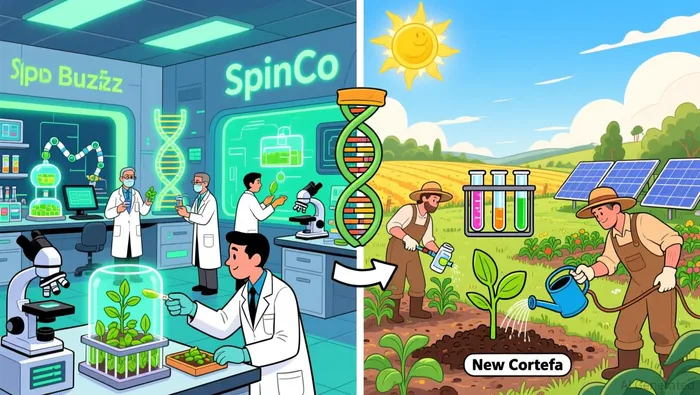
The separation is rooted in the recognition that Corteva's two core segments-Seed and Crop Protection-face distinct market dynamics. SpinCo, the new Seed entity, will prioritize advanced genetics, hybrid wheat, biofuels, and gene editing, positioning itself at the forefront of innovation-driven agriculture, according to a Corteva press release. Meanwhile, New CortevaCTVA-- will focus on operational excellence in Crop Protection, with a particular emphasis on biologicals, a sector projected to grow rapidly, according to the same Corteva press release.
This bifurcation aligns with broader industry trends. For instance, the agriculture sector's EBITDA margin of 24.63% in Q3 2025 underscores the importance of operational efficiency and innovation, as highlighted in a Mosaic earnings report. By allowing each entity to allocate capital and R&D resources independently, Corteva aims to accelerate growth in high-potential areas while mitigating cross-business inefficiencies.
Financial Performance and EBITDA Growth
Corteva's third-quarter 2025 results provide a strong foundation for the spin-off. The company raised its full-year 2025 operating EBITDA guidance to $3.8 billion–$3.9 billion, driven by robust performance in both segments, according to a StockTitan article. Analysts project further growth, with preliminary 2026 EBITDA estimates reaching $4.1 billion, according to the same StockTitan article. This trajectory suggests that the separation could amplify existing momentum.
However, the path to value creation is not without hurdles. The spin-off is expected to incur dissynergy costs of $80–100 million, according to a Yahoo Finance earnings call, a one-time expense that could temporarily pressure margins. Yet, these costs are relatively modest compared to the long-term benefits of streamlined operations and targeted R&D investment.
R&D Investment: A Differentiator or a Burden?
Corteva has reaffirmed its commitment to R&D, allocating 6–7% of revenue to innovation-a critical differentiator in a sector where technological leadership drives competitive advantage, according to a Yahoo Finance earnings call. The Crop Protection business alone boasts a $9 billion R&D pipeline, according to the same Yahoo Finance earnings call, while SpinCo's focus on gene editing and biofuels positions it to capitalize on emerging markets.
This emphasis on R&D contrasts with the industry's current valuation multiples. The agriculture sector's P/E ratio of 6.86 (Q3 2025) reflects undervaluation relative to its EBITDA margins, as highlighted in a Mosaic earnings report. If the spin-off accelerates R&D-driven growth, the new entities could trade at premiums to these benchmarks, particularly if they capture market share in high-margin biologicals or biofuels.
Valuation Analysis: Overvalued or Strategic Buy?
Despite the lack of explicit P/E or P/EBITDA ratios for Corteva as of November 2025, analyst sentiment offers insight. Barclays upgraded its rating to "overweight" with a $84 price target, while Mizuho maintained an "outperform" rating but lowered its target to $78, according to a MarketBeat filing. These divergent views reflect uncertainty about near-term execution risks, such as Brazil's pricing pressures in crop protection, as highlighted in a Yahoo Finance earnings call.
However, the spin-off's potential to unlock value is compelling. By separating capital allocation decisions, each entity can optimize for its unique growth drivers. For example, SpinCo's focus on high-margin innovations could justify a premium valuation, while New Corteva's operational efficiency might attract value-oriented investors.
Risks and Mitigation
Key risks include the $80–100 million separation costs, according to a Yahoo Finance earnings call, and macroeconomic headwinds, such as currency fluctuations and input cost volatility. Yet, Corteva's strong balance sheet and disciplined M&A strategy, according to a Corteva press release, provide a buffer. Additionally, the company's emphasis on operational excellence-particularly in biologicals-positions it to benefit from regulatory tailwinds and sustainability trends.
Conclusion: A Calculated Bet on the Future
Corteva's strategic separation is a high-stakes maneuver with the potential to redefine its competitive positioning. While the immediate costs and market uncertainties are real, the long-term benefits of focused innovation and operational agility appear to outweigh these risks. For investors, the spin-off represents a strategic buy opportunity if the stock trades at a discount to its projected EBITDA growth and R&D-driven value creation.





Comentarios
Aún no hay comentarios