
Corporate Staking and Structural Supply Squeeze: Why Ethereum's Undervaluation Presents a High-Conviction Buy Opportunity
The EthereumETH-- network is undergoing a seismic shift in its structural dynamics, driven by corporate staking, institutional capital flows, and a tightening supply environment. These forces are creating a compelling case for Ethereum as a high-conviction buy opportunity in 2025. Let's break down the numbers, the narratives, and the institutional tailwinds that are reshaping the crypto landscape.
Structural Supply Squeeze: A New Era of Scarcity
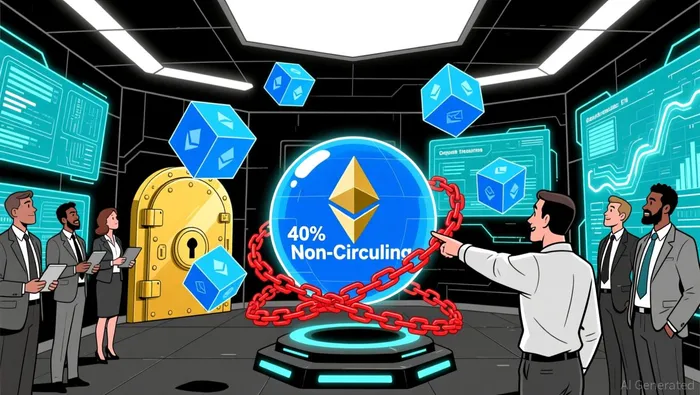
Ethereum's supply dynamics have evolved dramatically since the Shapella upgrade in 2023, which unlocked staked ETH and catalyzed a surge in participation. By late 2025, 32.4 million ETH (27% of total supply) is staked, with over 1.0 million ETH held in corporate treasuries-a 770% increase from the end of 2024 according to data. Combined with institutional ETFs and Layer-2 rollups, this locks 40% of the total ETH supply in staking, treasuries, or capital-efficient derivatives as research shows.
Centralized exchange liquidity has plummeted to 8.7% of total supply (16.6 million ETH), a 20% decline since July 2025 according to market analysis. This represents a structural shift: institutions are no longer treating ETH as a speculative asset but as a reserve asset. The result? A deflationary narrative amplified by reduced liquidity and heightened demand.
Institutional Capital: The Black Hole Effect
The launch of spot Ethereum ETFs in 2025 has created what analysts call "black holes for institutional capital." U.S.-listed ETFs, including BlackRock's iShares Ethereum TrustETHA-- (ETHA), attracted $5.4 billion in net inflows in July 2025 alone according to market reports. These products provide a compliant on-ramp for Wall Street, with Ethereum's market cap now at $449 billion and a price of $3,700 according to estimates.
Corporate treasuries are also redefining Ethereum's role. Companies like BitMine Immersion Technologies have staked billions in ETH for yield, while others, like Shapelink, have exited positions according to market data. This duality underscores Ethereum's growing utility as both a store of value and a capital-efficient asset.
Undervaluation: A Mathematical Certainty
Simon Kim of Hashed has quantified Ethereum's undervaluation with precision. Using a composite of eight models-including DCF, TVL multiples, and Metcalfe's Law-Kim estimates Ethereum is 56.9% undervalued at $3,022.3, with a fair value of $4,747.4 according to analysis. The most aggressive model, Metcalfe's Law, suggests a 217% undervaluation at $9,583.6 according to the same analysis.
These metrics are reinforced by Ethereum's fundamentals:
- Total Value Locked (TVL) across DeFi and Layer-2s has reached $100 billion according to market data.
- Staking yields remain attractive, with over $146 billion in value locked in proof-of-stake mechanisms as research shows.
- EIP-1559 has transformed Ethereum into a low-inflation asset, with burn rates outpacing issuance according to analysis.
The Long-Term Capital Allocation Play
Ethereum's structural supply squeeze and institutional adoption are not transient trends-they represent a fundamental reclassification of digital assets. As corporate treasuries and ETFs continue to absorb ETH, the network's scarcity premium will only intensify. This is a classic case of demand outpacing supply, amplified by Ethereum's transition to a deflationary, utility-driven asset class.
For long-term capital allocators, the question isn't whether Ethereum will appreciate-it's how much further it can go. With 40% of supply locked up and institutional inflows accelerating, Ethereum's price discovery phase is just beginning.
Conclusion: A High-Conviction Buy
Ethereum's undervaluation is mathematically defensible, structurally inevitable, and institutionally validated. The combination of corporate staking, ETF-driven demand, and a shrinking exchange supply creates a perfect storm for price appreciation. For investors with a multi-year horizon, Ethereum is not just a buy-it's a must-own in the new digital asset paradigm.





Comentarios
Aún no hay comentarios