
Corporate Social Responsibility as a Strategic Imperative: How NRG Energy's 2 Million Meal Initiative Strengthens Investor Confidence and Brand Equity
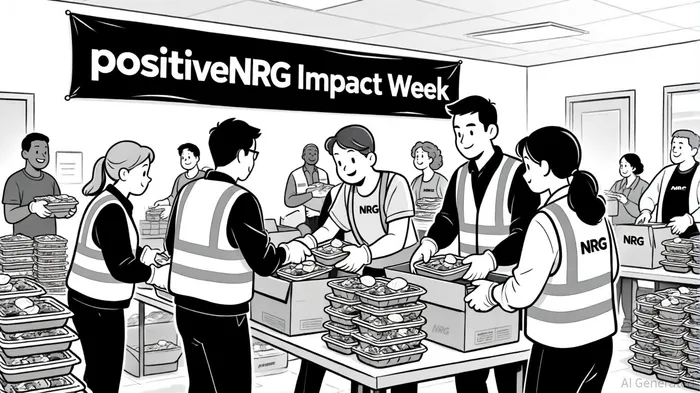
In an era where environmental, social, and governance (ESG) criteria dominate investor decision-making, corporate social responsibility (CSR) has evolved from a peripheral activity to a core strategic lever. NRGNRG-- Energy's 18th Annual Impact Week-where employees mobilized to deliver 2 million meals across 41 U.S. and Canadian communities-exemplifies how purpose-driven initiatives can create sustainable competitive advantages while aligning with ESG trends. This case study reveals how CSR, when executed with operational rigor and stakeholder engagement, enhances brand equity, operational resilience, and investor returns.
Aligning CSR with ESG: A Dual-Track Strategy
NRG's meal-packaging initiative directly addresses the social pillar of ESG, tackling food insecurity for 47 million Americans, as highlighted by a Yahoo Finance report. By partnering with regional nonprofits like the Houston Food Bank, NRG not only amplifies its community impact but also builds long-term relationships with local stakeholders-a critical component of ESG alignment, according to a StockTitan article. According to CSRHub data, 85% of investors now prioritize ESG factors, with 75% of Gen Z and Millennials demanding transparency in corporate sustainability efforts. NRG's Impact Week, therefore, serves as both a social intervention and a strategic signal to investors that the company is attuned to societal needs while maintaining operational excellence.
The company's broader ESG strategy further reinforces this alignment. NRG's sustainability report, which emphasizes clean energy transitions and climate responsibility, demonstrates a commitment to environmental stewardship. However, its reliance on fossil fuels-reflected in a net impact ratio of -72.9% per MarketBeat's ESG score-highlights the tension between short-term profitability and long-term sustainability goals. This duality underscores the importance of balancing CSR initiatives with decarbonization efforts to avoid reputational risks and maintain ESG credibility.
Operational Resilience and Employee Engagement
Purpose-driven CSR programs also bolster operational resilience. NRG's Impact Week engaged thousands of employees, fostering a culture of collaboration and shared purpose. As Melissa Hensley, Senior Director of Corporate Philanthropy at NRG, noted in the Yahoo Finance report, the event delivered "more than meals-it brought hope, dignity, and support to families facing food insecurity." This sentiment resonates with a workforce increasingly prioritizing sustainability: 71% of employees, according to CSRHub, prefer working for environmentally sustainable employers.
Such engagement translates into tangible business outcomes. As reported in NRG's Q1 results, the company posted a record $750 million GAAP Net Income and $531 million Adjusted Net Income, reflecting operational efficiency and stakeholder trust. The company's ability to raise 2025 guidance-projecting Adjusted EPS of $7.55–$8.15-was noted in an Investing.com report. By aligning CSR with employee values, NRG strengthens retention and productivity, both of which are critical to sustaining financial performance.
Investor Confidence and Capital Allocation
The link between CSR and investor confidence is increasingly measurable. NRG's stock price surged 26% in the month following its Q1 2025 earnings report, after a Yahoo Finance article highlighted its results. Analysts have set a 12-month price target range of $185.00–$308.00, with an average of $212.17, according to a Benzinga analysis, reflecting optimism about the company's long-term trajectory. While direct causal relationships between CSR and stock performance are complex, NRG's strategic acquisitions-such as a $12 billion LS Power portfolio-are detailed in the Q1 slides and demonstrate how ESG-aligned growth can attract capital.
Investor sentiment is further reinforced by NRG's disciplined capital allocation. The company's $2.7 billion share repurchase plan through 2025, coupled with its focus on clean energy investments, signals a balance between rewarding shareholders and future-proofing its business, per an NRG press release. This approach aligns with ESG principles of long-term value creation, as opposed to short-term profit maximization.
The Path Forward: Balancing Ambition and Accountability
NRG's Impact Week and broader ESG strategy are not without challenges. Its lack of a publicly disclosed Net Zero target and continued reliance on coal and natural gas raise questions about the scalability of its sustainability efforts, as noted by MarketBeat. To solidify its ESG credentials, NRG must accelerate its transition to renewable energy while expanding CSR initiatives that address systemic issues like food insecurity.
Conclusion
NRG Energy's 18th Annual Impact Week illustrates how CSR, when integrated into core business strategy, can drive both social impact and shareholder value. By addressing food insecurity, engaging employees, and aligning with ESG trends, NRG has positioned itself as a leader in the energy transition. For investors, the company's example underscores a critical insight: purpose-driven initiatives are not merely ethical imperatives but strategic assets that enhance resilience, brand equity, and long-term returns. As ESG criteria continue to shape capital markets, companies that follow NRG's dual-track approach-combining operational excellence with societal impact-will be best positioned to thrive.





Comentarios
Aún no hay comentarios