
Corporate Social Responsibility and Brand Resilience: How Subaru's Strategic Partnerships Drive Long-Term Value for Shareholders
In an era where consumers increasingly prioritize ethical alignment with brands, corporate social responsibility (CSR) has evolved from a peripheral activity to a strategic imperative. For investors, the question is no longer whether CSR matters, but how it translates into measurable financial outcomes. Subaru of America's partnership with Operation Warm offers a compelling case study in this regard, illustrating how purpose-driven initiatives can fortify brand value, foster consumer loyalty, and indirectly bolster shareholder returns.
Strategic CSR: Beyond Philanthropy to Brand Identity
Subaru's collaboration with Operation Warm, part of its broader "Subaru Loves to Help" initiative, exemplifies how CSR can be woven into a company's core identity. Since 2020, the partnership has mobilized over 1,200 volunteer gifting events, providing essential items like coats and shoes to more than 290,000 children across 49 states. By 2024, this effort had expanded to include experiential events such as the Operation Warm tent at Subaru WinterFest celebrations, blending community service with brand engagement.
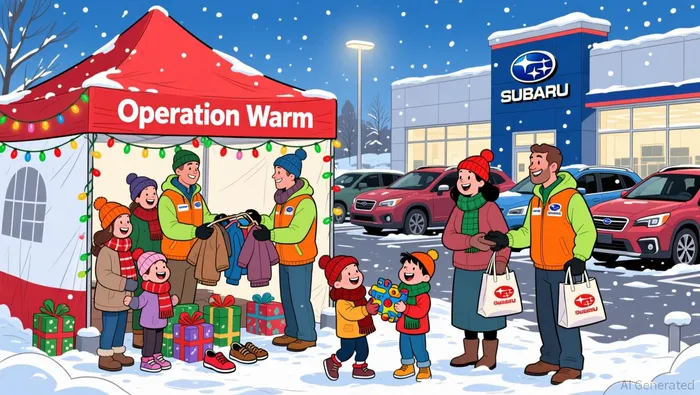
This approach aligns with Subaru's "More Than a Car Company" ethos, a narrative reinforced by nearly $320 million in donations to nonprofits since 2007. The company's commitment to social responsibility is not merely transactional; it is a calculated strategy to resonate with conscious consumers. According to a report by 3BL Media, Subaru's Sponsored Series with TriplePundit generated over 150,000 views, targeting sustainability professionals and nonprofit leaders-audiences likely to influence purchasing decisions.
Brand Value Metrics: Recognition and Customer Loyalty
While direct financial metrics linking CSR to shareholder returns remain elusive, indirect indicators suggest a strong correlation. Subaru's brand value has been consistently validated by third-party rankings. For instance, it was named the No. 1 automotive brand on Forbes' Best Brands for Social Impact list for two consecutive years, and in 2025, it topped the American Customer Satisfaction Index with an 85-point score, excelling in categories like safety and dependability.
These accolades are not accidental. A 2024 Corporate Impact Report revealed that Subaru's CSR efforts, including Operation Warm, contributed to its recognition as one of America's most community-minded companies by Points of Light Civic 50. Such reputational capital enhances brand loyalty, particularly among demographics that prioritize ethical consumption. As stated by J.D. Power, Subaru ranked second among mass-market brands in the 2025 U.S. Sales Satisfaction Index, underscoring the link between CSR and customer experience.
Market Resilience and Shareholder Implications
The financial implications of Subaru's CSR strategy may not be immediately quantifiable, but they manifest in market resilience. During economic downturns, brands with strong ethical reputations often retain customer trust more effectively. Subaru's "Share the Love" campaign, which raised $31.7 million for charities in 2024 alone, has cumulatively generated $319.8 million since 2008. This sustained engagement likely mitigates customer attrition, a critical factor in maintaining market share.
Moreover, Subaru's environmental initiatives-such as using 970,000 pounds of recycled content in floor mats and remanufacturing 51 million pounds of vehicle parts- align with global sustainability trends, reducing regulatory risks and appealing to eco-conscious investors. While no academic studies directly correlate these efforts with shareholder returns, the company's share repurchase programs and consistent ACSI rankings suggest a foundation of financial stability.
Conclusion: CSR as a Strategic Investment
Subaru's partnership with Operation Warm demonstrates that CSR, when strategically integrated, can enhance brand value, drive consumer loyalty, and foster market resilience. While the direct financial returns on such initiatives remain difficult to isolate, the indirect benefits-ranging from reputational equity to customer retention-position Subaru as a model for investors seeking long-term value. In an increasingly competitive and socially conscious market, companies that treat CSR as a strategic lever, rather than a compliance checkbox, are likely to outperform peers in both brand equity and shareholder returns.







Comentarios
Aún no hay comentarios