
Corporate Share Buybacks: Strategic Value and Market Implications
The fourth quarter of 2025 has witnessed a record surge in corporate share buybacks, with U.S. companies returning capital to shareholders at an unprecedented pace. S&P 500 firms alone spent $293.5 billion on repurchases in Q1 2025, and the total annual buyback expenditure is projected to exceed $1.3 trillion by year-end. This trend, driven by tech and financial giants, underscores a strategic shift in capital allocation priorities. However, the efficiency of these programs and their implications for market dynamics remain critical questions for investors.
Buyback Momentum and Sector Leadership
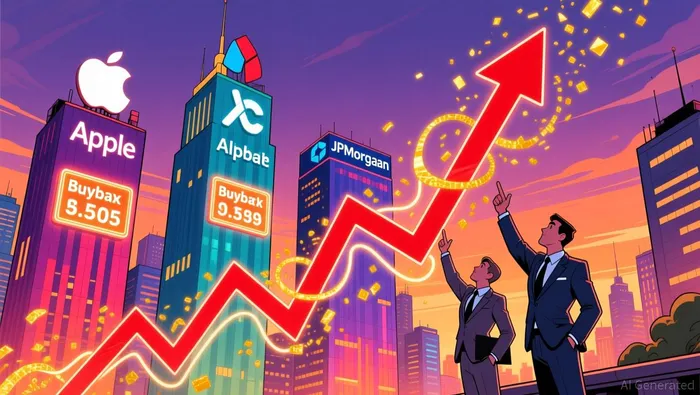 The 2025 buyback boom has been concentrated among a handful of large-cap firms. AppleAAPL-- (AAPL) exemplifies this trend, having announced a $100 billion buyback program in May 2025 and spending $106.9 billion in the prior 12 months. AlphabetGOOGL-- (GOOGL) and JPMorgan ChaseJPM-- (JPM) followed suit with $70 billion and $50 billion repurchase programs, respectively. These initiatives reflect confidence in capital allocation strategies, particularly in sectors with strong cash flow generation.
Apple's Q4 2025 results highlight its financial strength: revenue of $102.5 billion, a 26.6% cash flow from operations to revenue ratio, and a trailing P/E ratio of 38.2x. Despite a debt load of $101.7 billion, the company's $55.4 billion in cash and robust free cash flow ($20 billion in Q4 2025) support its buyback commitments. JPMorganJPM--, meanwhile, reported $8.293 billion in Q3 2025 buybacks, a 30.37% year-over-year increase, alongside $14.4 billion in net income and $47.1 billion in managed revenue. Its trailing P/E of 15.48 and debt-to-capital ratio of 0.54 suggest disciplined leverage management. Alphabet's ROIC of 29.23% and conservative debt-to-equity ratio of 0.10 further underscore its capital efficiency.
Capital Allocation Efficiency and Risks
While these firms demonstrate strong financial metrics, the broader market implications of concentrated buyback activity warrant scrutiny. The top 20 S&P 500 companies accounted for 51.3% of total buyback authorizations in Q2 2025, signaling a top-heavy trend. This concentration raises questions about whether smaller firms are underutilizing their capital or if market dynamics are skewing investor preferences.
For Apple, the high P/E ratio (38.2x) and aggressive buybacks suggest a focus on sustaining shareholder value amid elevated valuations. However, critics argue that such programs may prioritize short-term gains over long-term innovation, particularly when funded through debt. JPMorgan's buybacks, supported by $177.5 billion in 2024 revenue and a net interest income of $92.6 billion, appear more aligned with its capital-light business model. Alphabet's $91B–$93B 2025 capex budget indicates a balance between buybacks and reinvestment in AI-driven growth.
Market Implications and Regulatory Scrutiny
The surge in buybacks has contributed to rising stock prices and earnings per share (EPS) growth, but it has also intensified debates over corporate short-termism. Regulators are increasingly concerned about transparency, particularly when buybacks are executed at overvalued prices or funded through excessive debt. For instance, Goldman Sachs' $40 billion buyback program in late 2025, which represented 18.1% of its market cap, drew attention for its aggressive scale.
Investors must weigh these factors against macroeconomic conditions. With U.S. companies authorizing $1.2 trillion in buybacks through October 2025-a 15% increase from 2024-market participants are bracing for continued volatility. The seasonal strength of November buybacks, coupled with year-end repurchase targets, could further amplify equity market movements.
Conclusion
The Q4 2025 buyback frenzy reflects a strategic emphasis on shareholder returns, particularly among tech and financial leaders. Firms like Apple, Alphabet, and JPMorgan demonstrate strong capital allocation efficiency, supported by robust cash flows and disciplined leverage. However, the concentration of buyback activity and regulatory concerns highlight the need for a balanced approach. Investors should monitor how these programs align with long-term growth objectives and macroeconomic risks. As the market navigates this dynamic landscape, the sustainability of buyback-driven gains will depend on firms' ability to balance capital returns with innovation and resilience.







Comentarios
Aún no hay comentarios