
Corporate Risk Management and ESG Exposure in Mining: The Long-Term Costs of Legacy Environmental Disasters
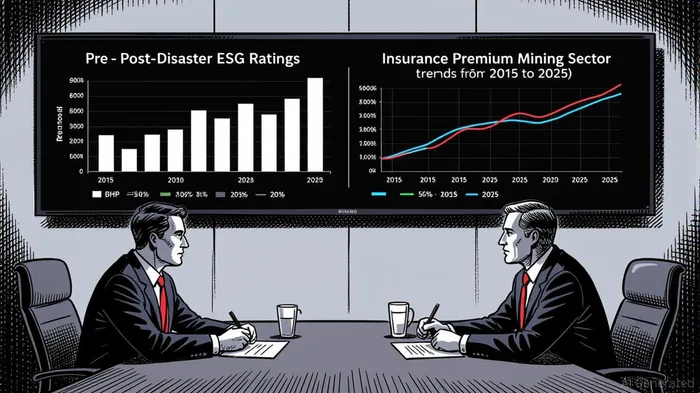
The mining industry, long synonymous with resource extraction and economic growth, now faces a paradigm shift driven by environmental, social, and governance (ESG) scrutiny. Legacy environmental disasters—such as the 2015 Fundão dam collapse in Brazil and the 2019 Brumadinho disaster—have exposed the fragility of corporate risk management frameworks and their cascading impacts on shareholder value and insurance recoverability. For investors, understanding these dynamics is critical to navigating the sector’s evolving risks.
The Financial Toll of Legacy Disasters
The 2015 Fundão dam disaster, operated by BHPBHP-- and Vale’s joint venture Samarco, unleashed $7.9 billion in immediate compensation and remediation costs, with BHP estimating total liabilities could reach $32 billion over two decades [1]. Meanwhile, victims are pursuing $47 billion in UK court claims, underscoring the unresolved financial exposure. ValeVALE--, meanwhile, faced a $1.683 billion loss in 2019 alone following the Brumadinho collapse, which killed 270 people and triggered criminal charges against its executives [2]. These events highlight how environmental negligence can morph into multi-decade liabilities, eroding capital and straining balance sheets.
Insurance recoverability, a key metric for risk mitigation, has also been compromised. Insurers are increasingly factoring ESG performance into underwriting decisions, with weak sustainability practices leading to higher premiums and reduced coverage [3]. For instance, Vale’s Integral Reparation Agreement—valued at R$37.7 billion—includes socioenvironmental restoration efforts aimed at rebuilding trust with insurers and regulators [4]. However, the lack of transparency in quantifying insurance payouts for mining disasters suggests that companies often bear a disproportionate share of costs, further amplifying financial risks.
ESG Ratings: A Double-Edged Sword
ESG ratings, once seen as a reputational buffer, have become a litmus test for corporate resilience. Vale’s ESG disclosures post-Brumadinho revealed a “neutral” tone in CSR reports, starkly contrasting with the negative media sentiment surrounding the disaster [5]. This disconnect eroded investor confidence, contributing to Vale’s downgrade to junk status—a rare blow for a mining giant. Similarly, BHP’s ESG governance faced scrutiny for prioritizing short-term shareholder returns over long-term risk mitigation, as evidenced by executives receiving $516 million in pay and bonuses since 2015 despite ongoing litigation [1].
Investors are now demanding tangible ESG progress. A 2025 report by EY noted that mining firms with robust ESG frameworks see 15–20% lower capital costs compared to peers with weak practices [6]. This aligns with broader trends: insurers and lenders increasingly tie financing terms to ESG metrics, penalizing companies with poor track records through higher interest rates and stricter covenants [3].
Strategic Implications for Investors
For mining companies, the path forward hinges on balancing remediation costs with sustainable innovation. Green mining technologies—such as electric vehicles and renewable energy integration—offer a dual benefit: reducing environmental footprints while cutting operational expenses [7]. However, upfront investments in these technologies remain a hurdle, particularly for firms still grappling with legacy liabilities.
Investors must also consider the role of regulatory tailwinds. Stricter environmental policies and climate risk disclosures (e.g., the EU’s CSRD) are forcing companies to internalize externalities, potentially reshaping insurance models. Insurers, for their part, are recalibrating risk assessments to account for climate change and corporate ESG performance, with some pivoting toward “green insurance” products that reward sustainable practices [8].
Conclusion
Legacy environmental disasters in mining are not isolated incidents but systemic risks with long-term financial and reputational consequences. For BHP and Vale, the Fundão and Brumadinho disasters serve as cautionary tales: weak ESG governance and inadequate risk management can lead to billions in liabilities, downgrades, and eroded shareholder value. As the sector transitions toward sustainability, investors must prioritize companies that treat ESG not as a compliance checkbox but as a strategic imperative. In an era where environmental stewardship directly impacts insurance recoverability and capital costs, the mining industry’s future belongs to those who learn from the past.
Source:
[1] Dam winners: Mining bosses at companies being sued after Brazil dam disaster receive $516m in pay and bonuses since 2015 [https://www.financeuncovered.org/stories/brazil-dam-disaster-fundao-bhp-vale-victimes-compensation-remuneration]
[2] What misguides environmental risk perceptions in ... [https://www.sciencedirect.com/science/article/abs/pii/S0301420721000398]
[3] How Insurers are Integrating Climate Change into their ... - AonAON-- [https://www.aon.com/en/insights/articles/how-insurers-are-integrating-climate-change-into-their-investment-decisions]
[4] Controversies [https://vale.com/esg/controversies]
[5] (PDF) BEYOND CLAIMS: CSR Reports, ESG Initiatives... [https://www.researchgate.net/publication/392657982_BEYOND_CLAIMS_CSR_Reports_ESG_Initiatives_and_The_Consequences_of_Impressions_Management_Empirical_Analysis]
[6] Top 10 mining and metals risks in 2025 [https://www.ey.com/en_us/insights/energy-resources/risks-opportunities]
[7] The emergence of green mining technologies and practices [https://www.sciencedirect.com/science/article/pii/S2950555024000338]
[8] The Impact of Climate Risk on Insurers' Sustainable ... [https://www.mdpi.com/2071-1050/17/8/3423]





Comentarios
Aún no hay comentarios