
Corporate Risk Exposure to Public Unrest and Protest: Assessing Long-Term Impacts on Private Security Firms
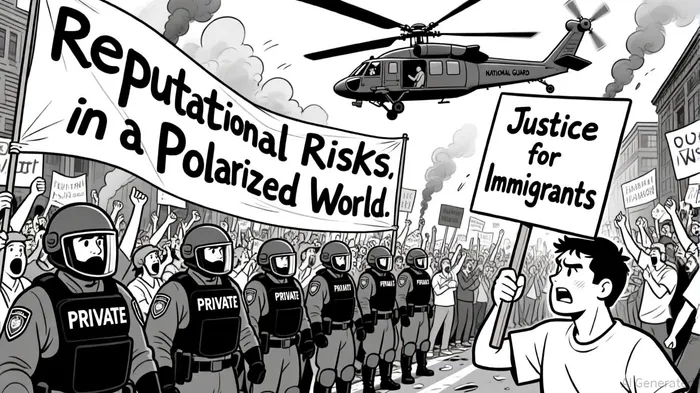
The rise of politically charged public unrest in 2025 has placed private security firms at the intersection of operational, reputational, and financial risk. Nowhere is this more evident than in the case of U.S. Immigration and Customs Enforcement (ICE), which has faced unprecedented scrutiny following the Los Angeles anti-ICE protests. These events, fueled by a mix of grassroots activism and substantial financial backing, highlight the dual-edged nature of corporate risk exposure: while demand for security services surges amid societal fragmentation, firms like ICE must navigate the reputational fallout of being perceived as enforcers of controversial policies.
The Financial and Reputational Dilemma
Public protests targeting private security entities are not merely operational disruptions—they are existential threats to brand equity. According to a report by the Global Situation Room, disinformation campaigns and polarized political agendas now rank as the top reputational risks for corporations, particularly those with high visibility in contentious policy debates [1]. For ICE, this has translated into a crisis of perception. The 2025 LA protests, organized by groups like the Coalition for Humane Immigrant Rights of Los Angeles (CHIRLA), drew on over $34 million in public and private funding, including grants from the Department of Homeland Security and billionaire-backed foundations [2]. While these funds were ostensibly allocated for immigration services, their indirect role in amplifying anti-ICE activism has sparked investigations into potential coordination and real-time intelligence leaks [2].
The reputational damage is compounded by the agency's $175 billion budget, the largest in U.S. law enforcement history. Critics argue that such funding fuels a "surveillance state" narrative, while supporters view it as necessary for border security. This duality creates a volatile environment where public trust erodes even as operational budgets expand. Data from the Q2 2025 Reputation Risk Index underscores this paradox: firms with strong corporate social responsibility (CSR) profiles are more likely to be targeted by activists, as their visibility amplifies protest messaging [1].
Market Dynamics and Strategic Vulnerabilities
The private security sector is experiencing a boom driven by political unrest. The "defund the police" movement and police staffing shortages have pushed businesses and communities toward privatized security solutions. By 2032, the global private security and VIP services market is projected to grow to $350 billion, with a 6.5% CAGR [3]. However, this growth is not without caveats. The same forces driving demand—such as distrust in public institutions—are eroding the social license of firms perceived as extensions of state power.
ICE's operational challenges further illustrate this tension. Protests have disrupted enforcement activities, forcing the agency to divert resources to crisis management. For example, the 2025 LA riots led to the deployment of National Guard troops and coordinated demonstrations across the U.S. and internationally [2]. Such events test not only operational preparedness but also crisis communication strategies. A report by the International Security Ligue notes that firms lacking integrated security cultures are more vulnerable to reputational cascades in polarized environments [4].
Lessons from Crisis Management
Comparisons with other corporate crises reveal critical lessons. CrowdStrike's swift response to a 2024 global IT outage—marked by an unreserved apology and transparent communication—helped preserve investor confidence, with 96% of stock ratings remaining "buy" [5]. Conversely, Boeing's mishandling of mechanical failures and PR missteps led to a stock price plunge and CEO resignation [5]. For private security firms, the takeaway is clear: reputational resilience hinges on proactive transparency and alignment with public sentiment.
Strategic Recommendations for Investors
Investors must weigh both the tailwinds and headwinds facing private security firms. While the sector's growth trajectory is robust, long-term viability depends on a firm's ability to mitigate reputational risks. Key considerations include:
1. Diversification of Service Offerings: Firms investing in AI-driven surveillance and biometric access control (as seen in 2025) may offset reputational risks by positioning themselves as technologically advanced rather than politically aligned [3].
2. Political Climate Monitoring: Proactive engagement with activist groups and transparency in funding sources can reduce the likelihood of being weaponized in public discourse [2].
3. Crisis Communication Protocols: As demonstrated by London Drugs' effective handling of a 2024 cyberattack, maintaining customer trust through open communication is critical [5].
Conclusion
The 2025 anti-ICE protests underscore a broader trend: in an era of heightened political polarization, private security firms must balance operational demands with reputational stewardship. While the sector's financial prospects are strong, long-term success will depend on navigating the complex interplay between public trust, regulatory scrutiny, and activist mobilization. For investors, the imperative is to prioritize firms that treat reputational risk not as a peripheral concern but as a core component of strategic planning.







Comentarios
Aún no hay comentarios