
Corporate Governance Risks in the Hospitality Sector: Regulatory Backlash and Its Impact on Hotel Chains' Valuations and Brand Equity
The hospitality sector, long characterized by its reliance on customer trust and operational efficiency, has faced mounting regulatory scrutiny in recent years. From energy efficiency mandates to anti-money laundering (AML) protocols, hotel chains are navigating a complex web of compliance requirements. These pressures are not merely administrative hurdles; they directly influence financial performance, brand equity, and long-term valuation. This analysis examines how political and regulatory backlash-exemplified by recent cases involving major players like MGM ResortsMGM-- and Caesars Entertainment-has reshaped the risk landscape for hospitality investors.
Regulatory Pressures and Financial Penalties
The District of Columbia's CleanEnergy DC Omnibus Amendment Act (CEDC Act) has set a precedent for stringent energy efficiency standards, imposing fines of up to $10 per square foot (capped at $7.5 million) for non-compliance with metrics like Energy Star scores and Source Energy Use Intensity (EUI) thresholds. Such penalties, combined with the costs of retrofitting aging infrastructure, create immediate financial strain. Meanwhile, the Federal Trade Commission's Junk Fees Rule, effective May 2025, mandates transparent pricing for hotels, penalizing practices like drip pricing with per-violation fines and class-action lawsuits. These regulations reflect a broader trend of consumer protection policies that elevate operational costs and necessitate strategic repositioning.
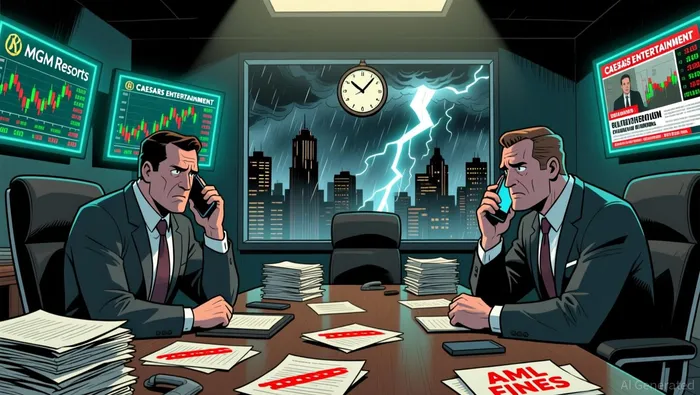
The stakes are particularly high for companies with a history of regulatory missteps. For instance, MGM Resorts and Caesars Entertainment faced AML violations linked to illegal bookmakers, resulting in fines totaling $8.5 million and $7.8 million, respectively. These penalties, while significant, pale in comparison to the reputational damage incurred. As one analyst noted, "Regulatory failures in the hospitality sector are not just financial events-they are trust crises."
 The hospitality industry's reliance on trust is further amplified by its visual branding. A 2025 study found that 91% of consumers associate high-quality video content with brand reliability, underscoring the importance of maintaining a positive public image. Regulatory violations, particularly those involving data security or ethical lapses, disrupt this trust, leading to long-term customer attrition and reduced revenue per available room (RevPAR).
Stock Price Volatility and Valuation Impacts
The financial markets have responded to these governance risks with volatility. Publicly traded hotel chains saw a 20% decline in returns and a 3% drop in market capitalization between 2023 and 2025, driven by regulatory pressures and tariff-related cost increases. MGM Resorts, for example, reported a $100 million loss from its 2023 cyberattack, while its stock price lagged despite a $637 million adjusted EBITDA in early 2025. Similarly, Caesars Entertainment traded at a 30% discount to its estimated fair value of $33.37 per share in early 2026, reflecting investor skepticism about its ability to recover from AML-related fines and operational challenges.
The valuation gap is not uniform across the sector. Companies like Hyatt Hotels Corp. and Marriott International have outperformed peers by prioritizing compliance and transparency, including strategic divestitures of non-core assets to fund sustainability upgrades. This contrast highlights the divergent paths available to hotel chains: proactive governance can mitigate risks, while reactive measures often exacerbate them.
Conclusion: Governance as a Strategic Imperative
For investors, the hospitality sector's regulatory environment underscores the importance of governance as a value driver. Hotels that fail to align with evolving standards-whether in energy efficiency, pricing transparency, or data security-face not only fines but also irreversible damage to brand equity and shareholder value. Conversely, firms that integrate compliance into their core strategies, as seen with Hyatt's $2 billion real estate divestiture to fund sustainability goals, position themselves for resilience in a high-risk market.
As regulatory frameworks continue to evolve, the ability to anticipate and adapt to governance challenges will determine the long-term success of hospitality brands. In an industry where trust is currency, the cost of non-compliance is no longer just financial-it is existential.





Comentarios
Aún no hay comentarios