
Corporate Bitcoin Adoption and Strategic Allocation: How Small-Cap Real-World Asset Firms Are Leveraging Bitcoin for Long-Term Value Preservation
The adoption of BitcoinBTC-- by small-cap real-world asset (RWA) firms has emerged as a transformative trend in the institutionalization of digital assets. As traditional financial markets grapple with macroeconomic uncertainty and regulatory evolution, these firms are increasingly integrating Bitcoin into their strategic allocation frameworks to preserve value, enhance liquidity, and diversify risk. This shift is not merely speculative but rooted in a maturing infrastructure that bridges blockchain innovation with real-world economic activity.
Strategic Allocation Frameworks: From Speculation to Institutional Legitimacy
By late 2025, Bitcoin's market capitalization had surged to $1.65 trillion, solidifying its role as a cornerstone of institutional portfolios. Small-cap RWA firms, in particular, have adopted Bitcoin as a strategic asset to hedge against inflation and economic volatility. For example, the "MicroStrategy Playbook"-where companies convert cash reserves into Bitcoin and report "BTC Yield" as a key performance indicator-has been replicated across sectors, including RWA. This approach is supported by regulatory clarity, such as the U.S. SEC's GENIUS Act and the EU's MiCA framework, which have created a predictable environment for institutional participation.
Tokenized assets now represent over $33 billion in value as of October 2025. These tokenized instruments often coexist with Bitcoin allocations, enabling firms to diversify their exposure while leveraging blockchain's efficiency. For instance, Ondo Finance's Ondo Global Markets platform tokenizes stocks and ETFs onchain, with over $300 million in total value locked (TVL). 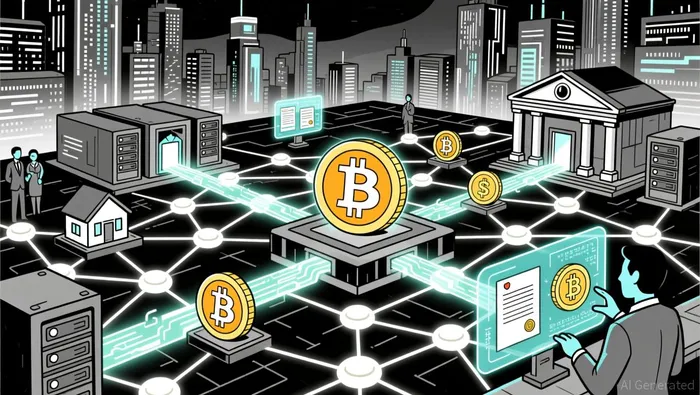 By partnering with Chainlink for institutional-grade data infrastructure, OndoONDO-- ensures accurate pricing and cross-chain interoperability, demonstrating how Bitcoin and tokenized RWAs can operate programmably within decentralized finance (DeFi) ecosystems.
Key Players and Case Studies: Bridging Traditional and Digital Finance
MakerDAO's expansion into RWA-backed collateral- reaching $948 million in 2025-exemplifies the integration of Bitcoin into decentralized finance. By tokenizing tangible assets like bonds and real estate, MakerDAO enhances its collateral base and offers diversified financial products. Similarly, Centrifuge has focused on tokenizing SME invoices and real estate, reducing capital costs and enabling global investor access. These platforms illustrate how small-cap RWA firms are leveraging Bitcoin not just as a store of value but as a tool to unlock liquidity in traditionally illiquid markets.
Institutional custody and settlement frameworks have also evolved to support Bitcoin adoption. Platforms like Securitize and Ondo Finance now provide institutional-grade tokenization solutions, catering to diversified tokenized treasuries and funds. For example, Jiuzi Holdings allocated $1 billion to Bitcoin staking and yield products via its partnership with SOLV Foundation, positioning itself as a compliant gateway for institutional Bitcoin exposure. This aligns with broader trends in the RWA sector, where tokenized Bitcoin products are gaining traction as yield-generating assets and bridges between traditional and decentralized finance.
Regulatory Clarity and Market Outcomes
Regulatory advancements have been pivotal in legitimizing Bitcoin as an institutional-grade asset. Singapore's Project Guardian and the UAE's tokenization initiatives have demonstrated how governments can facilitate cross-border finance and tokenized real estate. In the U.S., the repeal of SAB 121 and the establishment of the Strategic Bitcoin Reserve have further normalized Bitcoin's role on corporate balance sheets. These developments have enabled firms to treat Bitcoin as a core operating strategy, with nearly 172 publicly traded companies holding Bitcoin by Q3 2025.
The outcomes of these strategies are evident in market performance. Tokenized assets grew from $15.2 billion in December 2024 to over $24 billion by mid-2025, driven by institutional demand for yield-bearing instruments. Bitcoin's integration into these ecosystems has also enhanced capital efficiency, as seen in platforms like BlackRock's BUIDL Fund, which tokenized U.S. Treasuries and attracted $500 million in institutional capital. Such cases underscore Bitcoin's role as a complementary asset to tokenized RWAs, offering both diversification and a hedge against monetary debasement.
Challenges and Future Outlook
Despite progress, challenges remain. Bitcoin's volatility necessitates active risk management, and regulatory frameworks are still evolving. However, the growth of digital asset treasuries (DATs) and full-stack strategies-where firms vertically integrate custody, settlement, and yield generation- suggest a path toward maturity. By 2030, the RWA market is projected to reach $10 trillion, with Bitcoin playing a central role in bridging traditional and digital finance.
For small-cap RWA firms, the strategic allocation of Bitcoin represents more than a hedge-it is a catalyst for innovation. By leveraging tokenization, cross-chain interoperability, and institutional-grade infrastructure, these firms are redefining value preservation in an era of macroeconomic uncertainty. As the RWA ecosystem continues to evolve, Bitcoin's role as a foundational asset will likely expand, offering new opportunities for capital preservation and yield generation.





Comentarios
Aún no hay comentarios