
V.F. Corp's Reinvent Program: Can Cost-Cutting Salvage a Fractured Brand Portfolio?
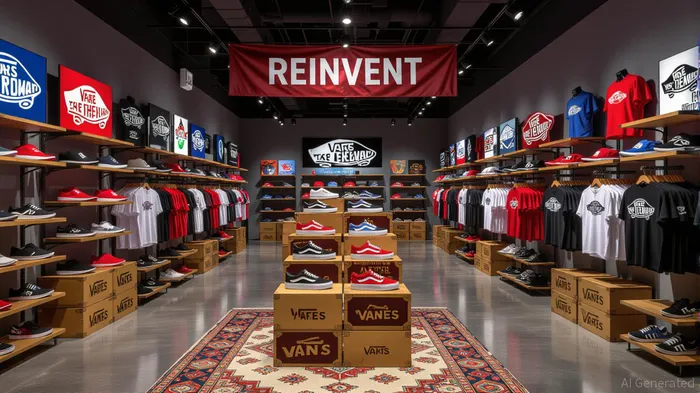
VF Corporation (VFC) has long been a titan in the global apparel industry, but its recent earnings report and ongoing restructuring efforts reveal a company at a crossroads. The Q1 2025 results—marked by a 9% revenue decline, a $259 million net loss, and a 12.6% operating margin—paint a grim picture of a brand portfolio struggling to adapt to shifting consumer preferences and a competitive retail landscape. At the heart of this crisis lies Vans, whose 21% revenue drop in Q1 (despite a modest Q2 improvement) has become a symbol of the broader challenges facing VF's "Reinvent" transformation program.
The Reinvent Program: A Double-Edged Sword
VF's "Reinvent" initiative, launched in 2023, aims to achieve $300 million in cost savings by fiscal 2025 through restructuring, workforce reductions, and operational streamlining. While these measures have trimmed expenses—$59 million in restructuring costs in the first half of 2025—the financial toll is evident. The program has shaved 122 basis points off operating margins and reduced adjusted EPS by $0.33 year-over-year. For context, Vans' revenue decline of 21% in Q1 2025 (its worst performance since the brand's acquisition in 2004) highlights the fragility of VF's core brands.
The cost-cutting strategy includes layoffs, facility closures, and a 70% allocation of restructuring costs to severance. While this has reduced net debt by $587 million and inventory by 24%, the question remains: can these savings offset the erosion of brand value and market share? Vans, in particular, faces a dual challenge: declining wholesale demand (down 21% in Q1) and a saturated DTC market where it competes with rivals like NikeNKE-- and Converse.
Vans' Restructuring: A Work in Progress
VF's leadership has emphasized that Vans is “improving,” citing a 11% revenue decline in Q2 2025 as a sign of stabilization. However, this improvement is relative. The brand's U.S. wholesale segment, which fell 21% in Q1, remains a liability, and its DTC growth (8% in constant currency) is insufficient to offset these losses. The company's pivot to a “global commercial organization” and the Americas regional platform is promising, but execution risks loom large.
The sale of the Supreme brand ($1.475 billion in proceeds) has provided liquidity, yet it underscores a troubling pattern: VF is offloading non-core assets to fund its transformation. This raises questions about the long-term sustainability of its brand portfolio. For Vans, the challenge is not just cost-cutting but repositioning the brand in a market where Gen Z consumers increasingly favor niche, streetwear-focused labels.
Financial Metrics and Long-Term Value Potential
VF's balance sheet shows progress: inventories are down 24%, and free cash flow plus asset sale proceeds are on track for $600 million in 2025. However, the company's debt load remains a concern, with net debt at $5.3 billion. Analysts have offered mixed signals, with price targets swinging from $25.53 in January to $16.97 in May 2025. This volatility reflects uncertainty about whether the Reinvent program will restore profitability or merely delay inevitable structural issues.
Earnings growth is projected to outpace revenue expansion (32% vs. 2.8% annually), but this relies heavily on cost discipline. For investors, the key question is whether VF can sustain its $0.09 quarterly dividend while investing in brand innovation. The company's ROE forecast of 24.3% in three years is optimistic, but it assumes a return to growth in core markets—a scenario complicated by the decline of the U.S. wholesale channel (down 8% in Q1).
A Cautionary Investment Outlook
The stock's valuation metrics are mixed. While some analysts argue VFC is 39% undervalued post-April 2025 price drops, others highlight its 21% overvaluation in February 2025. This fluctuation underscores the market's skepticism. For long-term investors, the appeal lies in VF's strategic clarity and its commitment to deleveraging. However, the risks are significant:
- Brand Erosion: Vans' 21% revenue drop in Q1 reflects deeper issues in brand relevance, not just operational inefficiencies.
- Margin Pressure: Even with $300 million in savings, VF's adjusted operating margin (4.0%) lags behind peers like Nike (15.5%).
- Debt Constraints: High leverage limits flexibility to invest in innovation or acquire growth assets.
Final Verdict: A High-Risk, High-Reward Play
VF's Reinvent program has bought time but not solved the root causes of its struggles. For patient investors willing to bet on a turnaround, the stock's depressed valuation and strategic clarity offer potential. However, the risks of ongoing revenue declines and brand fragmentation cannot be ignored. A cautious approach—such as dollar-cost averaging into the stock while monitoring Vans' Q3 performance and debt reduction progress—could balance the bet.
In the end, VF's success will depend on whether its cost-cutting can be paired with meaningful brand innovation. Until then, the stock remains a speculative play, not a sure bet.







Comentarios
Aún no hay comentarios