
Cornerstone Total Return Fund: A Premium Play with a Hidden Risk?
Investors seeking income often turn to closed-end funds (CEFs) for their ability to deliver steady distributions. But when a fund like the Cornerstone Total Return Fund (CRF) pulls off a $207 million rights offering at a premium to its net asset value (NAV), it's a sign of confidence—or a warning bell. Let's dissect this recent move and its implications for long-term returns.
The Rights Offering: A Win for Liquidity, but at a Cost
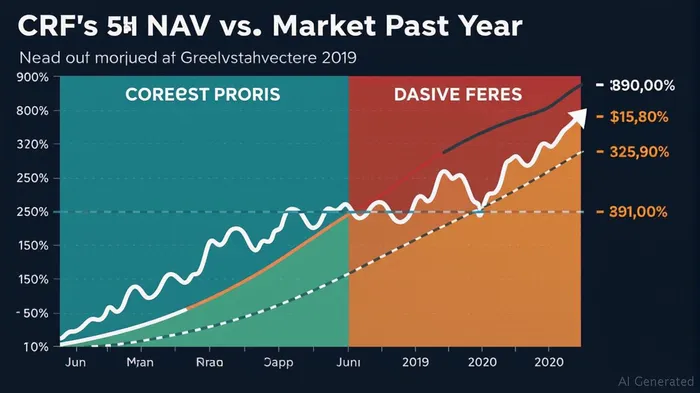
CRF's one-for-three rights offering, priced at $6.97 per share, closed in May 2025 with strong demand. This price was set at the higher of 112% of NAV or 80% of the market price at expiration, a mechanism that locked in a premium to NAV. The final price beat initial estimates of $6.29, suggesting investors were willing to pay up for exposure to Cornerstone's income-generating strategy.
Investors who don't participate in the rights offering risk seeing their ownership percentage shrink. Those who do participate, however, get a chance to lock in shares at a price tied to the fund's premium, which is no small feat in today's volatile market. However, historical data shows this strategy has been perilous: from 2020 to 2025, a backtest found that buying CRF when it traded at a premium and holding for 30 days led to a maximum drawdown of -108.64% and zero compound annual growth rate (CAGR), highlighting the risks of chasing premiums.
This offering injects $207 million into CRF's coffers, boosting liquidity and allowing the fund to reinvest in higher-yielding assets. But there's a catch: the issuance of over 33% more shares (due to the one-for-three ratio) could dilute existing shareholders' stake. Worse, the over-allotment provision—allowing up to 100% more shares—means dilution could climb further if demand remains strong.
The Distribution Policy: A Double-Edged Sword
CRF's managed distribution policy promises monthly payouts, but return-of-capital (ROC) components are lurking. For 2025, distributions include a portion of ROC, though the exact percentage won't be known until year-end. Here's why that matters:
- Asset Erosion Risk: If ROC exceeds the fund's income and gains, it effectively dips into shareholders' principal. Over time, this can shrink NAV, undermining long-term value.
- Tax Implications: ROC reduces your cost basis, which could trigger capital gains taxes if the basis hits zero.
The fund's August 2024 announcement set distributions for 2025 at $0.1168 per share for July–September. But without knowing how much of that is ROC, investors are flying blind. The danger here is clear: a high ROC percentage could turn this “income” into a hidden expense.
The Cramer Verdict: A Compelling Income Play, But Proceed with Caution
Here's the bottom line: CRF's premium pricing and successful rights offering signal demand for its income strategy. The liquidity boost could allow the fund to invest in higher-yielding assets, potentially lifting NAV over time. For income hunters, this is a tempting proposition.
But the risks are real. Dilution from the rights offering and the specter of ROC-driven erosion mean investors must monitor NAV growth obsessively. If the fund's NAV stagnates or declines while distributions rely on ROC, the party ends—fast.
Action Items for Investors:
1. Demand NAV Growth: If CRF's NAV isn't rising alongside its distributions, back away.
2. Track ROC Percentages: When the 2025 breakdown is released in early 2026, assess whether ROC is sustainable or a death spiral.
3. Stay Volatility-Ready: CEFs trading at premiums can snap back to discounts, so don't buy on margin or with long-term money you can't afford to lose.
In a low-yield world, CRF's blend of income and liquidity is hard to ignore. But this isn't a buy-and-forget investment. For aggressive income seekers, it's a speculative opportunity—but only if you're prepared to sweat the details.
Final note: Always consult a tax professional for advice on ROC distributions and their impact on your portfolio.







Comentarios
Aún no hay comentarios