
CoreWeave's Operational and Financial Irregularities: Red Flags for Long-Term Investors
In the high-stakes race to dominate the AI infrastructure market, CoreWeaveCRWV-- Inc. has emerged as both a disruptor and a cautionary tale. While the company's aggressive expansion has fueled revenue growth, its financial and operational practices have raised significant red flags for long-term investors. From unsustainable debt levels to governance missteps, CoreWeave's trajectory underscores the risks of prioritizing scale over stability in a capital-intensive industry.
Financial Irregularities: A Debt-Driven Growth Model
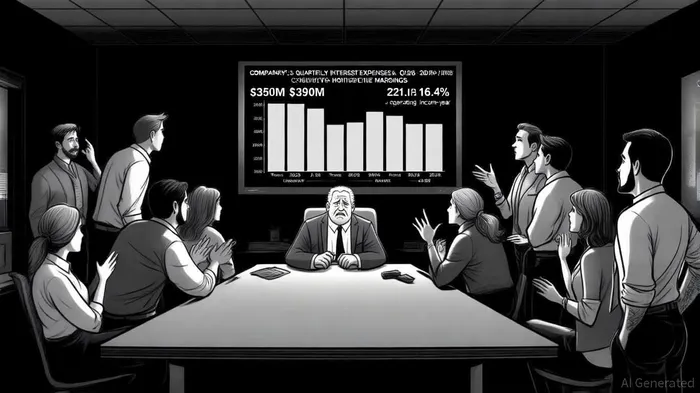
CoreWeave's financial strategy has relied heavily on external financing, with the company raising over $25 billion in debt and equity since early 2024 to fund its AI cloud infrastructure expansion [2]. This aggressive capital-raising has led to a surge in interest expenses, projected to reach $350 million to $390 million in Q3 2025 alone [2]. Such costs now threaten to erode profitability, as evidenced by the company's Q2 2025 operating loss of $131 million-a figure driven by $145 million in stock-based compensation and declining margins [4].
Despite these challenges, CoreWeave continues to secure large-scale financing. In July 2025, it closed a $2.6 billion secured debt facility to expand its AI infrastructure [4]. However, this move follows a recent default on a $7.6 billion loan due to undisclosed high-interest rates and hidden covenants, triggering regulatory scrutiny from the SEC and a 30% stock price drop [3]. These events highlight a pattern of opaque debt management, with investors now facing lawsuits over alleged misrepresentation of the company's financial health [3].
Operational Risks: Scalability vs. Profitability
CoreWeave's operational model is equally concerning. The company's capital-intensive approach-relying on long-term take-or-pay contracts-has led to a 62% revenue concentration from Microsoft in 2024 [2]. While such partnerships provide short-term stability, they expose CoreWeave to client-specific risks. A decline in demand from Microsoft or other key partners could destabilize its cash flow.
Moreover, the company's Q2 2025 results revealed a sharp contraction in adjusted operating income margins, falling from 21.5% to 16.4% year-over-year [3]. This decline, coupled with a $131 million loss, prompted a 21.3% intraday stock price drop-the largest since April 2025 [4]. Analysts attribute these struggles to the costs of rapid expansion, including $145 million in stock-based compensation [2]. While CoreWeave projects Q3 revenues of $1.26 billion to $1.3 billion, the expected surge in interest expenses underscores the fragility of its growth narrative [2].
Governance and Credit Risks: A Tenuous Outlook
Credit ratings offer a mixed picture. Fitch assigned CoreWeave a 'BB-' long-term issuer rating with a Positive Outlook, citing its "robust business model" and recurring revenue streams [1]. S&P Global similarly rated the company 'B+', noting its market leadership in AI infrastructure [3]. However, these ratings mask deeper governance issues.
CoreWeave's debt structure includes $1.5 billion in senior unsecured notes and a $7.5 billion facility led by Blackstone and Magnetar [2]. Yet, the company's recent default on a $7.6 billion loan-due to undisclosed terms-has raised questions about its risk management practices [3]. Additionally, put option rights held by former holders of series C convertible preferred stock could force CoreWeave to repurchase shares under certain conditions, further straining liquidity [2].
Assessing Long-Term Investment Risk
For investors, CoreWeave's trajectory presents a paradox: a high-growth AI infrastructure provider with a debt-laden balance sheet and governance vulnerabilities. While its partnerships with OpenAI and Microsoft suggest strong market demand, the company's reliance on short-term financing and opaque debt terms creates significant downside risk.
The credit ratings, though positive, reflect a "modest recovery" expectation in the event of default (approximately 25% for S&P-rated debt) [2]. This implies that lenders view CoreWeave as a high-risk bet, despite its market position. Meanwhile, the SEC's scrutiny and investor lawsuits highlight regulatory and legal uncertainties that could further erode shareholder value.
Historical context from a backtest of CoreWeave's earnings miss expectations from 2022 to now reveals additional risks. The company's valuation plummeted from $23 billion in 2023 to its current level, driven by competitive pressures, operational inefficiencies, and broader industry shifts . These trends underscore the fragility of its business model and the challenges of sustaining profitability in a rapidly evolving market.
Conclusion: A High-Stakes Gamble
CoreWeave's story is one of ambition and turbulence. Its AI infrastructure ambitions are undeniably aligned with a transformative industry, but the company's financial and operational practices suggest a lack of discipline. For long-term investors, the red flags-soaring debt, governance missteps, and margin compression-outweigh the potential rewards. While the AI boom may justify some level of risk-taking, CoreWeave's current trajectory appears unsustainable without a fundamental shift in its capital allocation and governance strategies.





Comentarios
Aún no hay comentarios