
Is CoreWeave-Nvidia Circular Financing a Red Flag or a Misunderstood Strategic Partnership?
The AI industry's explosive growth has created a web of interdependencies that critics now label as a "self-sustaining closed loop" of financing, where companies like CoreWeaveCRWV-- and NvidiaNVDA-- allegedly inflate demand for AI chips through circular transactions. This dynamic has sparked heated debates: is it a red flag signaling a speculative bubble, or a necessary capital play in a supply-constrained market? To answer this, we must dissect the financial architecture of CoreWeave and Nvidia's partnership, weigh the claims of demand manipulation against CEO Michael Intrator's rebuttals, and contrast grassroots skepticism with professional analysis.
The Red Flag: Circular Financing and Depreciation Risks
Critics argue that CoreWeave and Nvidia's relationship resembles the telecom bubble of the late 1990s, where vendor financing masked weak end-user demand. CoreWeave, which rents out Nvidia GPUs to hyperscalers like Microsoft and OpenAI, carries $10.45 billion in debt, much of it collateralized by GPUs. Its $6.3 billion agreement with Nvidia-committing the chipmaker to purchase unsold capacity through 2032-has drawn comparisons to Lucent's doomed vendor financing deals. Legendary short-seller Jim Chanos warns that Nvidia's depreciation schedules (six years) are unrealistic given the rapid obsolescence of AI chips. If these assets lose value in three to four years, CoreWeave and Oracle could face "massive financial risks" .
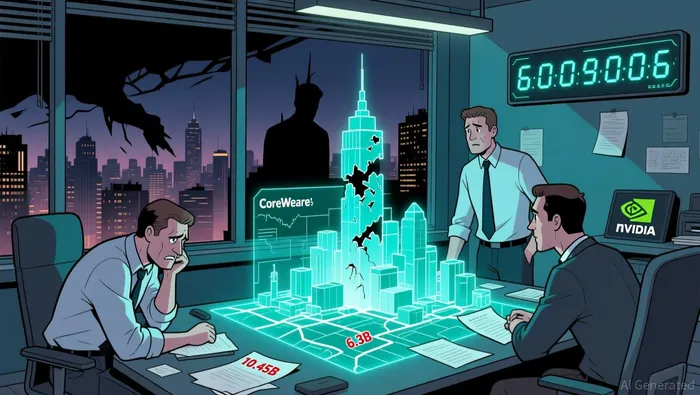 The circularity is stark: Nvidia owns 7% of CoreWeave and sells it chips, which CoreWeave then rents to Microsoft and OpenAI-two of Nvidia's largest customers. This creates a feedback loop where demand for Nvidia's chips is indirectly fueled by its own investments. CoreWeave's financials amplify the concern: it faces $34 billion in lease payments while relying on just three major clients. If Microsoft, for instance, shifts to its own $80 billion AI data center buildout, CoreWeave's revenue could collapse.
The Rebuttal: Supply Constraints, Not Artificial Demand
CoreWeave CEO Michael Intrator dismisses these claims as "financial gimmick" accusations, arguing that the collaboration is a response to genuine supply constraints. "The AI market is experiencing a violent change in supply and demand," he stated in a recent earnings call. High-performance GPUs, energy infrastructure, and data center construction all take years to scale, forcing companies to collaborate to meet surging global demand. CoreWeave, as a "neocloud" provider, fills a critical gap by offering GPU-first infrastructure that traditional hyperscalers like AWS cannot match.
Intrator highlights $55.6 billion in AI-related orders in Q3 2025 as evidence of real demand. However, supply chain bottlenecks-such as delays in third-party data center construction and limited access to copper-have prevented CoreWeave from meeting this demand. The $6.3 billion Nvidia agreement, he argues, is not a crutch but a buffer against short-term volatility, ensuring CoreWeave can continue investing in infrastructure without relying on speculative end-user commitments.
Contrasting Narratives: Reddit Skepticism vs. Professional Optimism
Grassroots sentiment on platforms like Reddit reflects a mix of bullish optimism and caution. One user on r/ValueInvesting noted, "CoreWeave's revenue backlog is staggering, but its debt and customer concentration make it a high-risk bet" . Others highlight the risk of a "GPUaaS market correction" once the current shortage eases. Meanwhile, Benzinga analysts acknowledge the risks but emphasize that 90% of AI infrastructure spending is cash-funded, with CoreWeave's challenges seen as isolated "tail risks" rather than systemic issues .
Professional analysis is similarly split. Goldman Sachs downplays CoreWeave's debt as a niche problem, while Jim Chanos's warnings about depreciation schedules have gained traction among value investors. Benzinga's coverage underscores the tension between long-term AI growth and near-term profitability, noting that CoreWeave's net margin of -8.07% and debt-to-equity ratio of 4.85 raise red flags . Yet, the company's 90% stock price surge from its March 2025 IPO suggests retail investors remain bullish .
Conclusion: A Calculated Gamble or a Bubble Waiting to Pop?
The CoreWeave-Nvidia partnership embodies the dual-edged nature of AI's golden age. On one hand, it reflects the urgent need to bridge supply gaps in a market where demand for computing power is projected to exceed $5-7 trillion in data center capacity . On the other, it exposes vulnerabilities in a sector where depreciation cycles and debt loads could amplify shocks.
For investors, the key lies in distinguishing between strategic necessity and speculative excess. If Nvidia's GPUs retain value for six years as assumed, CoreWeave's debt and vendor financing arrangements may prove manageable. But if obsolescence accelerates-as Chanos predicts-the partnership could mirror the telecom bubble's collapse. The coming months will test whether this circular financing is a bridge to AI's future or a precarious house of cards.







Comentarios
Aún no hay comentarios