
CoreWeave's Insider Selling: A Signal of Caution or a Cost of Doing Business?
In the high-stakes world of AI infrastructure, CoreWeaveCRWV-- (NASDAQ: CRWV) has emerged as a critical player, securing blockbuster contracts with Meta, OpenAI, and Nvidia in September 2025. Yet, beneath the surface of its bullish headlines lies a complex narrative of insider selling that has sparked investor unease. A recent SEC filing reveals CEO Michael N. Intrator sold $10,952,733 worth of Class A shares on September 30, 2025, to satisfy tax obligations tied to restricted stock unit (RSU) vesting, as TradingView reported. This transaction, while routine in structure, is part of a broader pattern of insider activity that demands closer scrutiny.
The Mechanics of Insider Selling
CoreWeave's insider sales are not isolated events but part of a pre-planned strategy. Intrator's September 30 sale was executed under Rule 144, which allows insiders to sell restricted stock after meeting certain holding periods. The shares were acquired on the same day as RSUs issued as compensation, a common practice for executives to cover tax liabilities, as TradingView noted. Similarly, Brian M. Venturo, CoreWeave's Chief Strategy Officer, sold $9.15 million in shares on the same day for the same purpose, in a Rule 144 notice. These transactions are further contextualized by multiple Rule 10b5-1 sales-pre-arranged trading plans designed to mitigate insider trading risks-by related parties between August and September 2025, totaling $28.37 million in gross proceeds, according to the TradingView write-up.
While such sales are often framed as "routine," their scale and timing raise questions. For instance, Magnetar Financial, CoreWeave's largest shareholder, sold $94.4 million in shares on August 28, 2025, immediately after the stock's lockup period expired, as Morningstar reported. This triggered a 9% single-day price drop and set the stage for ongoing volatility. By September, insider selling had accelerated, with directors and executives offloading millions in shares through Rule 144 and 10b5-1 programs, a trend documented by Morningstar.
Stock Price Volatility and Investor Sentiment
CoreWeave's stock price has been a rollercoaster in September 2025. On September 30, it surged 12.06% following a $14.2 billion AI processing deal with Meta and a $6.3 billion order from Nvidia, per a CapEdge filing. Analysts at Loop Capital even raised their price target to $165, citing the company's "profitability potential," as Morningstar reported. Yet, these gains were overshadowed by the shadow of insider selling.
The market's reaction to insider activity has been mixed. On one hand, the September 30 stock rally suggests investors remain bullish on CoreWeave's business fundamentals. On the other, the cumulative effect of insider sales-particularly Magnetar's August dumping-has eroded confidence. As of September 3, the stock had fallen to $93, down 50% from its July peak of $184, a decline highlighted in TradingView's coverage. This decline has not only dented investor sentiment but also reduced the implied value of CoreWeave's pending acquisition of Core Scientific, a deal now contingent on a more volatile stock price, Morningstar observed.
Valuation Challenges and Strategic Risks
CoreWeave's financials add another layer of complexity. Despite its high-profile contracts, the company reported a $290.5 million net loss in Q2 2025 and maintains a debt-to-equity ratio of 5.48, figures cited in Morningstar's analysis. Its aggressive capital expenditures and acquisition strategy-while positioning it as a leader in AI infrastructure-also raise questions about long-term profitability.
Insider selling, in this context, could be interpreted as a hedge against these risks. Executives and major shareholders may be diversifying their portfolios amid uncertainty, a rational move in a capital-intensive industry. However, the sheer volume of sales-$10.95 million by the CEO alone-risks signaling a lack of conviction in CoreWeave's valuation. As one analyst noted, the stock was already trading at a premium to diversified cloud peers before the recent selloff, a point emphasized in TradingView's reporting.
Conclusion: A Cautionary Tale for Investors
CoreWeave's insider selling reflects a tension between corporate strategy and market perception. While the company's AI partnerships and growth trajectory are undeniably compelling, the pattern of insider activity-particularly the timing of large sales ahead of major announcements-warrants caution. Investors must weigh the intrinsic value of CoreWeave's contracts against the potential for continued share price volatility driven by insider liquidity needs.
For now, the stock remains a high-risk, high-reward proposition. Those bullish on the AI sector may view the recent dip as an opportunity, but they would be wise to monitor insider activity closely. After all, in the words of Warren Buffett, "be fearful when others are greedy and greedy when others are fearful"-a mantra that feels particularly relevant as CoreWeave navigates this pivotal chapter. 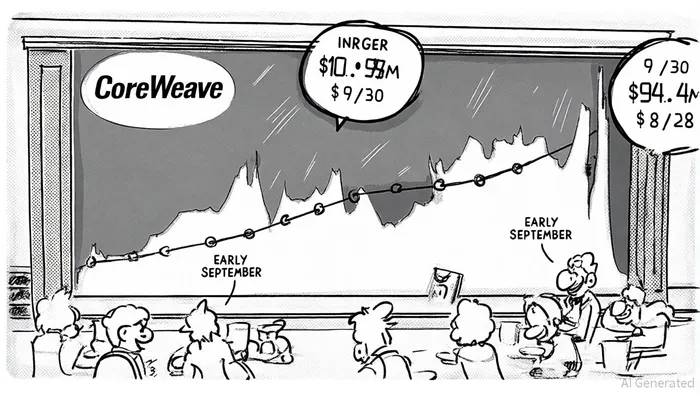





Comentarios
Aún no hay comentarios