
Is CoreWeave's Collapse a Warning Signal for the AI Infrastructure Sector?
The recent turbulence in CoreWeave's financial trajectory has sparked a critical question: Does its debt-laden model and valuation exuberance signal broader vulnerabilities in the AI infrastructure sector? As the company navigates a refinancing wall and mounting losses, its plight offers a cautionary tale for investors assessing the sustainability of high-growth, capital-intensive ventures in this transformative industry.
Valuation Risks: A Sector Built on Optimism
CoreWeave's valuation metrics underscore the precarious balance between growth and profitability. With an enterprise value of $52.9 billion and last twelve months (LTM) revenue of $5.0 billion, the company trades at a 10.6x EV/Revenue multiple and 17.3x EV/EBITDA multiple. These figures, while lower than the 40x–50x ranges seen in late-stage AI startups, remain elevated given CoreWeave's persistent net losses-$1.1 billion over the past year. The Rule of 40, a SaaS industry benchmark combining growth and profitability, further highlights the disconnect: CoreWeave's score of -49% indicates that its growth rate fails to offset its negative EBITDA margin.
This divergence reflects a broader trend in the AI infrastructure sector, where valuation multiples are driven by speculative optimism rather than proven cash flow generation. While foundational infrastructure providers and LLM vendors command multiples of 25.8x to 44.1x, such premiums often assume sustained revenue growth and technological defensibility. For CoreWeaveCRWV--, however, the reliance on a $30.1 billion revenue backlog-a forward-looking metric-raises questions about its ability to convert unearned value into actual cash flows.
Capital Structure Vulnerability: Debt as a Double-Edged Sword
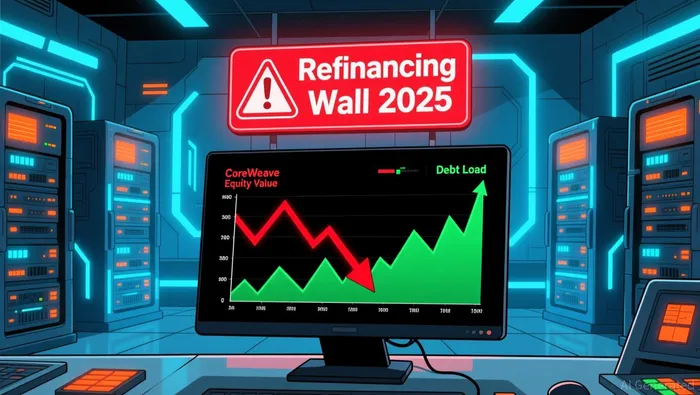
CoreWeave's capital structure epitomizes the risks of over-leveraging in a capital-intensive sector. As of September 30, 2025, its debt-to-equity ratio stood at 4.85, with some estimates suggesting a staggering 1,263%. This heavy reliance on debt-$11.17 billion in total debt as of June 30, 2025-is compounded by a refinancing wall: $986 million in debt maturing in 2025 and $4.2 billion in 2026. The company's interest expenses, which surged to $310.5 million in Q3 2025, now consume a significant portion of its operating expenses, which hit $1.31 billion in the same period.
This debt-heavy model contrasts sharply with industry peers. Oracle, for instance, maintains a 427.3% debt-to-equity ratio, while Microsoft's is a mere 16.7% according to valuesense. CoreWeave's leverage is further exacerbated by its reliance on depreciating GPU assets as collateral, creating a precarious feedback loop: asset values decline as technology evolves, potentially undermining the security of its debt.
Sector-Wide Implications: A House of Cards?
The AI infrastructure sector's broader capital structure trends reveal both opportunities and systemic risks. In 2025, AI captured nearly 50% of global venture funding, with $202.3 billion in investments. Hyperscalers and private equity firms have poured capital into foundational models and infrastructure, driving a surge in bond investments ($5.8 trillion projected from 2025–2030) and cloud capital expenditures ($300+ billion by hyperscalers in 2025 according to Crunchbase). However, this frenzy masks underlying constraints: 44% of IT leaders cite infrastructure limitations as the top barrier to AI scaling, while talent shortages and cybersecurity risks further strain capacity according to Flexential.
CoreWeave's situation, though extreme, mirrors sector-wide vulnerabilities. Many AI infrastructure providers operate with high burn rates and speculative valuations, assuming that future revenue will justify current debt loads. Yet, as CoreWeave's experience demonstrates, liquidity crises can emerge swiftly when growth stalls or refinancing proves elusive. The sector's reliance on debt-particularly in a rising interest rate environment-heightens the risk of a cascading correction.
Conclusion: A Call for Prudence
CoreWeave's challenges are not an isolated incident but a magnified reflection of the AI infrastructure sector's broader risks. While the transformative potential of AI remains undeniable, investors must scrutinize valuation logic and capital structures with renewed rigor. The Rule of 40, debt-to-equity ratios, and burn multiples should serve as non-negotiable filters for assessing sustainability.
For CoreWeave, the path forward hinges on its ability to delever, optimize operating expenses, and convert its revenue backlog into tangible cash flows. For the sector, the lesson is clear: Exuberance must be tempered with discipline. As the adage goes, "A rising tide lifts all boats"-but when the tide recedes, it is the poorly constructed vessels that sink first.







Comentarios
Aún no hay comentarios