
Core Natural Resources: A Strategic Inflection Point in Energy Transition and Operational Resilience
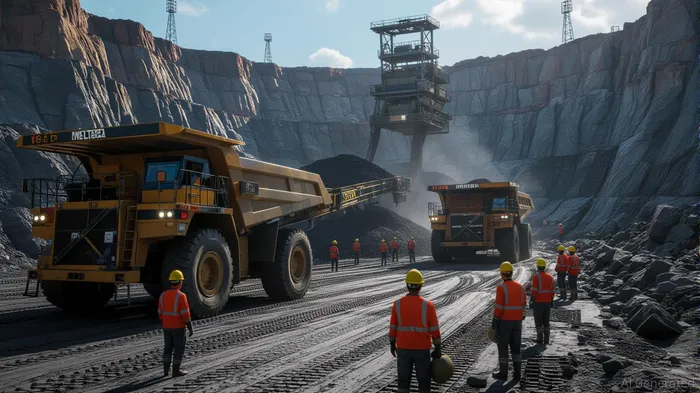
The energy transition is no longer a distant promise but a present-day imperative. As global demand for reliable, low-carbon power sources intensifies, companies that can demonstrate both operational excellence and strategic agility are poised to outperform. Core Natural Resources, a leader in metallurgical coal production, has recently signaled such a moment with its revised $170 million annual synergy target and progress on the Leer South mine restart. These developments, coupled with broader trends in the uranium sector, suggest a compelling inflection point for near-term value creation and operational credibility.
Strategic Momentum: From Synergies to Shareholder Value
Core's merger with Arch Resources and CONSOL Energy in early 2025 was initially projected to deliver $125–$150 million in annual cost synergies. By Q1 2025, the company had not only achieved this target but exceeded it, raising the revised synergy range to $150–$170 million. This acceleration reflects disciplined integration, optimized production schedules, and shared infrastructure efficiencies. For investors, the upward revision is a rare and powerful signal: management's ability to unlock value beyond initial expectations.
The financial implications are clear. Core's first-quarter 2025 results included $106.6 million returned to shareholders via buybacks and dividends, underscoring its commitment to capital allocation. With synergies now projected to grow further, the company is well-positioned to enhance profitability while maintaining a robust balance sheet. This is critical in a sector where operational disruptions—such as the Leer South incident—can test even the most resilient firms.
Operational Credibility: Navigating the Leer South Challenge
The Leer South mine, a cornerstone of Core's metallurgical coal operations, faced a combustion-related shutdown in January 2025. By June 2025, the company had re-entered the sealed area, restored ventilation, and confirmed the longwall system's structural integrity. However, elevated carbon monoxide levels in late June necessitated a cautious resealing and a revised restart timeline for Q4 2025.
While the delay is frustrating, Core's response has been methodical. A $100+ million insurance recovery will offset repair costs and lost production, preserving liquidity. More importantly, the company has reaffirmed its 2025 coking coal sales guidance, leveraging its diversified portfolio to absorb the disruption. This resilience is a testament to Core's operational credibility—a trait increasingly valued in volatile markets.
Uranium Sector Synergies: A Broader Energy Transition Narrative
Though Core operates in coal, its strategic momentum aligns with broader trends in the energy transition. The uranium sector, for instance, is experiencing a renaissance driven by nuclear energy's role in decarbonization. Energy Fuels' Pinyon Plain Mine in Arizona—a separate entity but a key player in U.S. uranium production—has achieved record output (151,400 pounds of U3O8 in April 2025) and high-grade drilling results in the Juniper Zone. These developments highlight the sector's potential for cost optimization and resource expansion.
Core's disciplined approach to integration and risk management could serve as a model for uranium producers navigating similar challenges. While Core itself is not a uranium miner, its ability to execute complex operational turnarounds and secure insurance recoveries demonstrates a playbook that could be relevant to the sector. Investors should also note the interplay between coal and uranium in the energy transition: both are critical for baseload power, with coal currently providing stability while uranium gains traction as a long-term solution.
Investment Implications: A Case for Resilience and Growth
Core's revised synergy target and Leer South progress are not isolated events but part of a larger narrative of strategic momentum. The company's ability to exceed integration goals, manage operational risks, and return capital to shareholders positions it as a standout in a sector often criticized for volatility. For investors, this represents a rare combination of near-term value creation and long-term resilience.
Conclusion: A Model for Energy Transition Leadership
Core Natural Resources is proving that traditional energy companies can adapt to the demands of the 21st century. By combining operational discipline with strategic foresight, it is not only navigating current challenges but also positioning itself to capitalize on emerging opportunities. For investors seeking exposure to a sector in transition, Core offers a compelling case: a company that balances short-term execution with long-term vision, all while contributing to the energy mix that powers the global economy.
In an era where energy security and decarbonization are twin priorities, Core's story is one worth watching—and investing in.





Comentarios
Aún no hay comentarios