
Was Corcept Therapeutics' 50% Stock Plunge a Cautionary Tale or a Buying Opportunity?
The 50% collapse in CorceptCORT-- Therapeutics' stock price on December 31, 2025, following the U.S. Food and Drug Administration's (FDA) rejection of its drug relacorilant for Cushing's syndrome, has sparked fierce debate among investors. Was this a warning shot about the perils of regulatory risk in biotech, or a mispriced opportunity for resilient long-term buyers? To answer this, one must dissect the interplay between regulatory hurdles, insider behavior, and the company's strategic response.
Regulatory Risk: A Double-Edged Sword
The FDA's decision to issue a Complete Response Letter (CRL) for relacorilant underscores the inherent volatility of biotech investing. According to a Reuters report, the agency cited "insufficient evidence" of the drug's effectiveness in treating Cushing's syndrome and hypertension, despite one of Corcept's two Phase III trials showing positive results. This highlights a critical lesson: even statistically significant data in one trial may not satisfy regulators if the overall benefit-risk profile remains unproven.
The CRL also reveals the FDA's emphasis on consistency. While Corcept's GRACE trial met its primary endpoint, the GRADIENT trial failed to confirm efficacy, creating ambiguity. For investors, this underscores the importance of evaluating not just statistical significance but also clinical relevance and reproducibility. As Biospace notes, the FDA's demand for "additional evidence" could delay relacorilant's approval by years, during which Corcept must fund costly trials while competing with existing therapies.
Insider Behavior: A Signal or Noise?
The stock plunge coincided with a wave of insider selling that raises eyebrows. CEO Joseph Belanoff alone sold over 200,000 shares-worth $15 million-before the FDA decision. While insider transactions are not inherently nefarious, the timing and volume in this case suggest a lack of confidence in relacorilant's prospects. This is compounded by a shareholder rights investigation launched by Hagens Berman, which questions whether Corcept overstated the drug's efficacy and commercial potential. 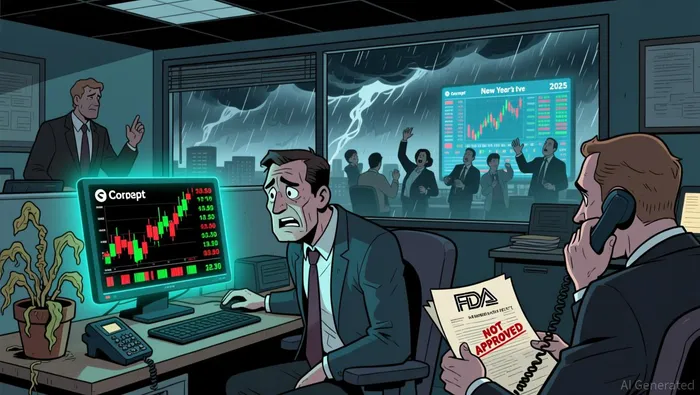
Yet, management's post-CRL statements add nuance. Belanoff has publicly expressed confidence in relacorilant's value, vowing to engage with the FDA to address concerns. This duality-selling shares while publicly defending the drug-reflects the tension between personal financial interests and corporate messaging. Investors must weigh whether these actions signal prescient caution or a disconnect between leadership and market realities.
A Buying Opportunity? The Calculus of Risk and Reward
For contrarian investors, the 50% drop presents a compelling case. Corcept's existing product, Korlym, generates stable revenue, and relacorilant's pending FDA decision for ovarian cancer (expected July 11, 2026) offers a potential lifeline. If the company can secure approval in one indication, it might regain credibility and pivot its strategy. Moreover, the stock's valuation now reflects a worst-case scenario, with a price-to-sales ratio of just 1.2x, far below its pre-CRL peak.
However, the risks remain acute. Relacorilant's failure to meet the FDA's standards for Cushing's syndrome-a condition it was designed to revolutionize-casts doubt on its broader therapeutic potential. The required additional trials could drain cash reserves, forcing Corcept to dilute shareholders or abandon the drug altogether. As Fintool observes, the market's reaction-erasing $3.6 billion in value overnight-reflects a loss of faith in the company's ability to navigate regulatory complexity.
Conclusion: A Tale of Two Perspectives
Corcept's stock plunge is neither purely a cautionary tale nor a clear-cut buying opportunity. It is a case study in the volatility of high-stakes biotech investing, where regulatory outcomes and insider actions can swing valuations dramatically. For risk-tolerant investors who believe in the company's ability to pivot and secure approvals in alternative indications, the current price may represent a discounted entry point. For others, the combination of regulatory skepticism and insider skepticism serves as a stark reminder of the perils of overreliance on a single drug candidate.
In the end, the answer hinges on one question: Can Corcept TherapeuticsCORT-- transform its setbacks into a renewed path to approval, or will the shadows of regulatory risk and internal discord prove insurmountable?







Comentarios
Aún no hay comentarios