
Copper's Volatile Trajectory Amid Divergent Macro Signals and Trade Policy Uncertainty
The copper market in 2025 has become a microcosm of global economic tensions, where near-term volatility clashes with long-term structural demand. Driven by acute supply disruptions, geopolitical risks, and divergent trade policies, copper prices have surged to record highs, yet conflicting macroeconomic signals leave investors grappling with uncertainty. This analysis dissects the interplay between immediate risks and enduring fundamentals, offering a framework to navigate this critical commodity's trajectory.
Near-Term Volatility: A Perfect Storm of Supply Constraints and Policy Uncertainty
Copper prices reached $11,770 per tonne on the London Metal Exchange (LME) in December 2025, a level not seen in decades, fueled by a tightening market and geopolitical headwinds. Mine outages at critical operations like Freeport-McMoRan's Grasberg mine in Indonesia and Ivanhoe Mines' Kamoa-Kakula in the Democratic Republic of Congo have exacerbated supply bottlenecks, while declining ore grades and long lead times for new projects amplify structural fragility.
Trade policy uncertainty further amplifies volatility. The U.S. imposed tariffs on copper imports ranging from 10% to 50% in mid-2025, creating a premium for U.S. copper prices relative to the LME. These tariffs, coupled with the threat of additional levies in 2026, have triggered a rush to import copper ahead of potential tax hikes, distorting short-term price dynamics. J.P. Morgan Global Research anticipates prices climbing to $12,500 per tonne in Q2 2026 due to these pressures, while Goldman Sachs predicts a moderation to $10,710 as a global surplus emerges. This divergence underscores the challenge of forecasting in a market where policy shifts and mine disruptions can rapidly alter trajectories.
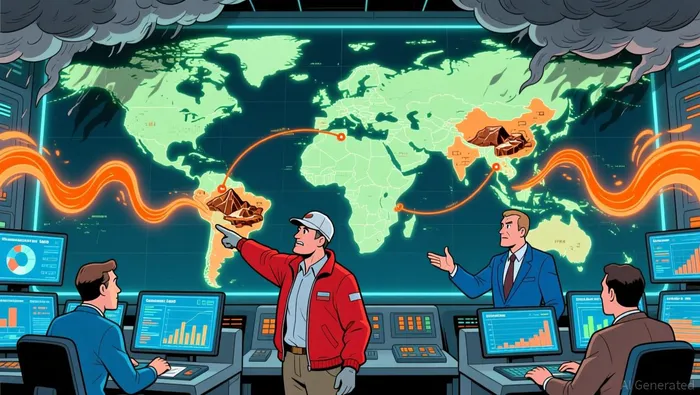
Structural Demand: The Energy Transition's Unstoppable Engine
While near-term risks dominate headlines, the long-term outlook for copper is anchored by its role in the global energy transition. The International Energy Agency (IEA) has emphasized copper's centrality to renewable energy systems, electric vehicles (EVs), and grid modernization, with demand from the U.S. and India emerging as key growth drivers. China, which accounts for 60% of global refined copper consumption, continues to prioritize green infrastructure and AI development under its 15th Five-Year Plan, despite a slowing property market.
India's trajectory is particularly striking. Analysts project it could overtake the.U.S. in copper consumption by 2050, driven by urbanization and renewable energy investments. Meanwhile, the U.S. has classified copper as a critical mineral, spurring domestic refining and smelting capacity to mitigate exposure to cross-border tariffs and supply chain disruptions. These structural trends suggest that even if short-term volatility subsides, demand fundamentals remain robust.
Balancing the Equation: Risk Mitigation in a Fragmented Market
Investors must weigh near-term volatility against long-term resilience. The immediate risks-geopolitical tensions, mine outages, and policy uncertainty-create a high-stakes environment where prices could swing sharply. For instance, a premature resolution of U.S. tariff threats or a surge in mine production could temper prices, while prolonged bottlenecks or new trade barriers could push them higher.
However, the structural underpinnings of demand are less susceptible to short-term fluctuations. J.P. Morgan forecasts a global refined copper deficit of 330,000 metric tons in 2026, driven by the energy transition and AI infrastructure growth. This deficit, combined with supply-side constraints like declining ore grades and lengthy mine development cycles, suggests a prolonged period of tightness. Investors who can tolerate near-term volatility may find compelling opportunities in copper's long-term narrative.
Conclusion: A Commodity at the Crossroads
Copper's 2025 trajectory reflects a market at a crossroads: short-term volatility driven by policy and supply shocks collides with long-term demand from the energy transition and industrialization. While near-term risks are significant, they are increasingly overshadowed by structural trends that position copper as a cornerstone of the 21st-century economy. For investors, the key lies in hedging against immediate uncertainties while capitalizing on the enduring fundamentals that will shape copper's value over the next decade.







Comentarios
Aún no hay comentarios