
Copper's Supply-Demand Imbalance: A Strategic Buy Opportunity in Mining Stocks
The global copper market is at a pivotal inflection point, driven by a confluence of industrial, technological, and geopolitical forces. As the backbone of the energy transition and digital infrastructure, copper is facing a structural supply deficit that is accelerating faster than anticipated. For investors, this imbalance-coupled with speculative inflows into mining equities-presents a compelling case for long-term strategic buying in copper producers.
A Looming Supply Deficit
The International Energy Agency (IEA) has warned that copper is on track for a 30% supply shortfall by 2035, a deficit rooted in declining ore grades, soaring capital costs, and protracted project development timelines. S&P Global underscores that bringing new copper supply online is becoming increasingly capital-intensive, with costs rising as the energy transition accelerates demand according to market intelligence. J.P. Morgan forecasts a refined copper deficit of ~330,000 metric tons in 2026, pushing prices potentially above $12,000 per metric ton. These trends are not cyclical but structural, as the industry struggles to match the exponential growth in demand.
Electrification and AI: Twin Engines of Demand
The energy transition and artificial intelligence (AI) infrastructure are the twin drivers of copper's surging demand. BloombergNEF estimates that energy transition-related copper demand could triple by 2045, with a structural shortfall of 19 million metric tons by 2050. Electrification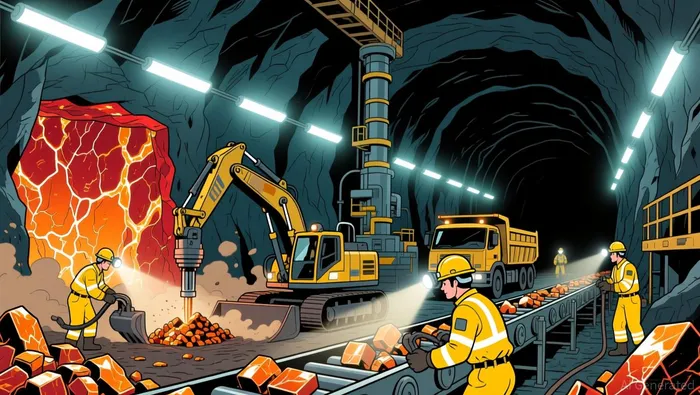 -spanning electric vehicles, grid expansion, and renewable energy systems-alone is expected to account for 70% of global copper demand growth by 2050 according to market analysis. Meanwhile, AI-driven infrastructure, particularly data centers, is emerging as a critical but underappreciated driver. A single hyperscale data center requires approximately 1,000 tons of copper, and global grid investment is projected to exceed $470 billion in 2025.
Geopolitical Shifts and Supply Chain Diversification
Geopolitical dynamics further complicate the outlook. China, which dominates midstream refining, faces scrutiny over its environmental practices and export policies. In response, the U.S., Europe, and Southeast Asia are prioritizing domestic production and circular economy strategies to reduce reliance on concentrated supply chains according to market research. The UK, for instance, aims to produce 10% of its critical minerals domestically by 2035 according to IEA warnings. Meanwhile, Trump-era trade policies, including tariffs on key partners, risk distorting market fundamentals. These shifts are pushing capital toward politically stable jurisdictions, particularly in Latin America, where companies like BHPBHP-- and Glencore are redirecting investments to projects in Argentina and Chile according to investment reports.
Speculative Inflows and Capital Expenditure Trends
Speculative demand for copper mining stocks has surged in 2025, driven by ETFs and institutional investors. The Sprott Junior Copper Miners ETF (COPJ) has surged 114.3% year-to-date, while the Global X Copper Miners ETF (COPX) holds $2.09 billion in assets under management according to market data. Institutional ownership of copper equities has also risen, with major miners like Freeport-McMoRanFCX-- and Southern CopperSCCO-- outperforming due to their production efficiency and strategic positioning according to market analysis. Capital expenditures in the sector reflect the urgency of addressing supply gaps: Glencore has committed $16 billion to projects in Argentina, while BHP is expanding operations in Argentina's Filo del Sol Vicuñium District according to investment reports.
A High-Conviction Investment Case
The interplay of tightening supply, multi-decade demand trajectories, and speculative inflows creates a high-conviction case for copper miners. Companies with advanced projects, low cash costs, and diversified geographies-such as Anglo American, BHP, and Glencore-are particularly well-positioned to capitalize on the coming decade of scarcity. For instance, Glencore's Q3 2025 production rose 36% quarter-on-quarter, driven by improved performance at key operations. Meanwhile, J.P. Morgan notes that corporate earnings in the sector have remained resilient despite trade tensions, underscoring the metal's inelastic demand.
Conclusion
Copper's role as the "new oil" of the 21st century is no longer a metaphor but a market reality. The structural supply deficit, compounded by electrification, AI, and geopolitical realignments, ensures that copper prices will remain anchored to a long-term upward trajectory. For investors, this is not merely a cyclical play but a strategic allocation to a commodity that underpins the global energy and digital transitions. As the IEA warns, failing to address the supply gap risks derailing net-zero goals. For now, the market is pricing in scarcity-and the best time to act was yesterday.





Comentarios
Aún no hay comentarios