
Copper's Stratospheric Price Rally: Tariffs, Arbitrage, and the Energy Transition Drive a New Bull Market
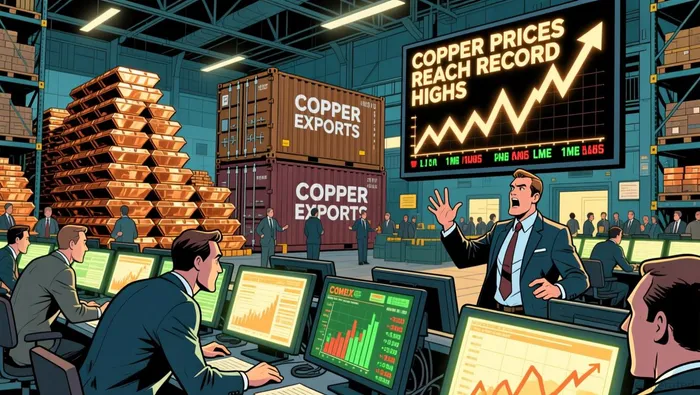
The copper market in 2025 has become a battleground of forces reshaping global commodity dynamics. A confluence of U.S. tariff policies, arbitrage-driven speculation, and the accelerating energy transition has propelled copper prices to record highs, creating a bull market with structural underpinnings. This analysis examines how these factors-both fundamental and speculative-are converging to redefine copper's role in the global economy.
Tariffs and Arbitrage: A Volatile Catalyst
The U.S. Section 232 tariffs, initially a source of uncertainty, have paradoxically become a catalyst for price volatility and speculative activity. In 2025, the exclusion of refined copper from these tariffs led to a 3.77% rise in U.S. prices and a 3.03% increase on the London Metal Exchange (LME), signaling synchronized global pricing. However, tariffs on semi-finished copper products created a 30% premium in COMEX prices over LME prices in July 2025, a gap that collapsed after tariff exemptions were clarified.
This volatility unlocked arbitrage opportunities of unprecedented scale. Traders exploited the $800–$2,000/mt price divergence between COMEX and LME markets, executing complex physical and futures trades to move copper across borders. Chinese smelters further capitalized on LME-Shanghai Futures Exchange differentials, exporting refined copper at a premium amid record-low domestic processing fees. These arbitrage strategies, fueled by supply disruptions like the Grasberg mine closure in Indonesia and operational issues in Chile, underscored the market's fragility and the role of speculation in amplifying price swings.
The Energy Transition: A Structural Tailwind
While short-term arbitrage and tariffs have driven immediate price spikes, the energy transition provides a durable foundation for copper's bull market. Copper's role in electrification-electric vehicles (EVs) contain four times more copper than internal combustion engines)-and AI-driven infrastructure expansion has created insatiable demand. J.P. Morgan forecasts a global refined copper deficit of ~330,000 metric tons in 2026, with prices potentially reaching $12,500/mt in Q2 2026.
The U.S., which imports 45% of its copper supply, faces a critical bottleneck: insufficient domestic smelting and refining capacity. Recycling, while a potential solution, requires time and investment to scale. Meanwhile, AI-driven data centers are emerging as an unpredictable but significant demand driver. Wood Mackenzie estimates that AI infrastructure could add 1.1 million metric tons of copper demand for grid infrastructure by 2030. These structural shifts, combined with mine supply constraints, suggest prolonged periods of high prices and volatility.
Speculative Momentum: A Double-Edged Sword
Speculative positioning in copper markets reflects a tug-of-war between caution and conviction. The latest Commitments of Traders (COT) report reveals that non-commercial speculators trimmed bullish bets after prices hit a two-year high in late 2025. Managed money accounts turned net sellers of copper, wary of macroeconomic headwinds and trade tensions. Yet, institutional demand-particularly from pension funds and sovereign wealth funds-has surged, driving futures trading volumes to historic levels.
Q3 2025 COT data highlights this duality: non-commercial traders increased net long positions for four consecutive weeks, signaling growing optimism. However, commodities funds struggled with -1.5% returns due to trade policy volatility. Open interest and futures positioning remain in a tight balance, with large speculators closely monitoring technical and fundamental signals. This tension between short-term caution and long-term bullish sentiment underscores copper's dual identity as both a cyclical commodity and a strategic asset in the energy transition.
Conclusion: A Bull Market with Structural Legs
Copper's stratospheric rally is not merely a function of tariffs or arbitrage-it is a reflection of a world reordering itself around decarbonization and digitalization. While speculative momentum may ebb and flow, the fundamentals are unambiguous: supply deficits, energy transition demand, and AI-driven infrastructure spending are creating a new normal for copper prices. Investors must navigate near-term uncertainties, such as U.S. tariff proposals adding $8.6 billion to import costs, while recognizing the long-term tailwinds. For those willing to look beyond the noise, copper offers a compelling case for a bull market with structural legs.







Comentarios
Aún no hay comentarios