
Copper's Record-Breaking Rally: A Strategic Case for Copper Miners in 2025-2026
The global copper market is undergoing a seismic shift, driven by a perfect storm of structural supply constraints and surging demand from the energy transition. Prices have surged to record highs, with the London Metal Exchange (LME) benchmark hitting $11,210.50 per ton on November 28, 2025, and projections suggesting further gains to $12,500/mt by mid-2026. This rally is not a fleeting anomaly but a reflection of deepening imbalances that will define the next decade of commodity markets. For investors, the implications are clear: copper miners are poised to capitalize on a tightening supply-demand gap, with strategic positioning and operational agility determining long-term success.
Structural Supply Constraints: A Perfect Storm
The current supply crisis is rooted in a confluence of factors. Mine closures and operational disruptions have crippled output. The Grasberg Block Cave mine in Indonesia, one of the world's largest copper operations, has been offline for months, while Chile's Quebrada Blanca mine faces prolonged technical challenges. These disruptions have exacerbated a slower-than-anticipated growth in global mine production, which is expected to rise by just 1.4% in 2026. Meanwhile, geopolitical tensions-such as U.S. tariff threats-have fragmented trade flows, creating a premium on COMEX copper prices relative to LME benchmarks.
China's role in the supply chain further underscores the fragility of the system. Treatment and refining charges (TCRCs) have plummeted to near zero, reflecting smelters' desperate competition for limited concentrate supplies. This bottleneck is not temporary; the International Energy Agency warns that without urgent investment in recycling infrastructure and new mine development, a structural deficit of 19 million metric tons could emerge by 2050.
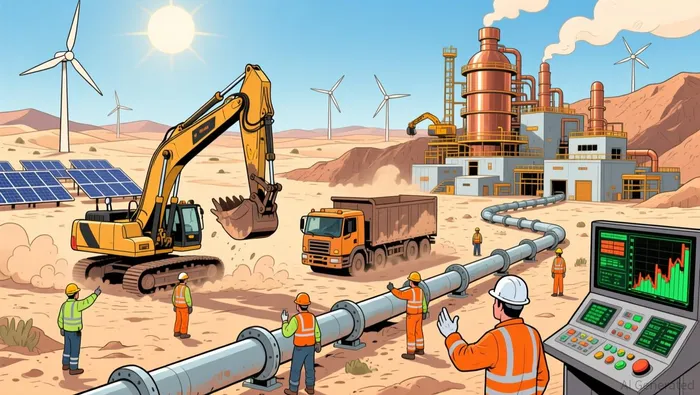
Demand Surge: The Energy Transition as a Tailwind
While supply constraints are acute, the demand side is equally compelling. The global energy transition is driving copper consumption at an unprecedented rate. Electric vehicles, renewable energy infrastructure, and data centers are now the dominant drivers of demand, with "green" applications growing seven times faster than traditional uses. The IEA estimates that copper demand will reach 28 million tons in 2025, a figure that could climb to 40 million tons by 2030 if electrification trends accelerate.
This surge is not limited to the private sector. Governments are increasingly treating copper as a strategic resource. The U.S. Inflation Reduction Act and the EU's Critical Raw Materials Act are incentivizing domestic processing and recycling, while China's push for self-sufficiency in green technologies is intensifying competition for raw materials. These policy shifts are reshaping global supply chains, creating both opportunities and risks for miners.
Copper Miners: Capitalizing on the Imbalance
The financial performance of copper miners in 2025 reflects their ability to navigate this volatile landscape. Companies with high-grade projects and infrastructure advantages are outperforming peers. Fitzroy Minerals, for instance, is advancing the Buen Retiro project in Chile, leveraging proximity to existing processing facilities to reduce capital expenditures. Similarly, Marimaca Copper has secured environmental approvals for its oxide project, positioning it to ramp up production as demand peaks.
South America remains the epicenter of the industry's transformation. Chile, the world's largest copper producer, is set to expand output by 3.6% in 2026, supported by $65.7 billion in planned investments. Argentina, under President Javier Milei, is attracting capital with tax incentives and constitutional protections for major projects like Glencore's El Pachón and Agua Rica deposits. These developments highlight a broader trend: miners are prioritizing regions with political stability and resource quality, even as they grapple with ESG pressures and energy costs.
Strategic Risks and Long-Term Outlook
Despite the bullish outlook, challenges persist. The average timeline from discovery to production now exceeds 16 years, a lag that could delay the market's ability to meet long-term demand. Additionally, environmental and social governance (ESG) scrutiny is intensifying, with communities and regulators demanding higher standards for mining operations. Logistical bottlenecks, such as port congestion and transportation delays, further complicate supply chains.
However, these risks also create differentiation. Miners that invest in sustainable practices, secure long-term power agreements, and build partnerships with local stakeholders are likely to outperform. For example, the Filo Copper project on the Chile-Argentina border aims to produce 75,000 metric tons annually by 2026 using efficient extraction technologies and sustainable development practices. Such initiatives not only address supply constraints but also align with global decarbonization goals.
Conclusion: A Compelling Investment Case
Copper's record-breaking rally is underpinned by structural forces that will persist for years. The combination of supply-side fragility, demand-side acceleration, and policy-driven reshaping of supply chains creates a unique investment opportunity. For copper miners, the key to success lies in strategic positioning: advancing near-term projects, securing high-grade discoveries, and aligning with the energy transition. Investors who recognize these dynamics early stand to benefit from a market that is not only tightening but also redefining the rules of global commodity trade.







Comentarios
Aún no hay comentarios