
Copper Price Volatility Amid US Tariff Uncertainty and Fed Rate Outlook: A Strategic Buy Opportunity?
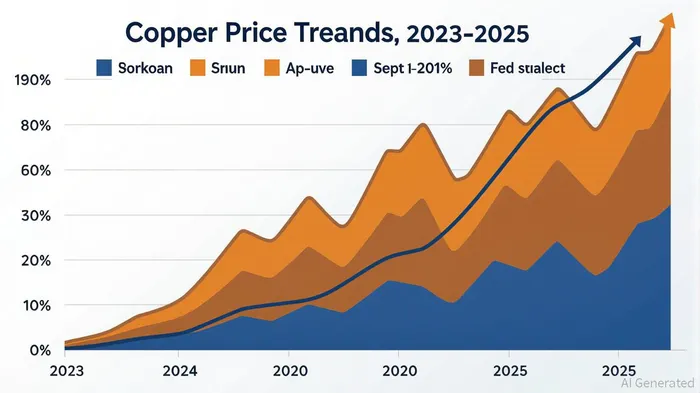
Copper is at a crossroads. The red metal, long a barometer of global economic health, is now caught in a perfect storm of structural supply constraints, surging demand from the energy transition, and a geopolitical tariff war that has sent shockwaves through markets. For investors, the question isn’t just whether copper will rise—it’s how to navigate the volatility and position for long-term gains.
Supply-Demand Imbalances: A Structural Crisis
The fundamentals are dire. According to the International Energy Agency, global copper demand will outstrip supply by 30% by 2035 if no action is taken [3]. This isn’t a cyclical blip—it’s a structural breakdown. Declining ore grades (down 40% since 1990) and mine development timelines averaging 16.3 years have left the industry scrambling to keep up with demand [6]. Meanwhile, the energy transition is accelerating: clean energy infrastructure investments hit $400 billion in 2025 alone, consuming 12.5 million tonnes of copper [4]. Electric vehicles (EVs) are compounding the strain, with demand for copper in EVs projected to reach 2.5 million tonnes by 2025—four times that of traditional vehicles [2].
China’s dominance in the supply chain adds another layer of complexity. The country accounts for 57% of global refined copper production by 2025, driven by strategic stockpiling and scrap processing [4]. Yet this concentration creates vulnerabilities, especially as environmental regulations tighten and geopolitical tensions simmer. Recycling, while critical (4.5 million tonnes of secondary refined copper in 2023 [1]), can’t bridge the gap alone.
Tariff Turbulence: A Double-Edged Sword
The US’s 50% tariff on copper imports, effective August 1, 2025, has been a game-changer. Announced by President Trump under Section 232, the tariff targets semi-finished products like wires and pipes but spares raw copper [4]. The market reacted instantly: COMEX copper futures surged 12% within minutes of the announcement, with prices hitting $5.69/lb on July 8 [3]. While the tariff aims to boost domestic production, the reality is more nuanced.
US copper firms like Southwire Co. and Cerro Wire have already raised prices by 5%, passing costs to consumers [4]. The US imports 44% of its refined copper, primarily from Chile, Canada, and Peru [3], and meaningful domestic production increases will take years. For now, the tariff has created a two-tiered market: US prices are surging ahead of global benchmarks, while downstream industries face inflationary pressures.
Fed Rate Outlook: A Tailwind or Headwind?
The Federal Reserve’s projected rate cuts in 2025 could provide a counterbalance. With the June FOMC projecting a median federal funds rate of 3.9% for 2025 and J.P. Morgan anticipating a 25-basis-point cut in September [2], the dollar is expected to weaken. Historically, Fed easing cycles have supported copper prices by 5–8% within three months of the first cut [2]. However, the physical market tells a mixed story. Chinese copper inventories dropped 16,300 metric tons week-over-week in Q3 2025, signaling tightening supply in the world’s largest consumer [1]. Meanwhile, Chinese wire and cable operating rates fell to 70.18% in June, reflecting cautious demand [1].
The key here is timing. While near-term volatility is inevitable, the Fed’s easing path—combined with potential Chinese stimulus and seasonal Q4 strength—could create a bullish tailwind.
Is Copper a Strategic Buy?
The answer hinges on risk tolerance. For long-term investors, the structural supply deficit and energy transition tailwinds make copper a compelling play. Prices are projected to hit $10,400–$11,000/tonne by 2026 [6], driven by tighter refined supply and structural demand growth. However, short-term volatility from tariffs, inventory fluctuations, and Fed policy remains a wildcard.
Actionable Takeaway: Position in copper ETFs or miners with strong recycling capabilities (e.g., companies leveraging secondary refined copper [5]). Avoid overexposure to US-based producers unless you’re prepared for near-term inflationary pressures.
Source
[1] Global Trade Update (May 2025): Focus on critical minerals [https://unctad.org/publication/global-trade-update-may-2025-critical-minerals-copper]
[2] US Fed Interest Rate Cuts: Impact on Copper Prices
https://discoveryalert.com.au/news/federal-reserve-interest-rate-copper-prices-2025/
[3] Demand for copper to dramatically outstrip supply within [https://www.theguardian.com/environment/2025/may/21/copper-supply-demand-analysis-international-energy-agency]
[4] Copper's Perfect Storm: Supply Constraints Collide with [https://www.cruxinvestor.com/posts/coppers-perfect-storm-supply-constraints-collide-with-structural-demand-in-a-critical-market-inflection]
[5] Copper Demand and Long-Term Availability [https://internationalcopper.org/sustainable-copper/about-copper/cu-demand-long-term-availability/]
[6] Copper Supply Constraints: Global Challenges & Solutions [https://discoveryalert.com.au/news/global-copper-supply-challenges-2025/]







Comentarios
Aún no hay comentarios