
Why Copper Is the Must-Owning Industrial Metal in 2026
In the ever-evolving landscape of industrial commodities, copper stands out as a rare combination of resilience and growth potential. As 2026 unfolds, a confluence of structural demand, tightening supply chains, and macroeconomic tailwinds positions copper as the most compelling industrial metal for investors. This analysis delves into the fundamentals driving copper's outperformance, contrasts it with bearish outlooks for other metals, and underscores why copper is a must-own asset in the coming year.
Goldman Sachs Upgrades Copper Forecast: A Signal of Structural Tightness
Goldman Sachs has recently raised its average LME copper price forecast for the first half of 2026 to $10,710 per metric ton, up from $10,415 previously according to a report. This upgrade reflects growing concerns over constrained mine supply growth and surging structural demand from grid and power infrastructure developments. While the bank cautions that copper's recent breakout above $11,000 per ton may not endure due to current global supply adequacy according to analysis, other analysts paint a more bullish picture. J.P. Morgan projects a global refined copper deficit of 330,000 tonnes in 2026, with an average price of $12,075 per ton for the year. These divergent views highlight a critical theme: while near-term volatility is likely, the long-term trajectory of copper is being reshaped by irreversible structural forces.
Structural Demand: Grid Infrastructure and the Energy Transition
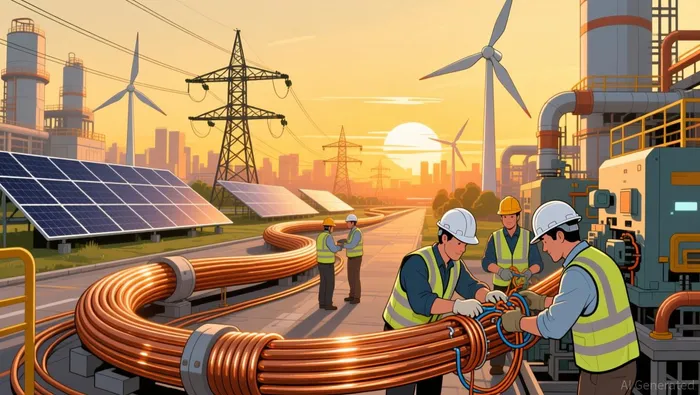
The energy transition is a primary driver of copper's outperformance. Copper is indispensable for grid modernization, renewable energy systems, and electric vehicles (EVs), with demand for the metal in these sectors growing at a compound annual rate of 10–15%. Goldman SachsGS-- and J.P. Morgan both emphasize that structural demand from grid infrastructure-particularly in the U.S.-is tightening the market. The U.S. consumes approximately 1.6 million tonnes of copper annually, but domestic production covers only 1.1 million tonnes, leaving a 30% reliance on imports according to market data. This vulnerability has been exacerbated by the 50% Section 232 tariffs on refined copper imports, which took effect in August 2025 according to analysis. These tariffs have not only driven COMEX premiums to record highs of $2,600 per tonne in July 2025 according to market reports but also triggered a stockpiling of copper cathode by U.S. importers ahead of the tariff deadline according to industry sources.
U.S. Tariffs and Global Market Dynamics
The U.S. Section 232 tariffs have created a unique arbitrage between the LME and COMEX markets, with U.S. prices trading at a significant premium to global benchmarks according to market analysis. This premium reflects both the direct cost of tariffs and the anticipated scarcity of refined copper in the ex-U.S. market. J.P. Morgan analysts note that mine disruptions at key operations like Indonesia's Grasberg and Chile's Quebrada Blanca have further tightened global flows according to research. Meanwhile, the U.S. has seen a sharp decline in copper scrap exports, which fell to a five-year low in early 2025 due to tariff uncertainty according to market data. These dynamics suggest that the U.S. market is becoming increasingly decoupled from global supply chains, amplifying price volatility and reinforcing copper's premium status.
Contrasting Bearish Outlooks for Aluminium, Lithium, and Iron Ore
Copper's strength is further highlighted by the bearish outlooks for other industrial metals. Goldman Sachs and Fastmarkets analysts project that aluminium, lithium, and iron ore will see price declines by Q4 2026 due to oversupply and robust production growth, particularly in Indonesia according to market analysis. For example, lithium's demand from EVs has plateaued as battery efficiency improves, while iron ore faces headwinds from slowing Chinese demand and a global shift toward green steel. These trends underscore copper's unique position: unlike its peers, it is not merely reacting to cyclical demand but is being pulled by structural, long-term growth drivers tied to decarbonization and infrastructure modernization.
Conclusion: Copper's Outperformance Is Fundamentally Justified
While short-term volatility remains a risk, the structural forces driving copper's demand-grid infrastructure, energy transition, and U.S. tariff-driven premiums-create a compelling case for long-term outperformance. With Goldman Sachs and J.P. Morgan forecasting prices to test $12,500 per tonne in Q2 2026, and supply constraints persisting well into 2029 according to analysis, copper is uniquely positioned to outperform other industrial metals. For investors, this is not just a commodity play-it is a bet on the backbone of the 21st-century economy.







Comentarios
Aún no hay comentarios