
Copper's Contradictions: Short-Term Pressures vs. Long-Term Bull Case
The copper market in 2025 is a study in paradoxes. On one hand, it grapples with acute short-term pressures-mine disruptions, geopolitical tensions, and volatile pricing-while on the other, it is underpinned by a robust long-term bull case driven by the energy transition, digitalization, and infrastructure modernization. For investors, navigating this duality requires a nuanced understanding of structural imbalances and strategic positioning to capitalize on both immediate opportunities and enduring trends.
Short-Term Pressures: A Perfect Storm of Supply Constraints
Copper prices have surged to record highs, reaching $5.20 per pound in December 2025, a 25.67% increase year-over-year. This volatility is fueled by a confluence of supply-side shocks. Mine disruptions, such as the fatal incident at Freeport-McMoRan's Grasberg mine in Indonesia and operational challenges in Chile and Peru, have slashed production, exacerbating a global deficit. J.P. Morgan Global Research projects a refined copper deficit of 330,000 metric tons in 2026, with prices averaging $12,075 per metric ton in 2026.
Geopolitical factors further complicate the landscape. According to analysis, U.S. tariffs on copper imports and shifting trade flows have fragmented markets, creating arbitrage opportunities and regional price premiums. For instance, the Israel-Iran conflict in 2025 triggered a 3-5% price swing, as the U.S. dollar's strength-often inversely correlated with copper-suppressed demand during periods of heightened uncertainty. These dynamics underscore the need for hedging strategies, such as futures contracts on the LME and COMEX, to mitigate exposure.
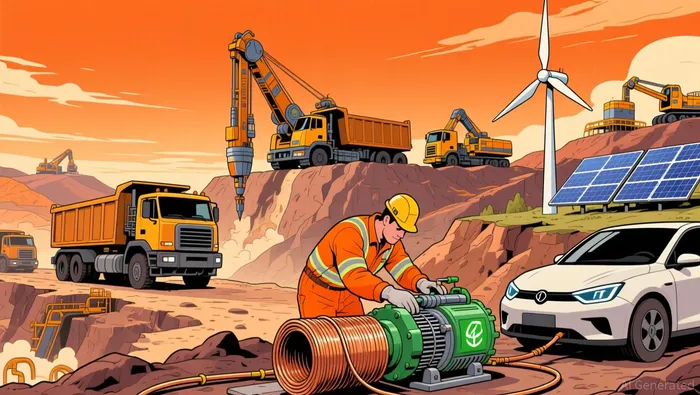
Long-Term Bull Case: The Energy Transition's Unstoppable Engine
While short-term headwinds persist, the long-term fundamentals for copper are compelling. By 2035, global demand is projected to rise to 42.7 million tonnes per annum, driven by electrification, digitalization, and infrastructure upgrades. Electric vehicles (EVs), which consume four times more copper than internal combustion vehicles, alone will account for 2.6 million tonnes of demand by 2035. Similarly, data centers-critical for AI infrastructure-are expected to drive an additional 1.1 million tonnes of copper consumption by 2030.
The energy transition is another megatrend amplifying copper's strategic value. Renewable energy projects, such as solar and wind farms, require significant copper inputs for grid infrastructure and energy storage systems. Meanwhile, defense spending in Europe, particularly for modernized power networks, is adding another layer of demand. Recycling is also gaining traction, with secondary refined copper accounting for 20% of global output in 2023, reducing reliance on primary supply.
Strategic Investment Opportunities: From Exploration to Circular Economy
Investors seeking to capitalize on copper's long-term potential must target high-conviction areas of the value chain. Advanced exploration projects, such as Marimaca Copper and Gladiator Metals, are attracting capital due to their high-grade deposits and efficient production models. Technology-driven mining operations, leveraging AI and satellite monitoring for resource mapping and environmental compliance, are also emerging as key players.
Recycling and circular economy initiatives present another avenue. With $250 billion in investment needed by 2030 to expand processing capacity, companies specializing in e-scrap recovery and urban mining are well-positioned to benefit. For example, secondary copper production is expected to grow as developing nations seek to reduce import dependence and ascend the value chain.
Risk Management: Diversification and Technological Resilience
Given the market's volatility, investors must adopt multifaceted risk management strategies. Hedging via futures and options-such as collars to set price floors and ceilings-can stabilize cash flows for producers and consumers. Diversifying supply chains across regions and forming strategic partnerships with stable producers are also critical to buffer against localized shocks.
Technological innovation further enhances resilience. AI-based risk prediction tools and satellite monitoring enable real-time oversight of environmental and operational risks, ensuring compliance with ESG standards. These tools also help identify bottlenecks in mine development, which typically take 25 years to reach production, allowing for proactive adjustments.
Conclusion: Positioning for a Copper-Centric Future
Copper's contradictions-short-term turbulence versus long-term growth-demand a balanced approach. While immediate supply constraints and geopolitical risks justify caution, the energy transition and digitalization ensure a structural bull case. Investors who strategically allocate to exploration, technology-driven mining, and recycling, while employing hedging and diversification, are poised to thrive in this dynamic market. As the world electrifies and decarbonizes, copper will remain an indispensable asset, bridging the gap between today's challenges and tomorrow's opportunities.





Comentarios
Aún no hay comentarios