
Copper's 2025 Surge: A Structural Bull Case or Policy-Driven Volatility?
The story of the CPERCPER-- ETF's stellar 2025 performance is a textbook case of policy-driven market mechanics. The fund's was not a reflection of broad market optimism but a direct, concentrated bet on a single, dramatic regulatory event. , but its engine was entirely different.
The primary catalyst was a sweeping trade policy shift. In July 2025, the administration announced a , effective August 1. This targeted a specific segment of the supply chain, focusing on semi-finished copper products like insulated wires and pipe fittings while excluding raw materials. The immediate market reaction was violent. , . This was a classic supply shock, as traders priced in immediate constraints and potential re-routing of global trade flows.
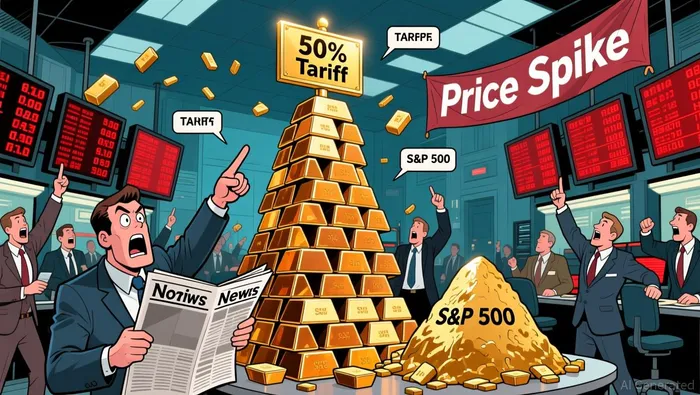
The bottom line is that CPER's performance was a tale of two drivers: a powerful, one-time policy shock and the underlying, structural demand for copper. The tariff created a massive, near-term price tailwind that the fund's futures-based strategy captured directly. Yet, the sustainability of that price, and thus the fund's future, now hinges on the second driver-the relentless physical demand from electric vehicles and AI infrastructure. For now, the policy shock has done its work, delivering a spectacular return that was entirely a product of a single, decisive government action.
The Structural Demand Engine: AI and Electrification
The recent surge in copper prices is not a speculative bubble but a direct reflection of two powerful, structural demand drivers that are fundamentally reshaping the metal's economic landscape. These are not cyclical trends; they are long-term, forces that create a durable floor for copper and justify strategic interventions like the 50% import tariff implemented in the U.S. last year. The first engine is the global electrification of transportation. Electric vehicles require approximately , a figure that is roughly four times higher than for traditional internal combustion engine cars. This copper intensity is driven by the need for motors, power electronics, and extensive wiring harnesses. As the world accelerates toward EV adoption, this creates a massive, recurring demand stream that is largely independent of short-term economic fluctuations.
The second, and perhaps more transformative, driver is the infrastructure buildout for artificial intelligence. Hyperscale data centers, the physical backbone of AI, have an insatiable appetite for copper. While a conventional data center uses between 5,000 and 15,000 tons of copper, a single hyperscale facility can require . This demand is for power distribution, cooling systems, and the dense cabling needed to connect thousands of servers. Crucially, this demand is largely price-inelastic. According to industry analysis, , making it a rounding error in a multi-billion dollar build. Developers will proceed regardless of copper's price, ensuring a steady, high-volume pull on the market.
Together, these forces are creating a supply-demand imbalance that analysts are calling acute. JPMorgan Global Research projects a global refined copper deficit of , a shortfall that is expected to persist. This structural tightness is the core rationale behind the tariff, which aims to protect domestic supply and pricing power. The bank's price forecast underscores the strength of this demand thesis, . The bottom line is that copper is no longer just an industrial commodity. It is becoming a foundational infrastructure metal for the energy transition and the digital economy, with demand that is both massive and remarkably resilient to price.
The Supply Chain Reality: Constraints and Costs
The strategic push to boost domestic copper production faces a stark reality: the United States is structurally constrained at every stage of the supply chain. The numbers reveal a fundamental imbalance. In 2024, the country consumed . This creates a massive shortfall, forcing a large share of mined ore to be exported for processing. The result is a supply chain that is both insufficient and inefficient, undermining the very security the tariffs aim to achieve.
This vulnerability is compounded by a severe cost disadvantage. U.S. copper producers operate at a significant economic penalty, . This gap is not marginal; it is a structural headwind that makes domestic production less competitive. The problem is rooted in the quality of domestic resources, . This low-grade ore requires more energy and processing to extract the same amount of metal, directly inflating costs.
The pressure is now crushing the midstream segment of the supply chain. The economics of domestic smelting have collapsed, . At these levels, smelters are operating at a loss, continuing production only to keep facilities viable. This severe economic pressure makes the prospect of building new domestic smelting capacity appear nearly impossible. The capital required for such projects is immense, and the current market offers no clear path to profitability. In this environment, tariffs may provide a political signal, but they do not solve the deep-seated cost and capacity bottlenecks that limit the U.S. supply response. The path to self-sufficiency is blocked by a combination of high input costs, low resource quality, and a smelting sector in distress.
The Policy Crosscurrent: Tariff Uncertainty and Market Dislocation
The macro risk to copper prices is now defined by a profound legal and political uncertainty. At its core is a 50% tariff on semi-finished copper products, a move that has already reshaped market structure. Yet the very foundation of this policy is under judicial review. The U.S. Supreme Court is evaluating the legality of President Trump's decision to impose these sweeping tariffs under the (IEEPA), with a ruling expected in early 2026. This pending decision creates a state of suspended animation for the market, where the future of a major trade policy hangs in the balance.
This uncertainty has already generated a bifurcated market. U.S. copper prices have consistently traded at a premium to the London Metal Exchange (LME) benchmark, a direct reflection of tariff expectations. The market is pricing in the probability of implementation, creating a sustained arbitrage opportunity. This geographic split has driven a physical redistribution of supply, with world surplus copper gravitating toward the United States. As a result, CME-registered copper inventories have climbed to multi-year highs, lifting U.S. .
The bottom line is a potential future glut. The current inventory build-up is a direct response to tariff anticipation, but it creates a precarious supply situation. If the Supreme Court ultimately revokes the IEEPA tariffs, the U.S. would face a sudden surplus of metal that has been stockpiled for a policy that may not materialize. This could trigger a sharp re-export of copper back into global markets, disrupting trade flows and pressuring prices worldwide. Even if the tariffs are upheld, the policy's exclusion of raw copper materials-intended to shield domestic manufacturers-means the U.S. is not expected to significantly ramp up mining in the short term. The resulting inventory pile-up, therefore, represents a structural vulnerability that could amplify price volatility when the policy uncertainty resolves.
The Investor Takeaway: Navigating the Copper Trade
For investors considering exposure to copper, the United States Copper ETFCPER-- (CPER) offers a straightforward, rules-based vehicle. . Instead, the fund's returns will diverge based on the shape of the futures curve, a dynamic that investors must actively monitor. The fund's unique roll methodology aims to maximize backwardation, but its actual outcome depends on whether the market is in contango or backwardation at the time of contract rollover. This structural feature turns CPER into a bet on the curve's behavior, not just the metal's price.
The primary macro driver for copper remains trade policy, and the legal status of the 50% import tariff is the single most important variable to watch. The U.S. Supreme Court is evaluating the legality of the administration's use of the International Economic Emergency Powers Act (IEEPA) to impose these duties, with a ruling expected in early 2026. A decision to revoke the tariffs could trigger a significant reset in the supply constraint narrative, potentially leading to short-term volatility as the market recalibrates. Even if tariffs are upheld, the ruling's outcome will signal the durability of this key policy support for copper prices.
Beyond the legal overhang, investors should track physical market signals for signs of tightening supply. Monthly London Metal Exchange (LME) copper inventory levels are a critical gauge. Persistent declines would indicate a genuine physical shortage, providing a fundamental floor for prices. Equally important is the CME-LME price spread, which has been a key arbiter of tariff expectations. A widening premium on the U.S. CME contract signals that market participants are pricing in a higher probability of tariff implementation, while a narrowing spread suggests the policy overhang is lifting. Monitoring these two metrics together provides a clearer picture of whether price moves are driven by real supply tightness or speculative positioning on policy risk.





Comentarios
Aún no hay comentarios