
COP30 and the Green Bond Revolution: Catalyzing Renewable Energy Finance or Stalling the Transition?
The 2025 COP30 summit in Belém, Brazil, has emerged as a pivotal moment for global climate finance, with renewable energy infrastructure and green bonds at the center of debates. While the summit has catalyzed record pledges-$1.6 trillion in renewable energy finance commitments, with $284 billion already mobilized, according to a UN DESA report-it also faces mounting scrutiny over whether these promises will translate into scalable, equitable, and credible market mechanisms. For investors, the interplay between COP30's policy frameworks and the green bond market's evolution presents both unprecedented opportunities and critical risks.
COP30's Momentum: Policy Alignment and Market Growth
The Energy Compacts initiative, a cornerstone of COP30, has galvanized public and private actors to accelerate renewable energy deployment. With 72% of countries setting quantified renewable energy targets, according to the E3G tracker, and 32 nations accounting for 21% of global emissions updating their Nationally Determined Contributions, per a UN press release, the stage is set for a surge in infrastructure financing. This aligns with the green bond market's trajectory: by 2024, the market had ballooned to $2.9 trillion in capitalization, with annual issuance hitting $700 billion, according to a BIS analysis. For 2025, forecasts predict $620 billion in green bond issuance, driven by policy tailwinds like the EU's Green Bond Standard and the U.S. Inflation Reduction Act, as outlined by Environmental Finance.
COP30's emphasis on public-private collaboration is particularly noteworthy. A private-sector coalition has pledged to scale investments in renewable energy, contingent on policy clarity and risk-mitigation tools. This synergy between regulatory frameworks and market demand is critical. For instance, the EU's Fit for 55 package-aiming to reduce emissions by 55% by 2030-has already reshaped energy infrastructure financing by expanding the Emissions Trading System (ETS) and incentivizing alternative fuels. Such policies not only reduce the cost of capital for renewables but also create predictable pipelines for green bond investors.
Challenges: Greenwashing, Fragmentation, and Fossil Fuel Lock-In
Despite this momentum, COP30's green bond agenda faces three major hurdles. First, greenwashing remains rampant. While green bond issuance surpassed $3 trillion cumulatively in 2024, warns an IEEFA briefing, inconsistent definitions of "green" across jurisdictions undermine credibility. The EU's new Green Bond Standard (EuGB), requiring 85% of proceeds to align with the EU Taxonomy, is a step forward, but its voluntary nature and transitional phase until 2026 leave room for ambiguity, according to a Compliance Corylated report. Developing economies, in particular, struggle with verification costs and data gaps, risking exclusion from the global green finance ecosystem, as summarized in the Boell guide.
Second, high costs for emerging technologies threaten to stall progress. Breakthrough decarbonization projects-such as green hydrogen and carbon capture-require upfront capital that exceeds current market appetites. According to the World Economic Forum, these technologies remain underfunded due to commercial risks and the lack of scalable offtake agreements covering 75–80% of production capacity. Without COP30-driven policy interventions (e.g., tax incentives, public guarantees), private investors may shy away from these high-risk, high-reward ventures.
Third, fossil fuel lock-in persists in climate finance. Critics argue that COP30's New Collective Quantified Goal (NCQG) lacks enforceable mechanisms to phase out coal and oil, despite its focus on tripling renewable capacity by 2030, according to a Fletcher Tufts analysis. This duality risks diverting green bond capital toward transitional technologies rather than deep decarbonization. For example, while blue bonds (focused on ocean resilience) are gaining traction in a CPI bulletin, their alignment with broader climate goals remains contested.
The Path Forward: COP30 as a Catalyst or a Stumbling Block?
COP30's success in catalyzing green bond markets will hinge on three outcomes:
1. Standardization: Harmonizing green bond definitions and reporting frameworks, particularly through the EuGB and Climate Bonds Initiative standards, as highlighted in Moody's outlook.
2. Equity: Ensuring developing nations have access to low-cost financing and technical assistance to meet COP30's renewable targets, argues Climate Change News.
3. Accountability: Establishing transparent monitoring systems to prevent greenwashing and ensure that pledged funds reach on-the-ground projects, a point made in a WEF commentary.
For investors, the stakes are clear. If COP30 delivers on these fronts, green bonds could dominate the $1 trillion sustainable finance market in 2025, according to a BNP Paribas analysis, with APAC and Latin America emerging as growth hubs. However, if the summit fails to address fragmentation and fossil fuel subsidies, the market risks stagnation. As Moody's notes, social and transition bonds may struggle without robust policy signals, leaving green bonds as the sole reliable segment.
Conclusion
COP30 represents a make-or-break moment for renewable energy infrastructure financing. While the $1.6 trillion in pledges and the $620 billion green bond forecast for 2025 signal optimism, the path to a just transition remains fraught with challenges. Investors must navigate a landscape where policy alignment and market innovation are equally critical. For now, the world watches Belém, where the fate of climate finance-and the green bond market-may be decided.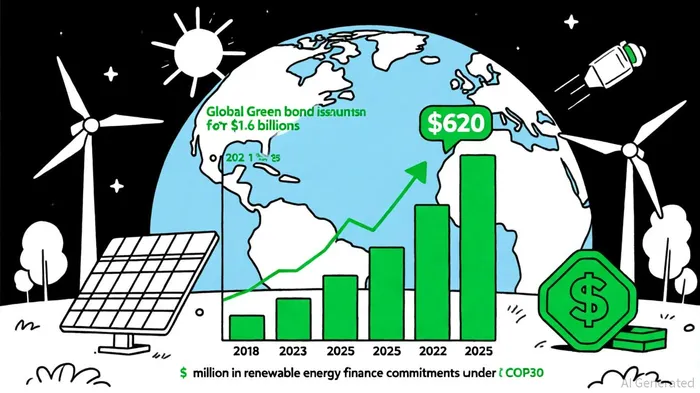







Comentarios
Aún no hay comentarios