
Mr. Cooper Group Inc.'s Exit from the S&P 1000: Implications for Mid-Cap Financial Sector Exposure and Risk Diversification
The recent removal of Mr. Cooper Group Inc. (COOP) from the S&P 1000 index marks a pivotal moment for investors seeking exposure to mid-cap financial sector equities. This development, driven by the company's impending acquisition by Rocket CompaniesRKT--, Inc. in a $9.4 billion all-stock transaction, is detailed in an S&P Global CreditWatch notice and underscores broader implications for portfolio diversification and index composition. As COOP transitions from an independent entity to a subsidiary of a larger conglomerate, its absence from the S&P 1000 raises questions about the evolving landscape of mid-cap financials and the strategies investors must adopt to mitigate risk.
Background: COOP's Market Cap Trajectory and Index Inclusion
Mr. Cooper Group Inc. had experienced significant growth prior to its acquisition announcement. As of October 2025, its market capitalization stood at $13.49 billion, according to Wall Street Numbers, a 130% increase from its 2023 valuation of $4.17 billion, according to MarketCap data. This growth trajectory positioned COOP as a key player in the mortgage banking sector, with strategic acquisitions-such as Flagstar Bank's mortgage operations-bolstering its operational scale. Despite its rising valuation, COOP remained a constituent of the S&P Small-Cap 600 Index, where it held a 0.61% weight. However, its removal from the S&P 1000 index in 2025 was directly tied to the acquisition by Rocket Companies, which triggered a reclassification of its market capitalization and operational structure, as noted by S&P Global Ratings.
Implications for Mid-Cap Financial Sector Exposure
The S&P 1000 index, which combines the S&P 500 and S&P 400 MidCap indices, serves as a critical benchmark for investors targeting mid-cap equities. COOP's removal highlights a structural shift in the index's composition, as its acquisition by Rocket Companies effectively transformed it into a component of a larger, diversified entity. This transition reduces the availability of high-growth mid-cap financials within the index, potentially limiting investors' access to companies with strong earnings momentum and sector-specific expertise.
For context, COOP's pre-acquisition market cap of $13.49 billion exceeded the typical S&P 400 MidCap threshold, suggesting it may have been reclassified as a large-cap stock. However, the acquisition's all-stock structure and the merged entity's anticipated credit profile-upgraded to CreditWatch positive by S&P Global Ratings-indicate a strategic realignment that prioritizes scale over mid-cap agility. This shift challenges investors to identify alternative mid-cap financials that balance growth potential with risk-adjusted returns.
Risk Diversification Considerations
The removal of COOP from the S&P 1000 also has implications for risk diversification. Mid-cap financials often provide a hedge against macroeconomic volatility due to their sector-specific exposure and operational flexibility. COOP's absence necessitates a reassessment of portfolio allocations, particularly for investors relying on the S&P 1000 as a proxy for diversified financial sector exposure.
One potential strategy involves increasing allocations to smaller, high-growth mortgage lenders or fintech firms that align with COOP's former business model. For example, companies like U.S. Bancorp or Discover Financial Services, which maintain robust mid-cap classifications and complementary risk profiles, could serve as viable substitutes. Additionally, investors might consider broadening their geographic or product diversification within the financial sector to offset the loss of a mortgage-focused player like COOP.
Conclusion
Mr. Cooper Group Inc.'s exit from the S&P 1000 index reflects the dynamic nature of financial sector consolidation and its impact on index-based investing. While the company's acquisition by Rocket Companies signals a new chapter for its credit profile and operational scale, it also underscores the need for investors to proactively adapt their mid-cap strategies. By scrutinizing alternative mid-cap financials and diversifying across sector subcategories, investors can navigate the evolving landscape while maintaining exposure to high-growth opportunities.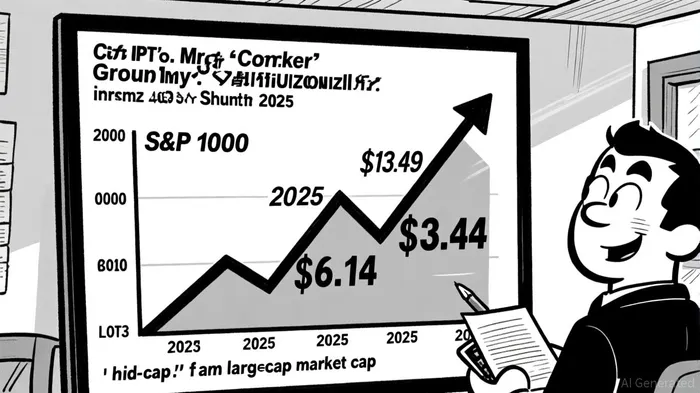





Comentarios
Aún no hay comentarios