
COOP's Deteriorating Fundamentals and Elevated Risk Profile: A Case for Proactive Risk Mitigation
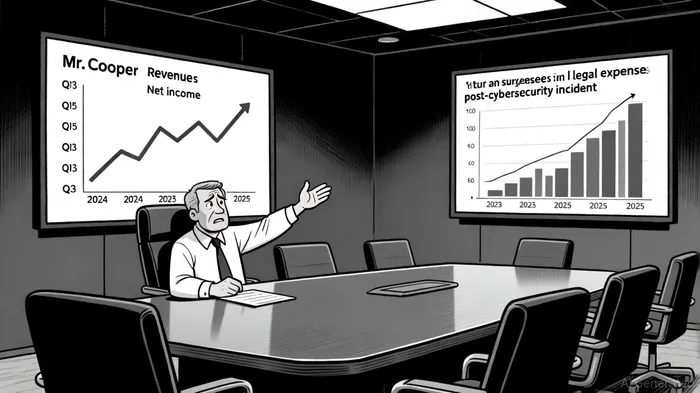
The mortgage servicing giant Mr. Cooper Group Inc. (COOP) has become a cautionary tale in risk management, with deteriorating fundamentals and compounding risks threatening its long-term viability. While the company's core servicing portfolio has expanded to $1.51 trillion in unpaid principal balance (UPB) as of Q2 2025 [2], its profitability has faltered due to a confluence of operational, regulatory, and strategic challenges. For investors, the case for proactive risk mitigation and portfolio rebalancing is compelling, given the elevated exposure to cybersecurity liabilities, integration complexities in its pending acquisition, and volatile earnings dynamics.
Earnings Volatility and Profitability Pressures
Mr. Cooper's Q2 2025 results underscored a troubling trend: revenue exceeded forecasts at $681 million, yet earnings per share (EPS) fell short at $3.04 versus $3.24 expected [1]. This divergence reflects the company's struggle to convert top-line growth into bottom-line gains. Net income for the first half of 2025 plummeted 26% year-over-year to $286 million, driven by mark-to-market losses on mortgage servicing rights (MSRs) and escalating legal costs tied to the October 2023 cybersecurity incident [2].
The incident, which exposed sensitive data of 14.7 million customers, has had a lingering financial impact. Legal-related expenses surged 178% to $25 million for H1 2025, with management warning of an additional $7 million to $15 million in potential losses beyond current reserves [3]. These costs, coupled with $25 million in vendor expenses for response and identity protection services [1], have eroded margins and created uncertainty for investors.
Historical backtesting of COOP's earnings release performance from 2022 to 2025 reveals limited predictive power for post-earnings price movements. Over this period, the stock exhibited only mild, statistically insignificant drift, with cumulative excess returns averaging -3 percentage points (pp) at day 5 versus the benchmark, recovering to +2.7 pp by day 30. Win rates oscillated around 50%, offering no directional edge, while volatility remained modest, with no single post-earnings window delivering outsized gains or losses. These findings suggest that earnings surprises, while material to short-term sentiment, have historically failed to establish durable trends in COOP's valuation.
Strategic Uncertainty and Integration Risks
The pending $9.4 billion all-stock acquisition by Rocket Companies, while offering a 35% premium for COOPCOOP-- shareholders, introduces new layers of risk. Rocket's plan to consolidate Nationstar Mortgage's assets into Rocket Mortgage, LLC, hinges on a complex reorganization that could strain operational and IT systems [5]. Analysts caution that aligning risk management frameworks and client servicing platforms across a $2.1 trillion combined portfolio may delay synergies and inflate integration costs [2].
Regulatory scrutiny also looms large. Rocket's growing dominance in the mortgage sector—bolstered by its acquisition of Redfin—has drawn attention from the Consumer Financial Protection Bureau (CFPB). Any missteps in compliance or customer service during the integration could trigger penalties or reputational damage, further complicating the path to projected $500 million in annual cost savings [2].
Proactive Risk Mitigation: A Prudent Path Forward
Given these risks, investors should prioritize portfolio rebalancing to limit exposure to COOP's volatile trajectory. Key considerations include:
1. Reducing Position Size: The cybersecurity incident and integration uncertainties justify a lower weight in COOP within a diversified portfolio. The stock's 4.36% premarket surge post-Q2 earnings [1] may reflect optimism about the acquisition, but fundamentals remain fragile.
2. Hedging Against Legal Liabilities: With unresolved litigation and potential fines from the breach, options strategies or insurance-linked securities could mitigate downside risks.
3. Monitoring Regulatory Developments: CFPB actions or changes in mortgage servicing regulations could amplify volatility, necessitating close tracking of policy shifts.
For long-term investors, the broader mortgage sector's concentration risks—exacerbated by Rocket's impending market share—warrant caution. While the acquisition promises scale, the path to realizing synergies is fraught with operational and regulatory hurdles.
Conclusion
Mr. Cooper's Q3 2025 earnings, which showed adjusted EPS of $2.84 (beating estimates) but revenue of $424 million (missing forecasts) [4], highlight the company's inconsistent performance. Amid a backdrop of cybersecurity fallout, integration challenges, and regulatory scrutiny, the case for proactive risk mitigation is clear. Investors should reassess their COOP exposure, favoring defensive allocations or alternative mortgage sector plays with stronger risk management frameworks. In an era where operational resilience defines long-term success, COOP's current trajectory offers little margin for error.





Comentarios
Aún no hay comentarios