
The Cooling U.S. Labor Market and Its Implications for Equities and Central Bank Policy
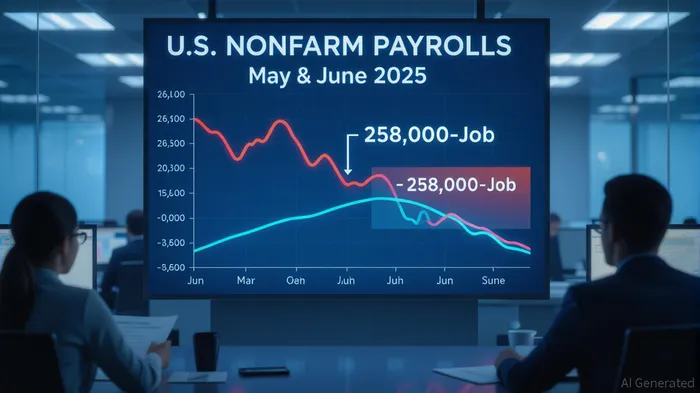
The U.S. labor market, once a pillar of economic resilience, has shown signs of cooling in the third quarter of 2025. The June nonfarm payrolls report, initially celebrated for adding 147,000 jobs, was later revised downward to 14,000—a staggering 133,000 reduction. When paired with a similar downward revision for May (from +144,000 to +19,000), the combined adjustment of 258,000 jobs underscores a labor market that may be weakening faster than initially perceived. This shift has profound implications for equity markets and central bank policy, particularly as the Federal Reserve grapples with whether to pause rate hikes or pivot to cuts.
Labor Market Revisions and the Fed's Dilemma
The June labor market data revealed a paradox: while the headline unemployment rate fell to 4.1%—its lowest since February—the labor force participation rate dropped to 62.3%, the lowest since late 2022. This divergence highlights a shrinking workforce, as 329,000 individuals exited the labor force in June alone. The household survey further complicated the picture, showing a mere 93,000 employment gain, with 234,000 more people classified as “not in the labor force.”
Such mixed signals have forced the Federal Reserve into a cautious stance. While the central bank has ruled out a July rate cut, markets now price in a September reduction, with expectations of only two cuts in 2025 instead of three. The Fed's dilemma lies in balancing the risk of inflationary pressures—core CPI remains stubbornly above 2%—against the growing fragility of the labor market. With downward revisions eroding confidence in the data, the Fed is likely to adopt a “wait-and-see” approach, prolonging its pause in rate hikes.
Sector Rotation: From Growth to Resilience
The cooling labor market has reshaped sector dynamics, favoring industries with pricing power and defensive characteristics. The healthcare and social assistance sectors have emerged as bright spots, adding 73,000 jobs in June alone. This trend, driven by an aging population and rising demand for medical services, has bolstered equities in these spaces. Conversely, manufacturing and federal government employment have contracted, with the latter shedding 7,000 jobs due to administrative cuts.
Investors are increasingly rotating into sectors poised to benefit from a potential Fed rate cut. Rate-sensitive industries like industrials and consumer discretionary are gaining traction as yield curves flatten and borrowing costs stabilize. For example, companies in the industrial sector, which rely on low interest rates to finance capital expenditures, could see improved margins as the Fed pivots. Similarly, consumer discretionary stocks—often sensitive to household spending—are set to benefit from a potential boost in consumer confidence if rate cuts materialize.
However, the AI and cloud sectors remain the standout performers. Firms like MicrosoftMSFT-- (MSFT), Alphabet (GOOGL), and AmazonAMZN-- (AMZN) continue to dominate earnings growth, with the S&P 500's tech sector projected to deliver 17.7% growth in Q2 2025. These companies are not just riding the AI wave; they are reshaping global infrastructure, making them essential holdings for long-term portfolios.
Positioning for a Fed Pause: Value vs. Growth
The cooling labor market has also reignited the debate between value and growth stocks. The Russell 1000 Value Index has outperformed its growth counterpart by 35% to 50% in risk-adjusted returns over the past year. This shift reflects value stocks' stronger ties to industrial production, which is rebounding as global trade policies stabilize. In contrast, growth stocks—particularly those in the information technology and professional services sectors—have underperformed due to their sensitivity to rising trade barriers and higher borrowing costs.
Small-cap stocks, meanwhile, have shown surprising resilience. The Russell 2000 Index, which tracks the smallest 1,000 U.S. companies, has outperformed the S&P 500 by 11 percentage points since early April. This outperformance is tied to small-cap firms' exposure to domestic demand and their agility in adapting to macroeconomic shifts. However, investors should remain cautious: small-cap equities are more volatile and could face headwinds if the labor market deteriorates further.
Hedging Against Policy Uncertainty
The Federal Reserve's prolonged pause has created a high-uncertainty environment, necessitating a hedging strategy. Short-term Treasuries and high-quality dividend stocks have gained favor as investors seek safe havens amid rate volatility. Additionally, gold and defensive sectors like utilities have seen inflows, though the latter's stretched valuations warrant caution.
For those with a longer time horizon, the AI and cloud sectors offer compelling opportunities. These industries are not only insulated from near-term rate fluctuations but are also driving a fundamental shift in global economic activity. Meanwhile, sectors like manufacturing and government services—hard hit by policy uncertainty and trade tensions—remain underperformers, with apparel and appliances particularly vulnerable to tariffs.
Conclusion: Balancing Caution and Opportunity
The U.S. labor market's cooling and the Fed's policy uncertainty have created a complex landscape for investors. While the risk of a sharper slowdown persists, the strong corporate financial health and the potential for a Fed pivot in September offer a path forward. Investors should prioritize sectors with pricing power and resilience—healthcare, industrials, and AI-driven tech—while hedging against volatility with high-quality assets.
As the Fed inches closer to a rate-cutting cycle, positioning for rate-sensitive sectors and small-cap equities could prove lucrative. However, the key to success lies in agility: adapting to shifting data and policy signals will be critical in navigating the uncertain months ahead.







Comentarios
Aún no hay comentarios