
Converging Cryptographic Innovation: ZK Proofs, FHE, and the Future of Secure Blockchain Applications
The Rise of ZKPs in DeFi and Secure Voting
Zero-Knowledge Proofs have emerged as a cornerstone of blockchain scalability and privacy. In 2025, DeFi platforms leveraging ZKP-based layer-2 solutions like zkSync and StarkNet have reduced gasGAS-- fees by over 70% while increasing transaction throughput to 10,000+ transactions per second, according to a Cardano Sees 28% DeFi TVL Growth to 3-Year Peak, 42% Rise in Market Cap in Q3 2025 analysis. This has enabled institutions to interact with public blockchains like EthereumETH-- without compromising data confidentiality, a critical factor for banks and asset managers navigating compliance frameworks, as noted in an LCPC AI Launches Global Strategy to Integrate Blockchain and AI for Trusted Infrastructure report.
Secure voting systems are another high-impact use case. Pilots in EU elections have demonstrated ZKP's ability to ensure private, verifiable, and tamper-resistant voting, with Vitalik Buterin emphasizing that ZKP alone cannot fully address post-quantum security or coercion resistance in such scenarios, as Lookonchain reported. This underscores the need for hybrid cryptographic architectures.
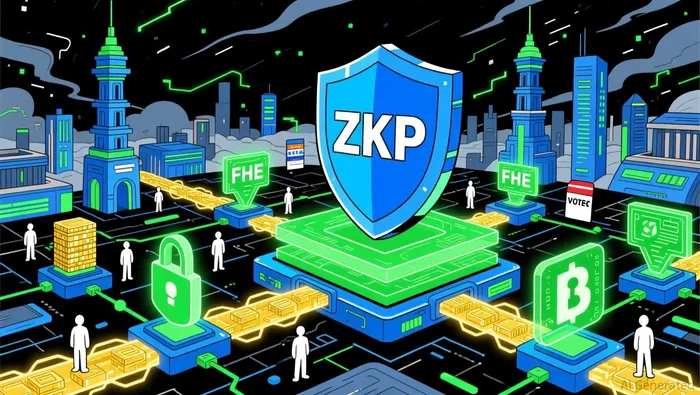
FHE: The Missing Layer for Post-Quantum Resilience
Fully Homomorphic Encryption (FHE) complements ZKP by enabling computations on encrypted data without decryption, a feature critical for post-quantum security. According to a Lookonchain report, FHE integration is essential for applications like secure voting, where non-coercion resistance and data integrity must persist even under quantum threats. While ZKP ensures transaction privacy, FHE adds an additional layer of resilience, creating a "layered security model" where breaches in one component do not compromise the entire system, as Lookonchain noted.
Cardano's Halo2-Plutus verifier exemplifies this synergy, allowing on-chain ZKP verification while abstracting sensitive data, as Cardano Sees 28% DeFi TVL Growth to 3-Year Peak, 42% Rise in Market Cap in Q3 2025 reported. Though FHE adoption remains nascent, its combination with ZKP is already attracting institutional interest, particularly in cross-border payments and identity verification.
Strategic Investment Opportunities in ZKP-FHE Infrastructure
The ZKP market is projected to reach $25 billion by 2027, driven by infrastructure developments such as specialized hardware for ZKP processing and AI integration for encrypted computations, according to a Cardano Sees 28% DeFi TVL Growth to 3-Year Peak, 42% Rise in Market Cap in Q3 2025 analysis. Projects that combine ZKP and FHE are poised to capture significant value, particularly in sectors requiring regulatory compliance and quantum resilience.
Cardano (ADA) has emerged as a leading ecosystem for ZKP-FHE integration. In Q3 2025, its DeFi TVL surged by 28.7%, driven by protocols like Liqwid and Minswap, while its market cap rose 42.5% to $29.5 billion, as Cardano Sees 28% DeFi TVL Growth to 3-Year Peak, 42% Rise in Market Cap in Q3 2025 reported. The launch of the Cardano Card-a partnership with Wirex-further demonstrates real-world adoption, enabling users to spend ADAADA-- and access DeFi utilities like yield farming and loans, as EMURGO and Wirex Partner to Launch the First-Ever Cardano Card at the Cardano Summit 2025, Bringing ADA to Millions Worldwide detailed. This initiative, coupled with Cardano's Voltaire governance upgrades, positions it as a strategic play for investors targeting scalable, privacy-preserving infrastructure.
Meanwhile, Remittix (RTX) and DigiTap ($TAP) are innovating in cross-border payments and digital banking, though their ZKP-FHE integration remains unproven. Remittix's $28.1 million in private funding and CertiK verification highlight its potential to bridge crypto and traditional finance, as Cryptopolitan noted.
Funding Trends and Institutional Adoption
Despite a 20-30% decline in crypto VC funding in 2025, projects addressing foundational needs like stablecoins and secure infrastructure continue to attract capital, as Coinotag reported. For instance, Telcoin and Hercle raised $100 million collectively, reflecting a shift toward resilient solutions, as Coinotag reported. Investors should prioritize projects with clear partnerships, real-world use cases (e.g., Cardano's EU voting pilots), and technical roadmaps for FHE integration.
Conclusion: Building the Next-Generation Blockchain Stack
The convergence of ZKP and FHE represents a tectonic shift in blockchain infrastructure, enabling secure, scalable, and quantum-resistant applications. While explicit ZKP-FHE projects remain rare, ecosystems like CardanoADA-- are laying the groundwork for mass adoption through hybrid cryptographic models and institutional partnerships. For investors, the key is to focus on projects with:
1. Proven ZKP adoption (e.g., zkSyncZK--, StarkNetSTRK--, Cardano).
2. FHE roadmap clarity (e.g., post-quantum upgrades, encrypted computation tools).
3. Real-world utility (e.g., EMURGO-Wirex, secure voting pilots).
As the market matures, early movers in this space will define the next era of decentralized finance and governance.






Comentarios
Aún no hay comentarios