
The Convergence of Tokenization and AI in Hollywood: A New Era for Media Assets
The entertainment industry is on the cusp of a transformative shift, driven by the intersection of blockchain-based tokenization and artificial intelligence (AI). As Hollywood grapples with evolving production models and financing paradigms, two forces-tokenized media assets and AI-driven workflows-are converging to redefine value creation, liquidity, and creative control. For investors, this represents a pivotal opportunity to capitalize on a $19.36 billion tokenized real-world asset (RWA) market according to market data and a Hollywood AI ecosystem projected to accelerate in 2026 according to industry analysis.
Tokenization: Unlocking Liquidity in Hollywood's Illiquid Assets
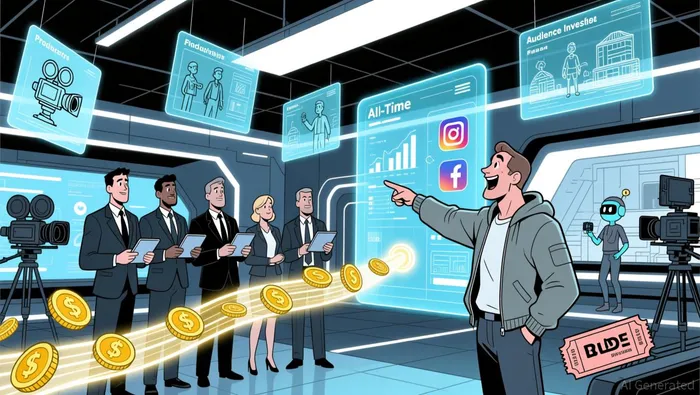
Tokenization is dismantling traditional barriers to liquidity in media assets, enabling fractional ownership and democratized access to high-value projects. Platforms like RWA.xyz report that tokenized U.S. Treasuries and commodities now dominate the market, with BlackRock's BUIDL fund alone holding $1.74 billion in assets. Hollywood is following suit: tokenized fan investing allows filmmakers to bypass studio gatekeepers, raising capital directly from audiences through compliant, SEC-exempt offerings. This model not only diversifies funding sources but also aligns creator and investor incentives, fostering a new era of risk-taking in storytelling.
The SolanaSOL-- network is emerging as a critical infrastructure layer for this shift. By September 2025, Solana hosted nearly $700 million in RWAs, with projections of $13 billion in tokenized assets by 2026. Its low-cost, high-speed transactions make it ideal for complex instruments like tokenized debt and carbon credits, while institutional backing from firms like Apollo Global and VanEck underscores its scalability. For investors, this signals a maturing market where blockchain platforms and RWA analytics tools (e.g., RWA.xyz) are becoming essential infrastructure.
AI: Reshaping Production, Distribution, and Creative Control
Hollywood's AI adoption in 2025 has moved beyond hype to tangible workflows. AI tools now automate rotoscoping, upscale VFX, and generate cinematic shots, reducing rendering times from days to minutes. Disney's $1 billion investment in OpenAI to license 200 characters for AI-driven platforms like Sora exemplifies the industry's pivot toward AI-native storytelling. However, this progress is shadowed by legal and ethical challenges: studios like Universal are suing AI firms over unauthorized IP training, while actors and writers fear displacement by synthetic performers and scriptwriting algorithms according to industry reports.
Despite these tensions, AI is proving indispensable for cost efficiency. A report by Vitrina.ai notes that studios are leveraging AI to protect EBITDA margins, with automated pre-visualization and script analysis cutting production costs by up to 30%. Meanwhile, startups and tech giants like Adobe and NVIDIA are racing to integrate AI into Hollywood's infrastructure, creating a $10 billion+ market for AI-driven creative tools.
Strategic Investment Opportunities in 2026
The convergence of tokenization and AI presents a dual investment thesis:
1. Blockchain Platforms and RWA Infrastructure: Solana's rapid adoption, coupled with RWA.xyz's analytics capabilities, positions it as a key player in the $18.17 billion RWA market. Investors should prioritize platforms that facilitate institutional-grade tokenization, such as those supporting BlackRock's BUIDL fund or tokenized gold at $1.69 billion.
2. AI-Driven Entertainment Firms: Firms enabling AI workflows-like Adobe (creative tools), NVIDIA (rendering), and OpenAI (generative models)-are poised for growth. Additionally, startups leveraging AI for fan-driven media could disrupt traditional distribution models.
The risks are non-trivial: short-term volatility in RWA markets and regulatory uncertainty around AI IP ownership require cautious positioning. However, the long-term potential-a $13 billion tokenized asset market on Solana and a Hollywood AI market expanding at 50%+ CAGR-justifies strategic allocation.
Conclusion
Hollywood's 2026 landscape will be defined by two pillars: tokenization democratizing access to media assets and AI reengineering production pipelines. For investors, the intersection of these trends offers a unique opportunity to bet on platforms (blockchain, AI tools) and firms (studios, tech enablers) that bridge finance, technology, and creativity. As Disney's Sora and Solana's RWA ecosystem demonstrate, the future of entertainment is being built on code and capital-both of which are now programmable.





Comentarios
Aún no hay comentarios