
The Convergence of AI and Crypto in 2026: Building the Future Financial Infrastructure
The financial landscape in 2026 is being reshaped by the symbiotic evolution of artificial intelligence (AI) and cryptocurrency. At the heart of this transformation lies a redefinition of value transfer and settlement, driven by AI agents, smart contracts, and protocols like x402. These innovations are enabling programmable, real-time, and secure financial systems that transcend traditional banking paradigms. For investors, the intersection of AI and crypto presents a unique opportunity to capitalize on infrastructure that is not only reimagining payments but also laying the groundwork for a decentralized, autonomous economy.
x402 Protocols: The Backbone of Autonomous Transactions
The x402 protocol, introduced by CoinbaseCOIN-- and CloudflareNET--, has emerged as a cornerstone of this new financial infrastructure. By repurposing the HTTP 402 "Payment Required" status code, x402 enables seamless, autonomous transactions using stablecoins like USDCUSDC-- and USDTUSDT--. This protocol allows AI agents, web services, and human users to pay for API access, data, and digital services in real-time without subscriptions, accounts, or API keys according to Galaxy research.
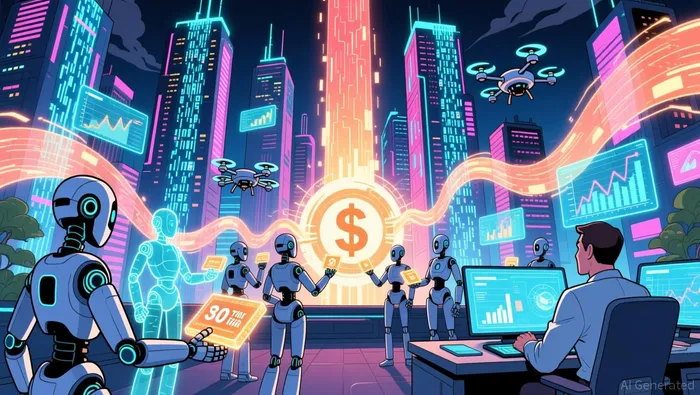
The x402 V2 protocol has further expanded its utility with a unified payment interface that supports multiple blockchains and assets, ensuring interoperability across networks like Base and SolanaSOL-- as research shows. Key enhancements include wallet-based identity and reusable access sessions, which reduce on-chain interactions for frequent users, and automatic service discovery, streamlining access to services without manual configuration according to Galaxy insights. For AI agents, x402 V2 introduces autonomous consumption models, enabling dynamic budget allocation for tasks like data acquisition or compute resource usage as detailed in Galaxy research. By 2025, x402 had already processed 15 million transactions, with projections suggesting autonomous agent transactions could reach $30 trillion by 2030 according to Fintech Wrap-Up.
Stablecoins: The Lifeblood of Real-Time Finance
Stablecoins have become the backbone of this emerging ecosystem, facilitating near-instant, low-cost global payments. Pegged to the U.S. dollar and built on blockchain technology, stablecoins now process over $27 trillion in annual transactions according to Fintech Weekly. Their adoption has been accelerated by regulatory clarity, such as the U.S. GENIUS Act, and institutional participation from entities like JPMorgan as Fintech Weekly reports.
AI is amplifying the potential of stablecoins by automating smart contracts and real-time analytics. For instance, AI-driven systems can execute self-adjusting transactions based on market conditions, optimizing treasury management and cross-border settlements according to World Economic Forum. This synergy is particularly evident in microinsurance and supply chain finance, where AI enables dynamic risk assessment and instant payouts as World Economic Forum notes. As stablecoins evolve into programmable money, they are becoming the preferred medium for AI agents to settle transactions, further entrenching their role in the agentic economy according to Filene's research.
Tokenization and Privacy: Enabling Trust and Compliance
Tokenization is bridging real-world assets (RWAs) with decentralized finance (DeFi), unlocking liquidity in traditionally illiquid markets like real estate and art. Startups like Securitize and Blockchain App Factory are leading this charge, offering compliance-driven platforms for asset tokenization and investor onboarding according to Predict. AI enhances these systems by enabling real-time valuations and automated income distribution via smart contracts as Predict reports.
Privacy technologies are equally critical. Protocols like Ocean Protocol and SingularityNET leverage zero-knowledge proofs and federated learning to protect sensitive data while enabling AI training on decentralized datasets according to Digital One Agency. These innovations align with global regulations like GDPR and FATF, making them attractive for institutional investors seeking compliance-ready solutions as Digital One Agency states. For example, Render Network's decentralized GPU marketplace supports AI model training while reducing reliance on centralized cloud providers, further democratizing access to compute resources according to Digital One Agency.
Investment Opportunities: Startups and Protocols to Watch
The convergence of AI and crypto has given rise to startups and protocols poised to redefine financial infrastructure. Ozak AI, a DePIN-powered platform, uses predictive analytics and cross-chain compatibility to generate actionable trading signals according to ChainUp. Fetch.ai's ASI-1 Mini enables decentralized AI agents to execute complex tasks like supply chain optimization as ChainUp reports. Chainalysis Reactor leverages AI for real-time blockchain forensics, offering financial institutions advanced fraud detection according to ChainUp.
Investors should also monitor x402 V2-compatible platforms, which are expanding into subscription and usage-based pricing models according to Galaxy research. Additionally, a16z Crypto predicts the emergence of "KYA" (Know Your Agent) standards for cryptographic identification, further legitimizing AI-driven transactions according to a16z Crypto analysis.
Conclusion: A New Era of Financial Infrastructure
The integration of AI and crypto is not merely a technological shift but a fundamental reimagining of how value is created, transferred, and settled. x402 protocols, stablecoins, tokenization, and privacy technologies are collectively building a financial infrastructure that is programmable, real-time, and secure. For investors, the key lies in identifying protocols and startups that address scalability, compliance, and interoperability-pillars of a sustainable agentic economy. As the agentic economy grows to $30 trillion by 2030 according to Fintech Wrap-Up, the winners will be those who can harmonize AI's analytical power with crypto's decentralized ethos.





Comentarios
Aún no hay comentarios