
Contrarian Crypto Opportunities Amid Fed Rate-Cut Cycles and Divergent Asset Behavior
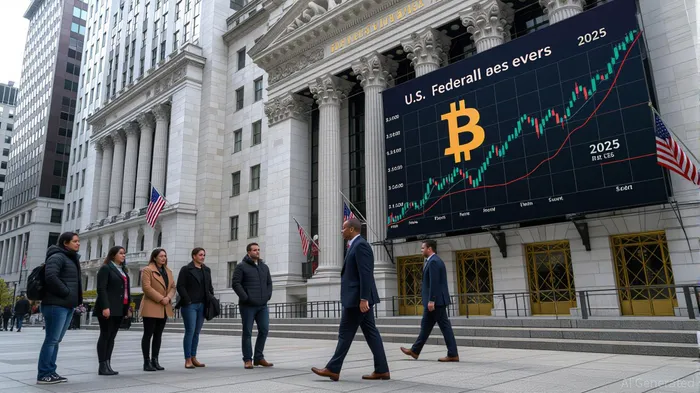
The Federal Reserve's cautious approach to rate cuts in 2025 has created a unique environment for investors seeking contrarian opportunities in cryptocurrencies. While traditional assets like equities and bonds have historically reacted predictably to monetary policy shifts, crypto markets have exhibited divergent behavior, driven by speculative demand, macroeconomic sentiment, and institutional adoption. For those willing to navigate the volatility, positioning for the Fed's next rate-cut cycle could unlock asymmetric returns in a landscape where risk-off environments are reshaping asset correlations.
The Fed's Tightrope: Rate Cuts and Market Uncertainty
As of July 2025, the Fed has maintained a 4.25–4.5% federal funds rate, a pause that has left investors in limbo. While the central bank has signaled a potential cut by year-end—priced at 63% probability via the CME FedWatch tool—the timing remains contingent on inflation data and labor market trends. This uncertainty has kept Bitcoin in a rangebound pattern between $105,560 and $117,000 since early 2025, with volatility spiking as investors weigh the likelihood of September or December cuts.
Historically, rate cuts have acted as a tailwind for crypto. During the 2020–2021 Fed easing cycle, Bitcoin surged from $7,000 to $68,000 as liquidity flooded markets and investors sought higher returns. However, the 2022–2023 tightening cycle saw Bitcoin plummet by 70%, underscoring its sensitivity to interest rate environments. The key divergence lies in how crypto responds to risk-off conditions: while gold and bonds typically serve as safe havens, Bitcoin's performance in 2022–2023 showed it can act as both a speculative asset and a hedge, depending on context. A 2023 study of the Russia-Ukraine conflict revealed Bitcoin's hedging properties during crises but also highlighted its amplified volatility, with negative news driving sharper declines than positive news.
Divergence in Risk-Off Behavior: Crypto vs. Traditional Assets
The interplay between crypto and traditional assets has grown more complex as institutional interest in Bitcoin has surged. In 2024, the approval of spot Bitcoin ETFs injected $12 billion into the market, bridging the gap between crypto and traditional portfolios. Yet, even with this institutional adoption, crypto's behavior in risk-off environments remains distinct.
During the 2022–2023 bear market, while equities and bonds fell in tandem with rising rates, Bitcoin's decline was more pronounced, reflecting its speculative nature. Conversely, in 2020, when the Fed slashed rates to near zero, Bitcoin's rally outpaced equities, with the Nasdaq Composite gaining 43% versus Bitcoin's 700% surge. This divergence underscores crypto's dual role as both a leveraged bet on monetary policy and a barometer of investor sentiment.
The correlation between Bitcoin and the S&P 500 has also risen to 0.90 in 2025, a sign that crypto is increasingly treated as a risk asset. However, this alignment can break down in periods of extreme volatility. For example, during the 2023 banking sector turmoil, Bitcoin briefly outperformed gold as investors sought alternatives to traditional financial systems, only to correct sharply when liquidity fears subsided.
Contrarian Strategies: Positioning for the Fed's Next Move
For contrarian investors, the key lies in exploiting the lag between Fed policy signals and market reactions. Here are three actionable strategies:
Buy Dips in a Rangebound Bitcoin: With Bitcoin trapped between $105,560 and $117,000, a breakout is imminent. If the Fed cuts rates in September, the $117,000 level could act as a catalyst for a bullish move. A contrarian approach would involve accumulating Bitcoin at the lower end of the range, hedging with short-term options to mitigate volatility.
Leverage ETF-Driven Liquidity: The 2024 ETF approvals have created a new flow of institutional capital into Bitcoin. Contrarian investors can position for further inflows by buying dips in ETF-related stocks (e.g., Grayscale or ProShares) or using Bitcoin futures to gain exposure without holding the asset.
Diversify into Altcoins with Use-Case Potential: While Bitcoin dominates headlines, altcoins like Ethereum and Solana offer asymmetric upside in a rate-cut environment. For example, Ethereum's transition to a proof-of-stake model in 2022 reduced its supply dynamics, making it a compelling play for investors betting on long-term adoption.
The Risks of a Contrarian Bet
Positioning for a Fed rate-cut cycle is not without risks. The 2022–2023 bear market demonstrated how rapidly sentiment can shift, especially in a high-leverage, low-liquidity environment. Additionally, regulatory uncertainty—such as the pending implementation of the GENIUS Act—could introduce volatility. Investors must also consider the drag of $7.4 trillion in money market balances, which could delay capital re-entry into risk assets even after rate cuts.
Conclusion: Balancing Optimism with Caution
The Fed's 2025 rate-cut cycle presents a rare window for contrarian crypto investors to capitalize on divergent asset behavior. While Bitcoin's correlation with equities suggests it will benefit from lower rates, its volatility and speculative nature demand a disciplined approach. By combining macroeconomic analysis with tactical positioning—such as buying dips in a rangebound Bitcoin or leveraging ETF-driven liquidity—investors can navigate the uncertainty and potentially reap outsized returns.
As the Fed's September meeting approaches, the market will test whether Bitcoin can break free from its range and rejoin the ranks of traditional risk assets. For those willing to bet against the crowd, the rewards could be substantial—but the path will remain anything but smooth.







Comentarios
Aún no hay comentarios