
Consolidated Water's Strategic Balance: Operational Efficiency and Sustainable Growth Drive Earnings Outperformance in Q3 2025
Operational Efficiency: A Foundation for Resilience
Consolidated Water's operational efficiency is evident in its diversified business model, which spans retail, manufacturing, and services segments. The services segment, in particular, drove much of the recent growth, with construction revenue surging 50% year-over-year to $14.3 million, a Globenewswire release. This was fueled by a 13% overall increase in services revenue, reflecting the company's ability to capitalize on infrastructure demand.
The manufacturing segment also showed strength, with revenue rising 7% to $4.7 million, supported by a 40% gross margin, a StockTitan report. This improvement was attributed to higher-margin products and the completion of a new 17,500-square-foot facility expansion, which streamlined production processes, a StockTitan report. Meanwhile, the retail segment saw a 2% revenue increase to $7.8 million, driven by a 6% rise in water volume sold, a Globenewswire release. These gains highlight the company's focus on operational excellence, with gross profit margins expanding to 37% of total revenue from 35% in the prior-year quarter, a Globenewswire release.
Sustainable Growth: Beyond the Balance Sheet
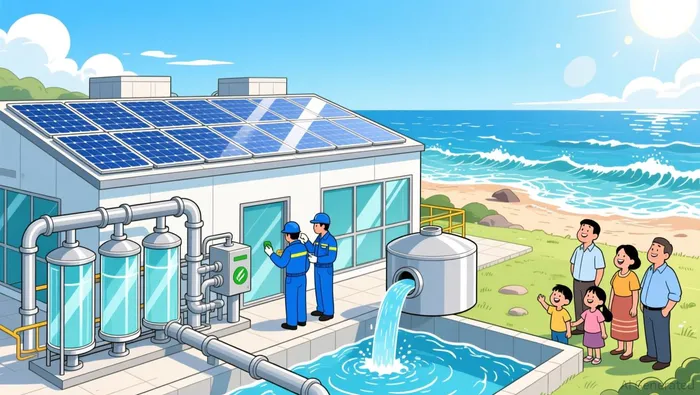
While financial metrics are compelling, Consolidated Water's true differentiator lies in its commitment to sustainable growth. The company's $204 million seawater desalination project in Kalaeloa, Hawaii-a critical component of its 2025 sustainability goals-exemplifies this ethos. With design work now 100% complete, the 1.7 million gallon-per-day facility is poised to begin construction in early 2026 and generate revenue through 2027, a StockTitan report. This project not only addresses water scarcity in a climate-vulnerable region but also aligns with global trends toward infrastructure resilience.
Equally noteworthy is a $11.7 million contract to build a wastewater recycling plant for a San Francisco Bay Area golf club. By converting untreated wastewater into irrigation water, the project is projected to save 36–38 million gallons of potable water annually, a StockTitan report. Such initiatives reinforce Consolidated Water's role as a solutions provider in the $400 billion global water treatment market, where demand is increasingly tied to ESG (environmental, social, and governance) criteria.
Future Outlook: Liquidity and Long-Term Vision
With $123.6 million in cash and $141.7 million in working capital, a Globenewswire release, Consolidated Water is well-positioned to fund its ambitious pipeline. CEO Rick McTaggart emphasized the company's "diversified business model" as a key strength, noting that two new U.S. construction projects-worth $15.6 million-will contribute to revenue in 2026, a Globenewswire release. These projects, combined with the Hawaii desalination plant, suggest a strategic pivot toward large-scale infrastructure, a sector with strong tailwinds from federal and state climate policies.
Conclusion: A Model for the New Economy
Consolidated Water's Q3 2025 results reflect a company that is both fiscally disciplined and forward-thinking. By leveraging operational efficiencies to boost margins while investing in projects that address critical environmental challenges, CWCO has created a virtuous cycle of growth. For investors, the question is no longer whether sustainability and profitability can coexist-it's how quickly the market will recognize Consolidated Water as a leader in this new paradigm.





Comentarios
Aún no hay comentarios